


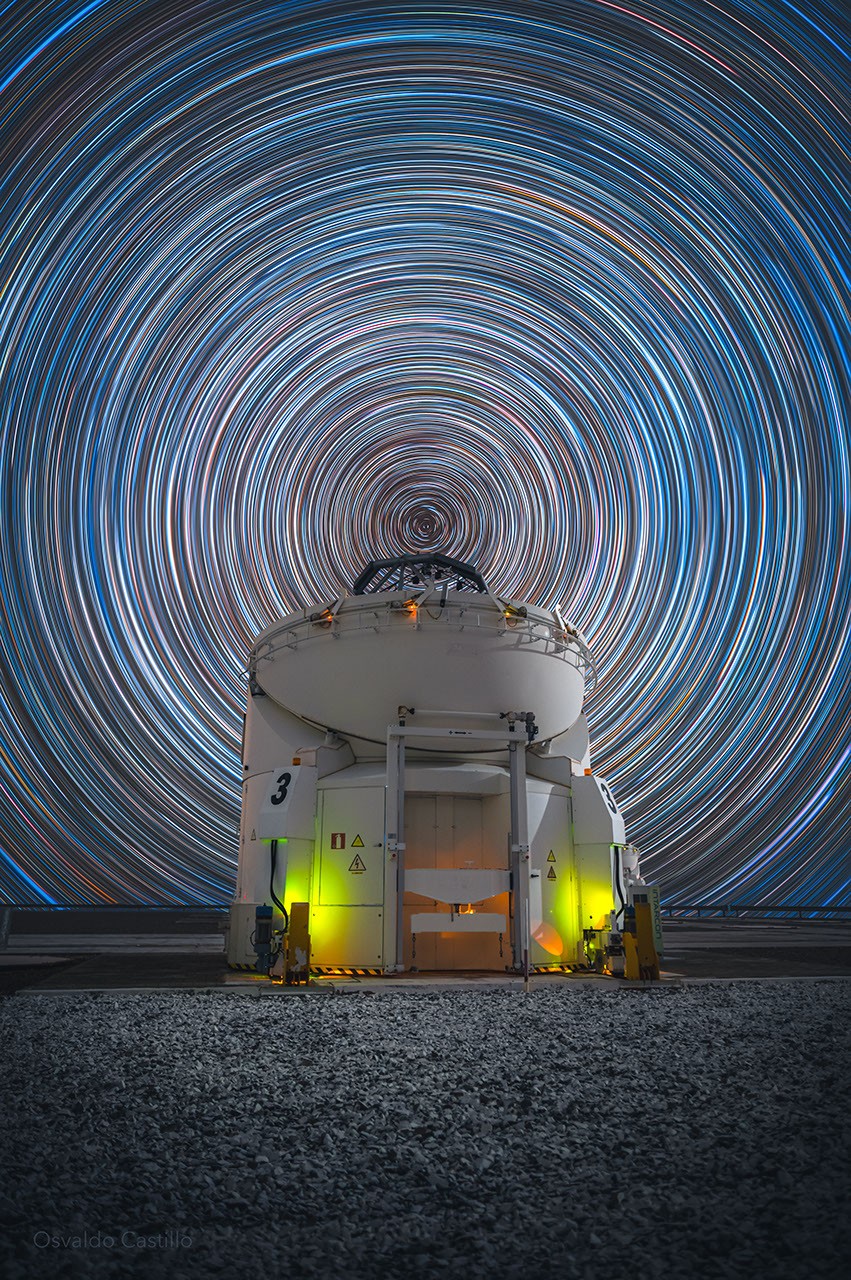
Explanation: At the Paranal Observatory in Chile, located at approximately 25 degrees south latitude, Earth’s rotation causes the observatory’s surface to move eastward at more than 1,500 kilometers per hour. Although this rotational speed is faster than the speed of sound at sea level, the motion is imperceptible to people on the ground. Its effects can be revealed, however, through long-exposure star trail photography, which captures the apparent movement of the night sky.
This stunning star trail image was created by digitally stacking 300 consecutive 25-second exposures taken with a camera mounted on a tripod. The graceful arcs form concentric circles centered on the south celestial pole, the point in the sky where Earth’s southern axis of rotation appears to extend into space. One of the observatory’s 1.8-meter auxiliary telescopes, AT3, can be seen below the south celestial pole, dimly illuminated in the foreground of this carefully composed view of our rotating planet.
NASA’s main APOD website is now: On the Move: Visit apod.nasa.gov or science.nasa.gov/apod for Astronomy Picture of the Day.
Tomorrow’s photo: pixels in space
Source: science.nasa.gov