


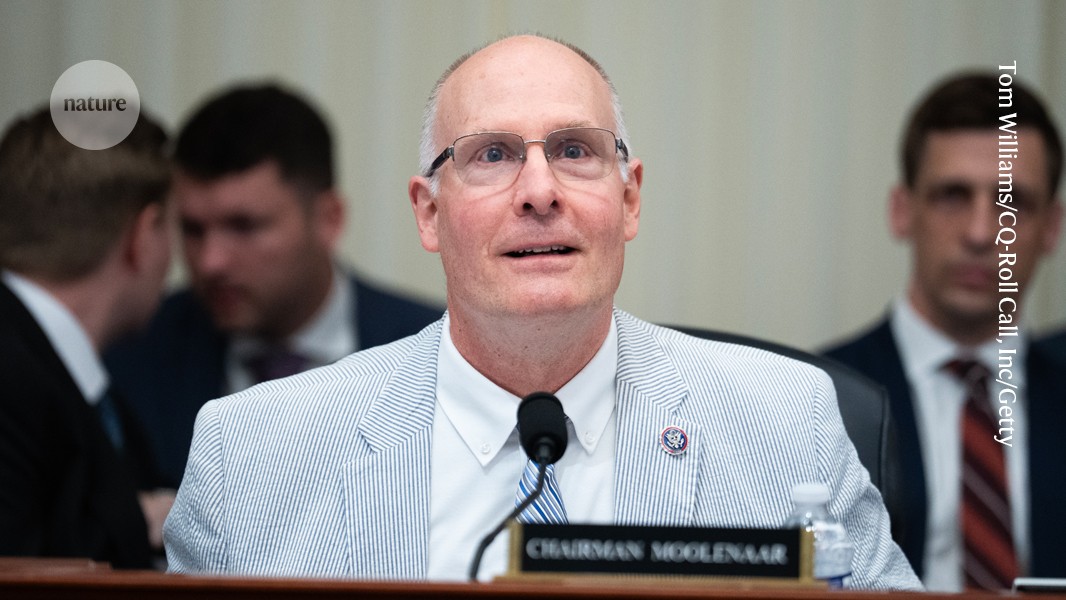
John Moolenaar, a Republican from Michigan, chairs the U.S. House of Representatives Select Committee on China.Credit: Tom Williams/CQ-Roll Call, Inc/Getty
Lawmakers from both political parties in the U.S. House of Representatives are voicing concerns over China’s misuse of American research, sparking a debate on how to protect and adequately fund U.S. research efforts. Anxiety emerged during a public hearing on July 15th, following a recent announcement by the National Science Foundation (NSF) that aims to ban collaborations between U.S. scientists and foreign entities flagged as national security threats, including various leading Chinese universities.
China’s Scientific Influence Grows as U.S. Influence Diminishes: The Data Reveals
Rep. John Moolenaar, the Michigan Republican leading the House Select Committee on China, supported the NSF’s new policy and urged other U.S. science agencies to adopt similar restrictions. “Should American taxpayer dollars be allocated for Chinese military research and affiliated organizations? The logical answer is no,” he stated during the hearing.
Patricia Valdez, the National Institutes of Health (NIH) director of research integrity, and Jeremy Ison, assistant secretary for science at the U.S. Department of Energy (DoE), acknowledged the significance of NSF policies, mentioning that both agencies currently have safety protocols in place regarding research integrity.
Democrats have also raised concerns about potential research theft stemming from collaboration with China, yet they caution that job and funding cuts at U.S. science agencies, initiated during former President Donald Trump’s administration, exacerbate the situation. Rebecca Kaiser, director of NSF’s Office of Research, Safety Policy, and Strategy, noted at the hearing that staffing has dramatically declined from ten employees in 2024 to just five now. “I am resolutely opposed to the Chinese Communist Party,” stated California Rep. Ro Khanna, the committee’s ranking Democrat. “However, we cannot ensure the safety of American research while dismantling the very resources and programs that protect it.”
Strengthening Research Security
The NSF, which funds close to 25 percent of basic academic research in the United States, has typically imposed minimal restrictions on international collaboration. However, the new policy, set to take effect on October 1, will prohibit senior researchers receiving grants from engaging with or being funded by “restricted entities” (organizations, companies, and individuals from China and other countries recognized as national security concerns by U.S. agencies like the Department of Defense). This includes prominent Chinese institutions such as the University of Science and Technology of China in Hefei and Sun Yat-sen University in Guangdong province.

Decline in Dual Affiliations Among Researchers in the U.S. and China
Over the last two decades, as China’s influence has risen and tensions with the U.S. have increased, officials have become increasingly vigilant regarding research safety. The Trump administration’s China Initiative, launched from 2017 to 2021, aimed to shield American laboratories from espionage and led to numerous arrests of Chinese-born American academics, although many charges were later dropped or dismissed. While Biden’s administration discontinued the initiative in 2022, it has continued to emphasize the importance of research safety as a priority.
Research security policies during the second Trump administration were largely delegated to U.S. agencies. Alongside the NSF’s policy update, the NIH altered its funding approach for foreign institutions, resulting in the cancellation of several clinical trials. However, a comprehensive proposal introduced by the White House Office of Management and Budget in May suggests a total ban on collaborations involving recipients of federal research grants and “foreign adversaries,” although it lacks a clear definition of who these adversaries would be.
House Republicans are advocating for stricter restrictions; calling for the DoE to prohibit Chinese researchers without U.S. citizenship from working in U.S. national labs. Democrat Jill Tokuda, who represents Hawaii, expressed at the hearing that such a ban could deter top researchers from coming to the United States, stating it is counterproductive.
Source: www.nature.com