


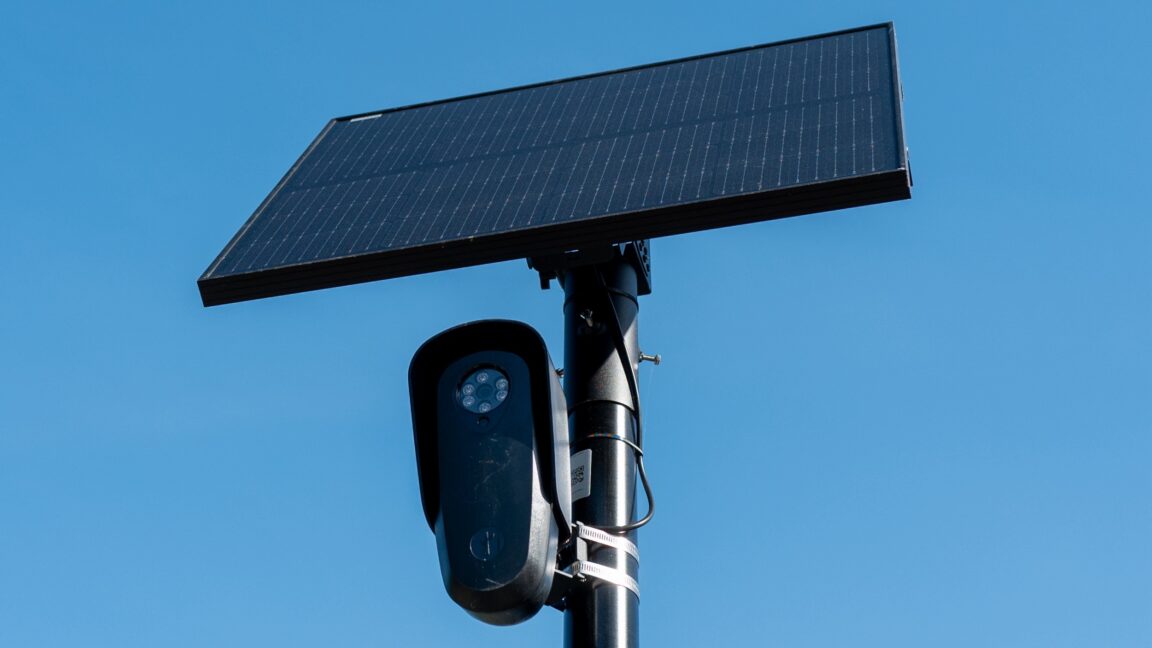
Last Friday, Flock Safety’s top lawyer outlined updated policies in a company blog post. The revised terms of service state that “customers and their users are expressly prohibited from using the Flock Services to mislead, harass, stalk, or otherwise impose or violate the legal rights of others.”
Those changes, however, have done little to ease growing political scrutiny of Flock Safety’s AI-powered surveillance cameras.
This week, Sen. Josh Hawley (R-Missouri) announced an investigation into the company’s technology. “We are investigating the collection, retention, and distribution of data generated by Flock Safety’s artificial intelligence surveillance cameras,” Hawley said.
On Wednesday, after two Florida police officers were arrested for allegedly misusing Flock camera data, Republican Gov. Ron DeSantis criticized the technology in a speech, saying that Flock cameras were “out of control” in the state.
“When you see police officers using this to go after ex-girlfriends and things like that, you wonder, do you know what’s going on?” DeSantis said.
Even experts who have tracked the spread of automatic license plate reader (ALPR) technology—which predates Flock Safety—say the rapid expansion of AI-powered surveillance is alarming.
“Perhaps in the past, you may not have felt that a red-light camera actually meant all eyes were watching you. But with the advent of AI, that is increasingly becoming a reality,” Jake Laperruque, deputy director of the Security and Surveillance Project at the Center for Democracy and Technology, told Ars in an email.
“We are already seeing how AI can turn ALPR systems into a dragnet for mass surveillance,” Laperruque added. “Flock is enabling its cameras to search for keywords and people, cities are incorporating real-time facial recognition into their camera networks, and Border Patrol is using AI to analyze ALPR data for driving patterns. Whenever an AI system determines that driving is ‘suspicious,’ it can contribute to police stops.”
After several widely publicized incidents, concerns about Flock Safety and ALPR surveillance have drawn bipartisan attention. “The Texas sheriff’s department used this system to search for a woman who had an abortion, and federal officials have suggested using similar technology outside gun shows,” Catherine Crump, a law professor at the University of California, Berkeley, told Ars in an email.
“It definitely doesn’t help that this is a Silicon Valley product that no one asked for and that could change people’s lives forever,” Crump said.
Update for August 28: Secure Justice has updated its data, reporting that 93 jurisdictions—up from 90—terminated their Flock Safety contracts this month alone.
Source: arstechnica.com