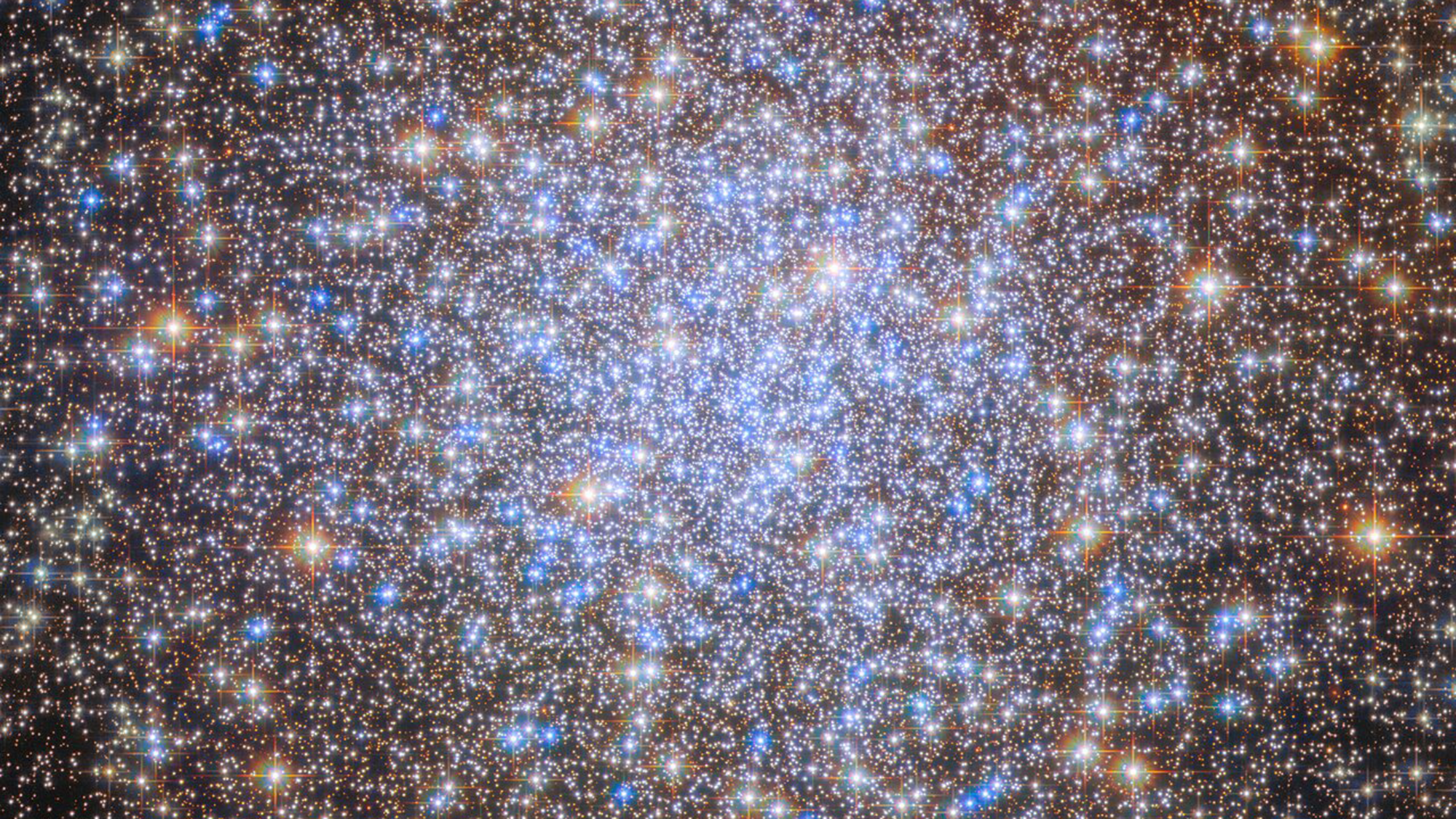
Hubble Reveals the Ancient Stars of NGC 6723, the Milky Way’s “Chandelier Cluster”
NGC 6723 is an ancient globular star cluster orbiting in the halo of the Milky Way.
(Image credit: ESA/Hubble & NASA, A. Saragedini, G. Piotto)
Quick facts
What is it: NGC 6723, also known as the “Chandelier Cluster”
Where is it: Approximately 27,000 light-years away in the constellation Sagittarius
When shared: June 26, 2026
The Hubble Space Telescope has captured a spectacular view of NGC 6723, a dense globular cluster containing tens of thousands—and possibly millions—of stars. Located roughly 27,000 light-years from Earth in the constellation Sagittarius, the cluster appears as a brilliant concentration of stars bound together by gravity.
NGC 6723 is also called the Chandelier Cluster because of its dazzling appearance. It is one of approximately 150 known globular clusters orbiting in the Milky Way’s halo. More may be hidden behind thick clouds of interstellar dust or crowded star fields near the galaxy’s bright central region.
Globular clusters are among the oldest structures in the Milky Way. Many of their stars are more than 10 billion years old, meaning they formed during the early history of the universe, which is approximately 13.8 billion years old. These ancient star systems likely developed billions of years before the Milky Way’s thin stellar disk—and the region now occupied by the Sun—fully formed.
From the latest videos Live Science
Astronomers once believed that all stars in a globular cluster formed at nearly the same time from the same cloud of gas. If that were true, the stars would share similar ages and chemical compositions.
However, Hubble’s detailed observations of NGC 6723 point to a more complicated history. The cluster’s core is especially dense and contains numerous bright blue stars, while orange stars are more common toward its outer regions. These differences suggest that globular clusters can contain multiple stellar populations with distinct ages, chemical compositions and formation histories.
Hubble observed NGC 6723 in visible and near-infrared light as part of a broader survey of 65 globular clusters. Observations showed that massive stars tend to migrate toward the cluster’s center, while lower-mass stars are more likely to occupy its outer regions. Additional Hubble studies conducted in 2013 and 2014 examined the cluster’s stellar ages and searched for subtle chemical differences.
Researchers identified two distinct stellar populations in NGC 6723. The younger population appears to have formed approximately 634 million years after the first generation, providing important evidence that globular clusters may not have formed in a single event.
One leading theory suggests that globular clusters formed when enormous clouds of gas collapsed rapidly in the early universe. However, recent simulations also suggest that some globular clusters could be the surviving cores of ancient dwarf galaxies. These smaller galaxies may have lost their outer stars after being stripped apart by larger galaxies. In either case, globular clusters preserve valuable evidence about how galaxies formed and evolved.
Get the world’s most fascinating discoveries delivered straight to your inbox.
Globular clusters are not exclusive to the Milky Way. Astronomers have found them surrounding many types of galaxies, including spiral, elliptical and dwarf galaxies. The Andromeda Galaxy, the closest large spiral galaxy to the Milky Way, also hosts a substantial population of globular clusters.
The giant elliptical galaxy M87 contains an estimated 15,000 globular clusters—far more than the Milky Way’s population. These systems give astronomers a way to study ancient stars and reconstruct the growth and evolution of galaxies across cosmic time. NASA provides further information about M87 and its globular cluster system.