


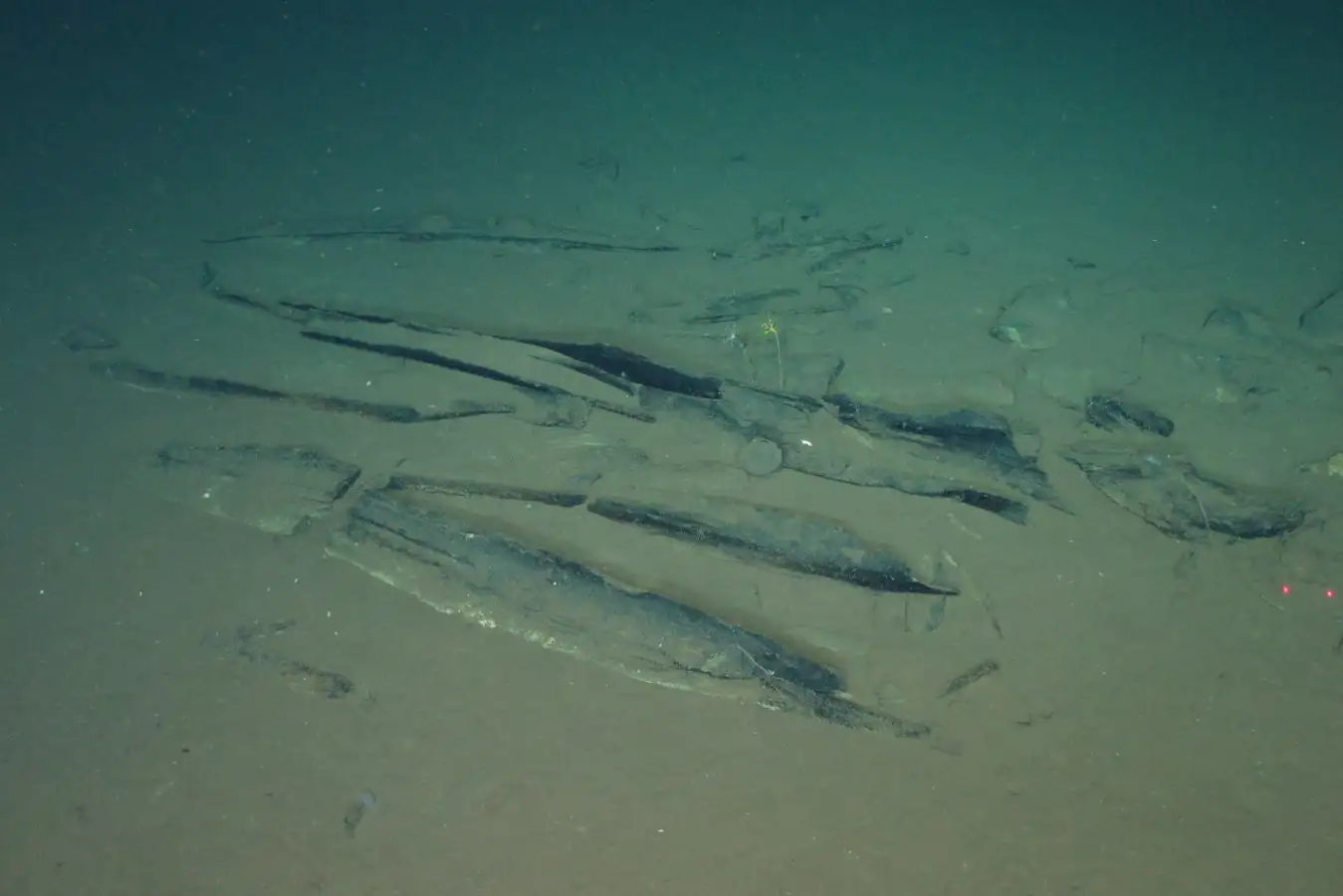

Fossils that may be baleen whale ribs found at a depth of 5,656 meters in the Indian Ocean
Global TREnD, IDSSE
Researchers have uncovered the world’s deepest whale graveyard at an astonishing depth of seven kilometers in the southern Indian Ocean. Among the remains are fossils of a newly identified extinct beaked whale, along with other specimens dating back over 5 million years.
In early 2023, Peng Zhou and his team from the Chinese Academy of Sciences conducted 32 dives in a manned submersible, exploring over 1,200 kilometers in the Diamantina Zone.
The expedition was part of the Global Hadar Exploration Program, aimed at investigating Earth’s darkest and deepest oceanic regions ranging from 6,000 to 11,000 meters. In these profound depths, sunlight does not penetrate, and life thrives either on organic matter that descends from above or through chemosynthesis, where organisms generate energy from chemical reactions.
The initial fossil whale was discovered at a depth of 7,002 meters in a segment of the Diamantina region referred to as the Dordrecht Strait, located more than 1,100 kilometers southwest of Perth, Western Australia.
“Thanks to the advanced lighting system of the submersible, we could see several meters ahead, even in the utter darkness of the ocean floor,” remarked Zhou. He described the experience as “a little scary but also incredibly fascinating.”
The researchers estimated a density of up to 760 whales per square kilometer, comprising a mix of ancient and recent carcasses, thus creating what they referred to as a “whale graveyard” or a “deep-sea fossil megasite.”
Among the recently fallen carcasses was a 5-meter-long Antarctic minke whale (Balaenoptera bonaerensis), which serves as sustenance for a diverse ecosystem of invertebrates. Many of these, such as bone-eating insects and spider stars, are believed to be new species with densities reaching up to 2,800 individuals per square meter.
“This was an incredibly unique experience,” Chow shared. “We were traversing a deep time archive of evolution and marine life, a habitat of millions of whales, some over 5 million years old. The experience was both humbling and awe-inspiring, and we treated this site with the utmost respect.”

The manipulator arm of the submersible Fendouzhe collects fossilized whale bones from the deep ocean floor.
Global TREnD, IDSSE
The research team identified 485 active sites of whale falls and fossil deposits throughout the expedition. Utilizing the submersible’s robotic arm, they successfully extracted 43 fossil specimens ranging in age from 120,000 to 5.26 million years.
The majority of these recent fossils were beaked whales, associated with two existing species: Mesoprodon Boudoini and Mesoprodone Rayadi.
Thus far, the research team has documented one new species, Pterocetus diamantinae, while additional fragmentary specimens may indicate more undiscovered species, as noted by Giovanni Vianucci from the University of Pisa, Italy.
Peng Xiaotong, another researcher from the Chinese Academy of Sciences, highlighted several factors contributing to the remarkable preservation of the fossils. Most collected specimens were beaked whale snouts, recognized for their dense structure akin to bone armor, making them less vulnerable to decay and scavengers.
Over the last 5 million years, sediment deposition in this area has been minimal—approximately 0.05 to 0.55 millimeters per 1,000 years—allowing many bones to remain protected under a layer of ferromanganese oxide, which insulates them from environmental factors.
“The combination of high bone density, slow sedimentation, and protective mineral coatings has contributed to the remarkable preservation of these bones for over five million years,” Penn explained.
Research indicates that the high incidence of whale mortality in the Diamantina region can be attributed to factors like migratory patterns and V-shaped topography, which collects whale carcasses on the ocean trench floor.
Culum Brown, a professor at Macquarie University in Sydney, Australia, praised the discovery as “remarkable.” “The density of whale-fall remains is astounding,” he stated.
Topics:
Source: www.newscientist.com