


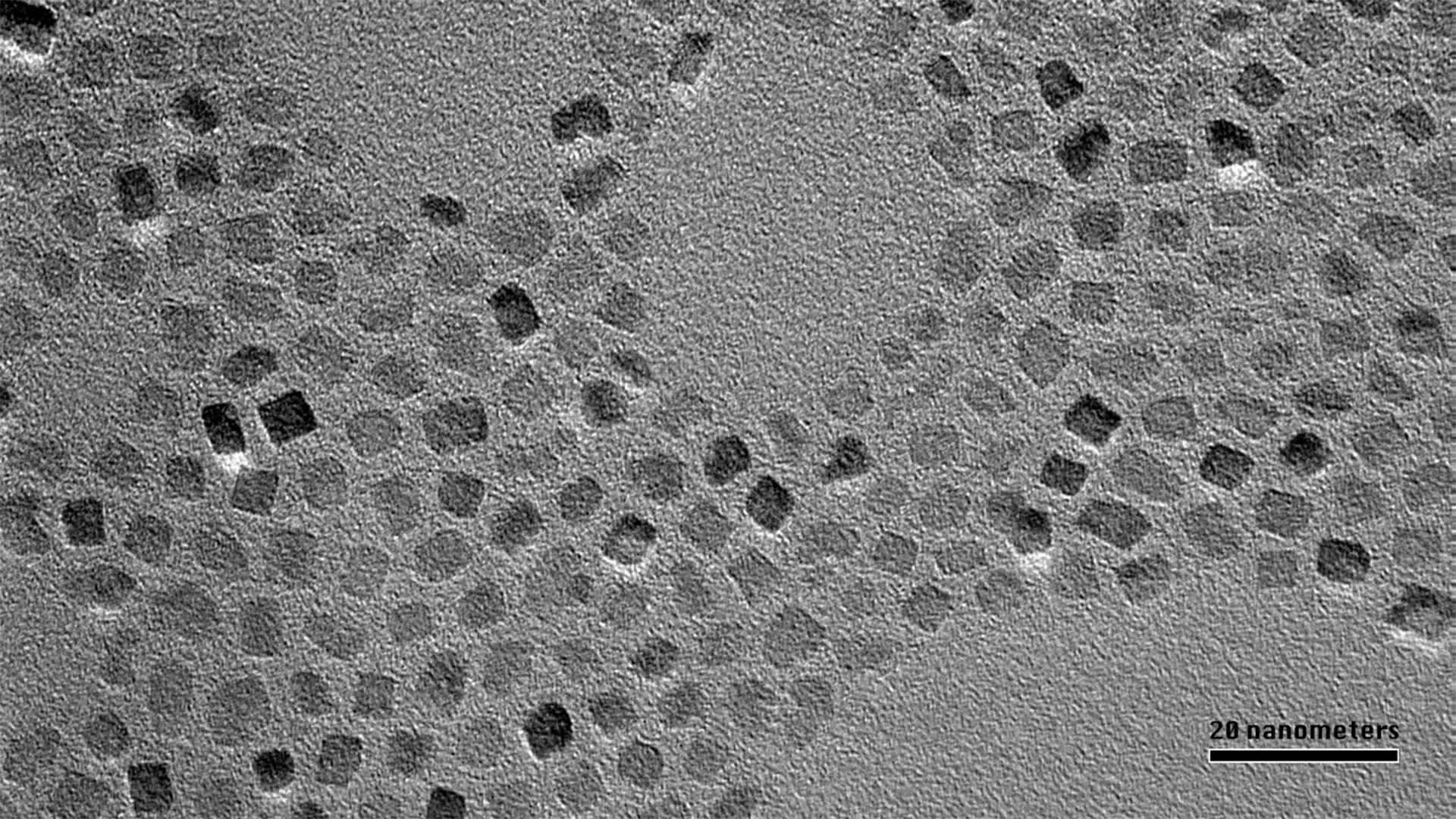
Nanocrystals have become an essential part of modern materials science, while quantum dots continue to inspire advances in chemistry and technology, including the work recognized by the 2023 Nobel Prize in Chemistry. Despite their enormous potential, researchers have traditionally been able to produce these microscopic crystals from only a limited range of materials.
Now, chemists at the University of Chicago and Argonne National Laboratory have developed a new method for creating nanocrystals from metal nitrides, a technically important class of materials that has been difficult to synthesize using conventional techniques. The study, published in Nature, could expand the use of metal nitride nanocrystals in electronics, flexible lighting, medical implants, and other advanced technologies.
“We were able to show how to make a series of more than a dozen materials that could not be synthesized using traditional methods,” said Ruiming Lin, a graduate student at the University of Chicago and lead author of the new paper.
Unlocking metal nitride nanocrystals
Metal nitrides are already widely used in technology and manufacturing. Gallium nitride, for example, is a key material in modern lighting, including LED light bulbs, laptop displays, and other electronic devices.
Converting these materials into nanocrystals could significantly expand their applications. Instead of being limited primarily to rigid films, metal nitride nanocrystals could eventually be blended into polymers, printed using inkjet technology, or incorporated into textiles and other flexible devices.
“This expands the boundaries of the field beyond what have been its fundamental limitations and lays the foundation for the use of nitrides as nanomaterials,” said Dmitri Talapin, the Ernest DeWitt Barton Distinguished Professor of Chemical and Molecular Engineering at the University of Chicago, a scientist at Argonne National Laboratory, and lead author of the paper.
Why are nanocrystals so useful?
Nanocrystals are crystals so small that millions or even billions of them could fit on a fingernail. At this scale, materials can display unique properties, making them particularly effective for producing bright light, driving chemical reactions, and supporting other technological applications.
In principle, scientists should be able to create nanocrystals from a wide variety of materials. In practice, however, many materials are difficult or impossible to produce in nanocrystal form.
Lin and other researchers in Talapin’s laboratory have been working to overcome these limitations.
The team focused on metal nitrides, compounds formed when metals combine with nitrogen. These materials are strong, biocompatible, and resistant to heat and corrosion.
These properties make metal nitrides valuable for applications ranging from consumer electronics to medical devices. However, the same chemical stability that makes them useful also makes metal nitride nanocrystals challenging to produce.
Strong bonds create major challenges
As a crystal grows, its ions need enough freedom to rearrange before settling into their final positions. The process is similar to changing partners during a square dance. In metal nitrides, however, the bonds are so strong that the ions do not readily rearrange.
“If the bonds are not broken during this process, it is a death sentence for the nanocrystals,” Talapin said. “Once you form the wrong bond, everything goes wrong.”
According to the researchers, two major advances were necessary to solve this problem.
First, the Talapin laboratory built on earlier findings showing that molten salts can serve as the liquid medium for the synthesis process and may help stabilize nanocrystals as they form.
The researchers then tested a range of conditions until they identified a “sweet spot” involving temperature and ammonia pressure. Under these conditions, the bonds between metal and nitrogen atoms can more easily break and reform, allowing the crystal structure to organize correctly.
“This process is highly unusual and defies all conventional wisdom in this field,” Talapin said. “We had to completely rethink our approach.”
More than a dozen new nanocrystal materials
The method worked for materials beyond gallium nitride. The research team also produced nanocrystals from several related nitride materials, including titanium nitride, which is used in medical implants; niobium nitride, an important industrial superconductor; and molybdenum nitride, which is commonly used as a catalyst.
These materials are useful and relatively inexpensive. The researchers hope that converting them into nanocrystals will enable their use in an even broader range of technologies.
“I remember the first time I looked into an electron microscope and saw that crystal,” Lin said. “I always hope that what I discover will be applied. I think there are many uses.”
Other University of Chicago authors include Ningxin Jiang, Wooje Cho, Zirui Zhou, Di Wang, Justin Ondry, Zehan Mi, James Cassidy, Alex Hinckle, Alexander Filatov, and John S. Anderson.
The scientists used resources from the Chicago-based National Science Foundation Center for Materials Research, Science and Engineering; the Chicago Soft Matter Characterization Facility; and the Argonne Nanoscale Materials Center.
Funding: U.S. Department of Energy, Samsung QD Cluster Collaboration, National Science Foundation, and Air Force Office of Scientific Research.
Source: www.sciencedaily.com