


NASA held a post-launch press conference at Kennedy Space Center in Florida on Sunday morning following the early maneuvers of the Nancy Grace Roman Space Telescope. The agency provided an update on the mission and its initial operations. Watch the NASA press conference.
However, the event took an unexpected turn less than 30 minutes after it began. NASA Administrator Jared Isaacman looked at his cellphone, stood up from the podium, and briefly left the room while other NASA officials remained seated at the table.
Isaacman returned about a minute later and apologized for interrupting NASA Chief Scientist Nikki Fox, who had been discussing the space telescope mission. After taking his seat, Isaacman explained that the President of the United States wanted to congratulate the NASA team and everyone involved in the Nancy Grace Roman Space Telescope mission.
In an unusual moment, President Trump addressed reporters and NASA officials through Isaacman’s cellphone. Speaking about the Roman Space Telescope launch, Trump said, “I want to thank you all and congratulate you. It looked so beautiful on TV.” He added, “Jared is doing a great job, you’re doing a great job, and I’m going to give you all that money.”
Why did President Trump join the NASA press conference?
The impromptu phone call was unusual because U.S. presidents rarely participate directly in NASA post-launch press conferences. Although presidents sometimes speak with astronauts during missions, they generally do not interrupt NASA briefings or address officials immediately after a spacecraft launch.
Space exploration has also traditionally ranked relatively low among most presidential priorities, particularly when compared with domestic policy and national security. That dynamic may be changing as space becomes increasingly important from both scientific and military perspectives.
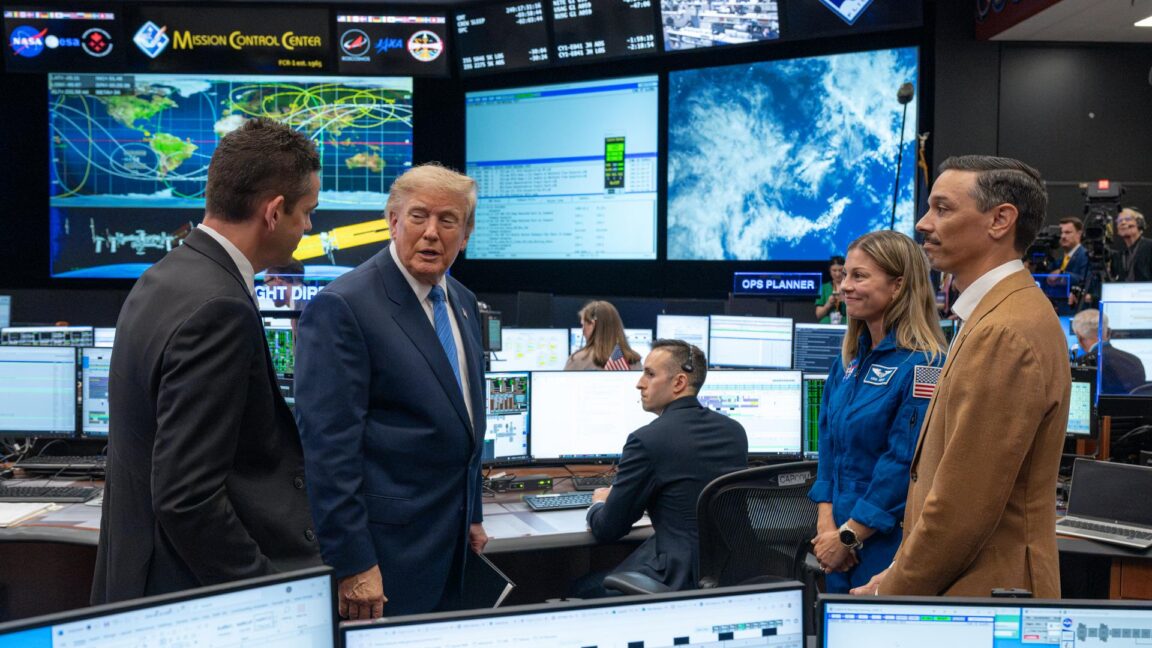
President Trump appears to be taking a strong interest in NASA and the agency’s upcoming missions. On Friday, he spent several hours at the Johnson Space Center in Houston, where he presented the Congressional Space Medal of Honor to the Artemis II crew and announced plans for the National Space Academy.
Over the weekend, the President also highlighted NASA’s plans for the Nancy Grace Roman Space Telescope, one of the agency’s most important upcoming space observatories. The mission is designed to study dark energy, dark matter, exoplanets, and the evolution of the universe, making it a major priority for modern astronomy.
Source: arstechnica.com