


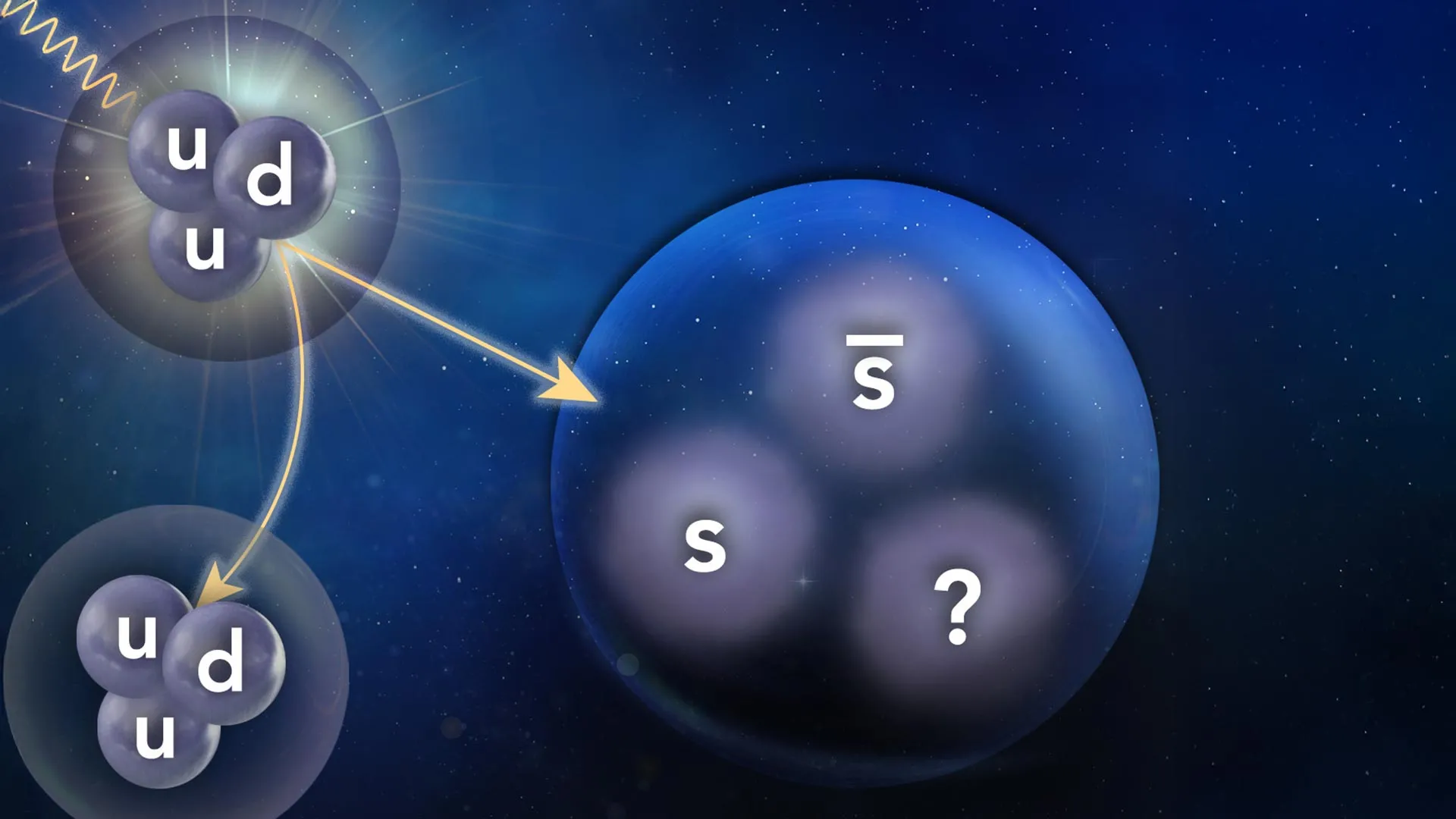
Physicists have identified evidence of two previously unobserved particle structures that could deepen our understanding of exotic hadrons and the strong nuclear force. Researchers at the U.S. Department of Energy’s Thomas Jefferson National Accelerator Facility detected the signals during an experiment in which high-energy photons collided with protons.
The findings may provide new insight into the mysterious family of particles known as XYZ states. These unusual particles do not fit easily into the traditional quark model, which describes most hadrons as combinations of quarks. The result marks the first time researchers at Jefferson Lab have observed these structures through photon–proton interactions.
The discovery was made by the GlueX Collaboration in Experimental Hall D at Jefferson Lab and was recently reported in Physical Review Letters. The research could help scientists determine how gluons—the particles that carry the strong nuclear force—contribute to the structure and formation of matter.
“We went looking for a confirmed XYZ candidate using a photon beam, but instead we found two other structures,” said Marte Albrecht, a scientist at Jefferson Lab. “That gives us new information about the exotic hadron spectrum.”
How the particle zoo took shape
Beginning in the 1950s, high-energy collision experiments revealed a rapidly expanding collection of subatomic particles known collectively as hadrons. Hadrons are composite particles made of quarks bound together by the strong nuclear force. Protons and neutrons are familiar examples, with each containing three quarks.
Many of the newly discovered hadrons were short-lived particles called mesons. Mesons generally consist of a quark and an antiquark, the antimatter counterpart of a quark. In 1964, physicists developed the quark model to organize these bound states. The earliest version included three quark “flavors”: up, down, and strange. Up and down quarks, for example, make up protons and neutrons.
In 1974, the discovery of the heavier charm quark transformed particle physics once again. The quark model was eventually expanded to include six quark flavors. These discoveries helped establish the Standard Model, the leading theory describing elementary particles and the fundamental forces, while also expanding the range of possible hadronic structures.
As particle accelerators became more powerful and detectors more precise, researchers began observing increasingly subtle phenomena. Since the start of the 21st century, experiments have identified numerous hadrons with unusual quantum properties that do not fit comfortably within the original quark model.
Because these discoveries accumulated so quickly, physicists began using the broad term XYZ states for many of these poorly understood particles.
“We are entering a new era here, similar to what we had 70-odd years ago,” said Frank Nerling, a co-investigator at Germany’s GSI Helmholtz Centre for Heavy Ion Research and Goethe University Frankfurt. “First, a zoo of hadrons was discovered. Now we are faced with a zoo of so-called exotic states.”
Exploring the strange-quark sector
Hadrons containing a charm quark and an anticharm quark occupy a region of the particle spectrum known as charmonium. A similar region contains particles made from strange quarks and antistrange quarks. Many XYZ candidates have been observed in these sectors.
In 2006, researchers with the BaBar experiment at the U.S. Department of Energy’s SLAC National Accelerator Laboratory reported a possible strange-quark state with a mass of approximately 2.16 billion electron volts, or 2.16 GeV. The particle was named Y(2175) because it was considered an XYZ candidate. BaBar produced Y(2175) through the annihilation of an electron and a positron.
Y(2175) displays quantum properties that are difficult to explain as a conventional quark–antiquark pair. Scientists have proposed several possible interpretations, including a hybrid meson containing an excited gluon, a four-quark configuration known as a tetraquark, or a molecular-like combination of other composite particles.
Later electron–positron experiments, including China’s Beijing Spectrometer and Japan’s Belle experiment, confirmed the existence of Y(2175). Until now, however, the particle had not been observed through a process other than electron–positron annihilation.
“The challenge is that there are many measurements made all over the world in very different experiments, and we have to find a consensus on the results,” said Klaus Göetzen, a GSI physicist involved in the Jefferson Lab research. “This is more complicated than it seems because many states are close together and may or may not be the same.”
The GlueX Collaboration began searching for Y(2175) using photoproduction, a process in which a high-energy photon beam strikes protons in a fixed target. Y(2175) did not appear through this production mechanism. Instead, the researchers found two unexpected structures in a nearby region of the hadron spectrum.
GlueX discovers two unexpected structures
Jefferson Lab’s GlueX experiment was designed to study hybrid mesons—exotic particles in which excited gluons may contribute directly to the internal structure. Quantum chromodynamics, or QCD, the theory describing the strong nuclear force, predicts that these gluon-rich states should exist.
“The excited gluon field is something that could exist in these mesons, where there’s more than just a quark–antiquark pair,” said Justin Stevens, a William & Mary professor of physics and GlueX spokesperson. “We are trying to determine whether a gluonic contribution is present in the structure we observe.”
GlueX uses the Continuous Electron Beam Accelerator Facility, or CEBAF, a DOE Office of Science user facility that supports research by more than 1,700 physicists worldwide. Thin diamond wafers convert CEBAF’s electrons into high-energy photon beams with polarized spins. Millions of these photons strike protons in a liquid-hydrogen target every second, while a large spectrometer records the particles created in each interaction.
“No other experimental facility can deliver such an intense photon beam at the energies available to us,” Albrecht said. “This is a truly unique research environment.”
The experiment generates enormous amounts of data—enough to fill an average laptop’s hard drive within minutes. Researchers analyzed these data while searching for evidence of Y(2175), which had never previously been observed through photon production.
Instead, they identified two nearby structures that may have similarly unusual origins. One appeared at a mass of approximately 2.24 GeV and was designated Y(2240). The other, called X(1830), appeared at a mass of about 1.82 GeV.
“One of the interesting things about this result is that Y(2175) was not observed where we were looking,” Albrecht said. “We discovered something new using a completely different physical process, and that is exciting. But observing these structures is only the beginning.”
How strong are the new particle signals?
GlueX detected Y(2240) with a very high level of statistical significance, corresponding to approximately 99.9994% confidence. In particle physics, this reaches the five-sigma, or 5σ, threshold. At this level, the probability of the signal resulting from a statistical fluctuation is less than one in a million.
The X(1830) signal was weaker but still notable. Its statistical significance reached 3σ, corresponding to approximately 99.7% confidence.
These measurements give theoretical physicists a foundation for developing new models of the structures and predicting future experiments that could distinguish among competing explanations.
“The next step is to determine which exotic quark configurations nature may have produced,” Nerling said. “Theorists can develop new predictions and identify measurements that may help reveal the true nature of these states.”
A new era in exotic-particle research
The study also establishes an upper limit on the likelihood that Y(2175) can be produced through photoproduction. This constraint will help physicists design and interpret future experiments involving photon beams and exotic hadrons.
For the GlueX Collaboration, the two unexpected signals could mark the beginning of a broader investigation into exotic hadrons using high-energy photons.
“This opens the door to entirely new hadron spectroscopy measurements with GlueX,” Stevens said. “This is just the beginning of the story, because there is still a great deal of data to analyze.”
Source: www.sciencedaily.com