


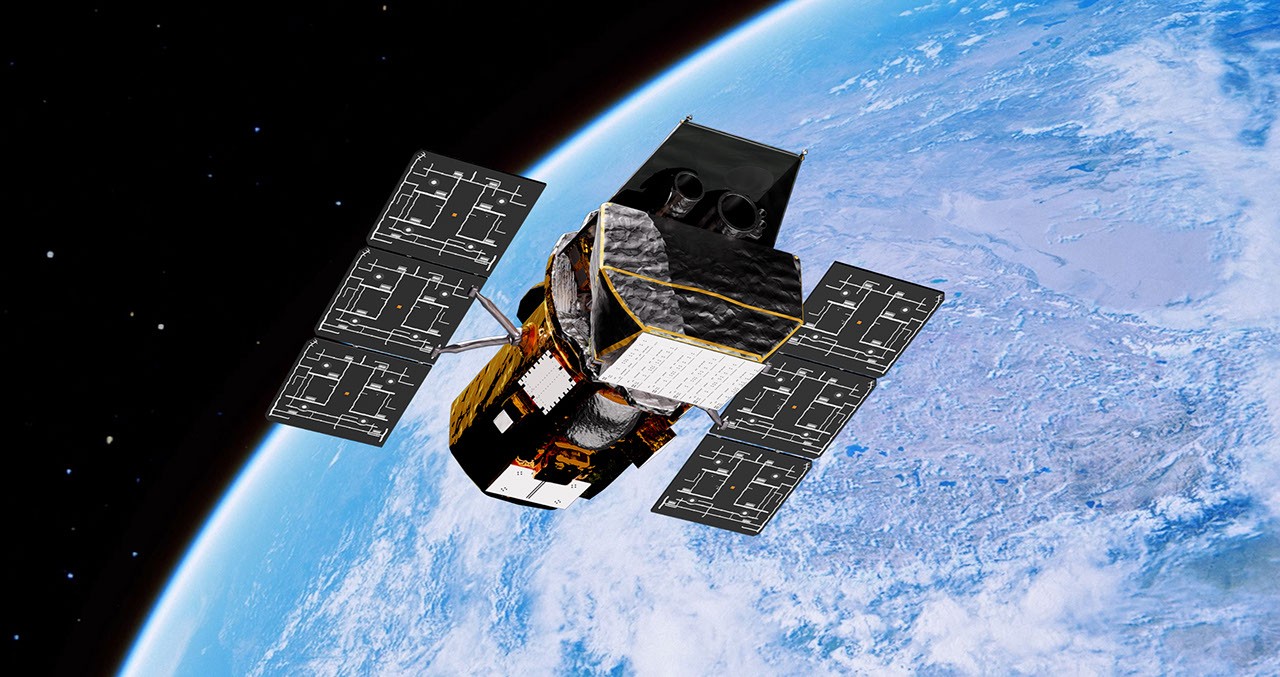
NASA’s Swift Boost Mission Ends After LINK Space Robot Encounters Problems
The commercial mission to raise NASA’s Neil Gehrels Swift Observatory to a higher orbit has ended without successfully boosting the spacecraft. However, NASA and Katalyst Space gained valuable experience that could support future commercial space servicing missions.
“From the beginning, this was a high-risk, high-reward mission,” said Sean Domagal Goldman, director of NASA’s Astrophysics Division. “Although we were disappointed to see the Swift mission end, we knew this booster effort would be valuable to the agency on a number of levels, including advances in U.S. spacecraft maintenance technology. We’re very proud of how quickly this team got to this point, and we’re capturing the lessons learned to ensure we’re ready to go even further.”
NASA’s Swift Observatory Spent 20 Years Studying the Universe
Launched in November 2004, NASA’s Swift Observatory was designed to study gamma-ray bursts, the most powerful explosions in the universe.
Over the past two decades, Swift has transformed researchers’ understanding of how the universe works. The observatory has studied everything from comets and asteroids in our solar system to distant explosions and flares from black holes in other galaxies.
Like all spacecraft in low Earth orbit, Swift experiences atmospheric drag. Without a propulsion system, that drag gradually lowers a spacecraft’s altitude. Increased solar activity further intensified the effect on Swift.
NASA Turned to Commercial Space Services to Save Swift
After deciding to explore the potential of its Boost program, NASA had only a few months to solicit proposals. The agency supported design concept research through the Collaborative Engineering Center of Excellence and the Small Business Innovation Research and Small Business Technology Transfer programs.
In September 2025, NASA contracted Flagstaff, Arizona-based Katalyst Space to attempt the mission. The company took about a year to design, build, test and launch a spacecraft capable of rendezvousing with, grappling, and lifting Swift.
The LINK spacecraft launched from Kwajalein Atoll in the Republic of the Marshall Islands in July aboard a Northrop Grumman Pegasus XL rocket. Based on the mission’s orbital and program requirements, Katalyst selected Pegasus as the best launch option for reaching the observatory on the condensed schedule.
LINK Experienced Communication and Guidance Problems
After reaching space and completing an initial spacecraft checkout, LINK began experiencing intermittent communication losses and problems with directional control.
Following a round-the-clock troubleshooting effort by both teams, NASA and Katalyst agreed to scale back the mission. LINK would no longer attempt to acquire or boost Swift. Instead, the spacecraft would conduct technology demonstrations intended to improve the capabilities of the U.S. commercial space services industry.
The demonstrations included LINK’s xenon-powered propulsion system and the operation of three robotic arms designed to provide flexibility in selecting a safe grappling location on Swift.
NASA officially ended its involvement in the LINK mission on September 3. LINK re-entered Earth’s atmosphere on September 25.
“LINK was built to tackle problems for which there are no easy solutions,” said Ghonhee Lee, CEO of Katalyst Space. “This was an ambitious mission on a tight schedule. Although we didn’t achieve all the goals we set out to achieve, we went from mission concept to launching and operating the first commercial space robot in less than a year. This is the foundation on which we can build.”
Swift’s Boost Mission Required Agile Project Management
Science missions such as Swift can take years to develop and then operate in orbit for decades. For the Swift boost effort, however, the schedule was the most important factor.
NASA’s decisions and risk acceptance were based on predictions that Swift would sink to an altitude of about 185 miles (300 kilometers) in fall 2026, reaching a point where boosting the observatory would become increasingly difficult. As a result, the mission required NASA to use a new, more agile approach to project management.
Members of NASA’s Space Science Mission Operations Swift team at the Goddard Space Flight Center in Greenbelt, Maryland, worked with Katalyst to develop milestones and an approval process. The approach was designed to maximize the chances of mission success while allowing the teams to move quickly toward launch.
Both groups also received input and feedback from the NASA Engineering and Safety Center as they addressed questions and issues during integration and testing.
“Katalyst was committed to leveraging NASA’s extensive experience to give itself the best chance of succeeding at the unprecedented challenges we posed,” said Russell Carpenter, SSMO project manager at NASA Goddard. “Missions like this, where public and private teams work tenaciously to overcome obstacles, inspire the world and remind us that striving for the near-impossible brings out the best in all of us.”
Swift Controllers Adjusted Operations to Delay Re-Entry
While NASA and Katalyst teams prepared LINK on the ground, flight controllers at the Swift Mission Operations Center at Penn State University in University Park, Pennsylvania, worked to keep Swift above its critical altitude for as long as possible. Below that level, a boost attempt would become increasingly difficult.
During normal operations, the Penn State team sends Swift a daily plan identifying the space objects and events the observatory should observe.
In December 2025, controllers began replacing about 25% of Swift’s science targets with points in the sky that minimized atmospheric drag on the spacecraft. By February, the team had fully adopted this approach.
“Although Swift did not conduct any sharp science observations from mid-February until late August, we continued Penn State’s history of innovative space research and operations, pioneering new ways to minimize drag on spacecraft,” said John Nousek, mission director and professor of astronomy and astrophysics in Penn State’s Eberly College of Science. “These changes bought valuable time for the Boost mission and can be carried over to future NASA missions.”
Controllers also had to avoid pointing Swift too close to Earth, the Moon or the Sun. Their brightness could overheat and damage the observatory’s instruments. At the same time, orienting Swift in the safest position could bring it too close to the atmosphere, allowing particles to strike the telescope and affect future observations.
The team balanced these competing risks and maintained Swift’s altitude above a critical threshold for several months.
Swift’s Legacy Continues Through Commercial Space Innovation
“We are grateful to all of our collaborators for their incredible time and dedication to the Boost mission,” said S. Bradley Cenko, Swift principal investigator at NASA Goddard. “When Swift’s namesake, Neil Gehrels, designed the observatory, it was unlike anything that had ever been launched before. He would have praised this propulsion effort as part of Swift’s legacy, allowing NASA to try new and bold things, even if the results weren’t guaranteed.”
“That’s how we explore space: as a team, learning from each other and always moving forward.”
Source: science.nasa.gov