


In 2004, Amy Proal developed an infection that permanently changed the course of her life. “I was in my final year of pre-med and completely tanked,” she says. “No one could explain what was happening. Everyone said my blood tests were normal, sent me to a psychiatrist — the usual story.” From her sickbed, Proal began reading scientific papers and discovered that many people experienced unexplained symptoms that continued long after an infection.
A year later, she was diagnosed with myalgic encephalomyelitis/chronic fatigue syndrome (ME/CFS), a complex chronic illness often associated with fatigue, cognitive problems and post-exertional malaise. Antiviral medicines and other treatments helped improve her symptoms. Proal later completed a PhD in microbiology, researching the long-term effects of pathogens. In 2018, she co-founded PolyBio, a Medford, Massachusetts-based foundation focused on infection-associated chronic illnesses. “Then,” Proal says, “COVID hit.”
COVID-19 has killed millions of people and left millions more with persistent health problems linked to SARS-CoV-2 infection. This condition became known as long COVID. A 2024 study estimated that approximately 400 million people worldwide are living with long COVID1, creating an estimated annual economic burden of around US$1 trillion.
What causes long COVID? Case builds for rogue antibodies
The scale of long COVID has driven renewed interest in post-acute infection syndromes, including ME/CFS, post-polio syndrome, post-Ebola syndrome and post-treatment Lyme disease syndrome. During the past six years, thousands of studies have examined the causes of long COVID, its similarities to other post-infection illnesses and possible treatments. In December 2020, the US government committed $1.15 billion to research the long-term consequences of SARS-CoV-2 infection. Last year, Germany announced €500 million (US$580 million) for research into post-infectious diseases. “The COVID pandemic has shone a light on this family of post-acute infection conditions,” says David Putrino, a neuroscientist at the Icahn School of Medicine at Mount Sinai in New York City.
Despite the growing number of people affected, the health and economic impact of these conditions still far exceeds available research funding. “It’s not a priority, despite having a major destructive influence on our society,” says Chris Ponting, a geneticist at the University of Edinburgh, UK.
Scientists are working to understand the biology of long COVID and related post-infectious illnesses, as well as identify reliable biomarkers. The lack of disease markers remains one of the biggest barriers to developing effective treatments. Although researchers still do not fully understand how an acute infection can trigger chronic disease, several biological explanations are emerging. “We certainly don’t have the answer,” says Michael Peluso, an infectious-disease clinician at the University of California, San Francisco. “But we have a lot of leads.”
Post-infection illnesses can cast long-term health shadows
In 1894, several years after a global epidemic of respiratory disease, English physician Thomas Dowse described symptoms that continued long after the initial infection. He called the condition “post-influenza exhaustion”. Since then, researchers have linked numerous chronic illnesses to infectious diseases, including post-polio syndrome, post-Ebola syndrome and post-treatment Lyme disease syndrome. Symptoms differ between conditions, but persistent fatigue and neurological problems are common. “Almost every infection — viral, bacterial or parasitic — is associated with chronic symptoms in a subset of people who do not recover,” Proal says.
Can long COVID be prevented? Two drugs finally show promise
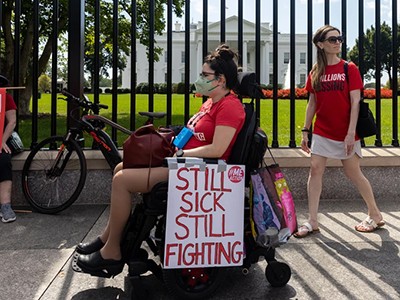
For decades, many people with post-infection symptoms were dismissed by doctors. The COVID-19 pandemic forced greater recognition of these illnesses. Data collected in 2023 and 2024 by the US Centers for Disease Control and Prevention (CDC) indicated that approximately 6% of US adults have long COVID (see go.nature.com/4zbjmmh).
In February 2021, the US National Institutes of Health (NIH) launched the RECOVER initiative to study long COVID. The programme initially focused on building large patient cohorts, documenting symptoms and collecting biological samples. RECOVER has been criticized for conducting too few treatment trials, but researchers say its large-scale infrastructure could support important discoveries in the years ahead.
Researchers studying post-infectious diseases are also forming new collaborations. “Many collaborations are happening, starting from long-COVID researchers reaching out to people who’ve been doing ME/CFS research for decades,” says Akiko Iwasaki, an immunobiologist at Yale School of Medicine in New Haven, Connecticut. Iwasaki and Danny Altmann, an immunologist at Imperial College London, helped organize a symposium in Santa Fe, New Mexico, in August 2025. The meeting brought together experts studying a range of post-infection syndromes. “All the talk was about shared pathways and mechanisms,” Altmann says.

Lilly Downs from Colorado has been in and out of hospital with long COVID after developing COVID-19 in 2020.Credit: Hyoung Chang/The Denver Post via Getty
Recognition of long COVID has also helped legitimize other post-infection illnesses and challenge the idea that they are psychological conditions. That misconception has affected people with ME/CFS for decades. The CDC and the UK National Institute for Health and Care Excellence now recognize ME/CFS as a biological illness. Common symptoms include profound fatigue, cognitive impairment and post-exertional malaise — a hallmark worsening of symptoms after physical or mental activity.
There is substantial overlap among post-infection syndromes, although each condition can include several subtypes. Some people with long COVID develop cardiovascular problems, while others experience severe brain fog or symptoms that meet the diagnostic criteria for ME/CFS. The key difference is that long COVID is defined by its trigger — SARS-CoV-2 infection — whereas ME/CFS is defined by its symptoms, regardless of the original cause. However, many people with ME/CFS report a previous infection.
Indeed, a proportion of people with almost every post-infection syndrome develop symptoms that satisfy the criteria for ME/CFS. “There’s nothing unusual about SARS-CoV-2 as a trigger,” Ponting says.
What causes long COVID and other chronic post-infection diseases?
Research increasingly points to a group of overlapping biological mechanisms that may explain the symptoms shared by long COVID, ME/CFS and other post-infectious illnesses. “It’s important for us to consider these diseases together,” Iwasaki says.
Scientists have identified several possible contributors, including immune-system dysfunction, chronic low-level inflammation and autoantibodies — antibodies that mistakenly target the body’s own tissues. Long-COVID studies have also found evidence that SARS-CoV-2 can persist in the body in some form2. The infection might also reactivate dormant viruses3, particularly viruses from the herpesvirus family.
Long-COVID signatures identified in huge analysis of blood proteins
Other studies suggest that long COVID can damage small blood vessels and endothelial cells, which line the inside of blood vessels4. The autonomic nervous system, which controls functions such as heart rate and breathing, is frequently affected. Researchers have also reported changes in the gut microbiome and damage to mitochondria, the structures that produce energy inside cells. Mitochondrial dysfunction could help explain persistent fatigue.
These mechanisms may be closely connected. “Many viruses infect the gut and lead to long-lasting low-level immune activation,” says Carmen Scheibenbogen, an immunologist at Charité University Medicine Berlin. This immune activation can disrupt the gut microbiome. Damage to the autonomic nervous system can also interfere with heart rate, blood pressure and blood flow, potentially depriving mitochondria of oxygen and nutrients. “So, what would happen to us if we ran a marathon happens to ME patients from climbing two stairs,” Scheibenbogen says.
The relative importance of each mechanism could help researchers divide patients into biological subgroups — for example, people with autoantibodies or evidence of persistent viral material. This could explain why a single treatment is unlikely to help everyone, although some therapies might work across several post-infection diseases.
Promising treatment targets include autoimmunity and viral persistence
Among the many possible disease mechanisms, immune dysfunction, autoantibodies and viral persistence are currently attracting the most attention. “The spotlight is on those two areas,” Altmann says.
Autoantibodies are a defining feature of autoimmune diseases, which are more common in women than men. Long COVID and ME/CFS also disproportionately affect women. One possible explanation is molecular mimicry: the immune system mistakes viral proteins for similar proteins in human tissues and attacks both.
Several research groups have shown that antibodies from people with long COVID can cause illness in mice. These experiments provide some of the strongest evidence so far that autoimmunity contributes to long-COVID symptoms. In a study published in May, immunoglobulin G (IgG) antibodies taken from people with long COVID caused increased pain sensitivity when injected into mice5.

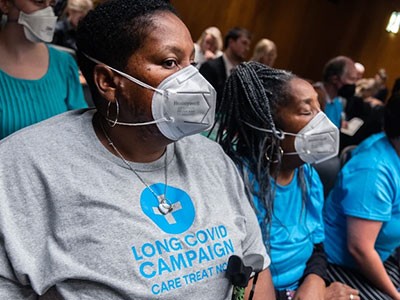
People with long-COVID symptoms listen to a 2024 US Senate Committee hearing on research and health care for the condition in Washington DC.Credit: Drew Angerer/Getty
Scheibenbogen’s team has attempted to remove autoantibodies from the blood through a procedure known as immunoadsorption. In a study of people diagnosed with ME/CFS after COVID-19, the procedure reduced autoantibody levels and improved symptom severity in most participants6. However, the study did not include a placebo group, so the results cannot yet establish that the treatment was responsible for the improvements. Immunoadsorption is also difficult to deliver on a large scale. The researchers plan to conduct placebo-controlled trials of medicines that target B cells and plasmablasts, the cells that produce antibodies.
A small Norwegian study has tested a similar approach. Øystein Fluge, a physician at the University of Bergen, and his colleagues treated ten people with ME/CFS using daratumumab, an antibody that targets plasmablasts. Some participants experienced substantial improvements that lasted for as long as two years7. Participants who responded to treatment also showed larger reductions in immunoglobulin levels midway through the study. A larger, placebo-controlled trial called ResetME began in June 2025, with results expected between 2028 and 2030.
Other clinical trials are testing whether long-COVID symptoms improve when persistent viral particles or fragments are removed. Growing evidence suggests that SARS-CoV-2 may remain in the body for months or years, prompting scientists to reconsider the traditional view that some pathogens are always transient. “I wasn’t a believer in viral persistence when I started in this field,” Peluso says. “But if nothing else, we have fundamentally started to rework how we think about pathogens that should be transient.”
Researchers do not yet know whether SARS-CoV-2 persists as genetic fragments or complete viral particles in organs such as the brain and eyes, which are partly shielded from immune surveillance. However, evidence indicates that viral material can remain in the body. A 2024 study found that people with long COVID were more than twice as likely as those who recovered fully to have viral proteins in their blood, up to 14 months after infection8.
Long-COVID research just got a big funding boost: will it find new treatments?
If persistent viral material contributes to long-COVID symptoms, antiviral drugs could potentially help. However, clinical evidence remains inconclusive. A RECOVER trial of paxlovid, an antiviral medicine used to treat SARS-CoV-2 infection, did not find a benefit in preliminary analyses. Amy Proal says the trial design might have influenced the results because participants were not required to show evidence of viral persistence before enrolment, and the 25-day treatment period might have been too short.
Many researchers support smaller and faster clinical trials designed to test biological theories rather than immediately demonstrate a clinically significant treatment effect. This approach, known as experimental medicine, could allow scientists to identify promising therapies more quickly before moving them into larger randomized trials.
Some treatment ideas come from clinicians who have studied post-infection illnesses for decades. William Pridgen, a physician in Tuscaloosa, Alabama, has treated people with ME/CFS and fibromyalgia — a condition associated with widespread muscle pain and fatigue — using combinations of herpesvirus antivirals. His theory is that an infection or another form of physiological stress can reactivate dormant herpesviruses and trigger a chronic illness.
One of Pridgen’s two-antiviral combinations is entering phase III trials for fibromyalgia. He is also testing a three-drug combination consisting of two herpesvirus antivirals and paxlovid. The treatment is designed to target both persistent SARS-CoV-2 and reactivated herpesviruses. In a study published in January, Pridgen and Putrino tested the combination in 24 people with long COVID9. Half of the participants received the two herpesvirus antivirals for 120 days, while the remaining participants received paxlovid as well. Symptoms improved in both groups, but the 12 people who received all three medicines experienced greater improvements, which remained evident two years later. In January, the US Food and Drug Administration granted the researchers an Investigational New Drug exemption to conduct a larger, placebo-controlled trial of the three-drug combination.
Source: www.nature.com