


Reptile communication is more complex than scientists once thought, with turtles, lizards and crocodiles using calls, clicks, pops and roars to interact
Reptiles Plus via Flickr under CC BY-NC 2.0
Along the sandy shores of northern India’s Chambal River, crocodile-like gharials usually appear calm. But when a male spots a rival, the quiet can be interrupted by a series of explosive popping sounds.
The unusual sound, which resembles a champagne cork popping, has only recently attracted scientific attention. The behavior is unique to male gharials. A male fills cavities in his snout with water and rapidly forces the water through a bulbous growth at the end of his long nose. The resulting sound may help identify the individual because each gharial appears to produce a distinctive “pop pattern.”
Gharials are not the only reptiles that communicate through sound. Although mammals and birds are best known for vocal communication, reptiles are not silent animals. Their soundscapes include chirps, squeaks, clicks, growls, bellows and roars.
Gharial pop

As researchers document more reptile vocalizations, they are beginning to understand how these sounds shape reptiles’ social lives. Calls may help animals find mates, defend territories, coordinate hatching or communicate between parents and offspring.
Reptiles have long been viewed as secretive and largely solitary. Conservation biologist Sean Doody of the University of South Florida says reptiles have been “long underappreciated in terms of their social behavior.”
Of the thousands of reptile species living around the world, most have not been studied closely, says Henrik Blum, a behavioral biologist at the Max Planck Institute for Biological Intelligence in Germany. Scientists are now investigating these diverse calls to better understand what reptiles may be communicating.
Reptile calls help siblings hatch together
Crocodilians are among the best-studied vocal reptiles. Scientists have known for decades that baby crocodiles call from inside their eggs. These sounds can help synchronize hatching among siblings and alert the mother that the young are ready to emerge.
Over the past decade, researchers have also discovered that many turtle species produce clicking and other sounds while still inside their eggs. Evolutionary biologist Gabriel Djorgevic Cohen and colleagues studied vocal hatchlings, including South American river turtles, as well as quieter species such as western swamp turtles.
South American river turtles can lay more than 100 eggs, and their hatchlings are often noisy as they leave the nest. By contrast, species that lay fewer than 10 eggs are less likely to vocalize or emerge together, according to research published in Ecology and Evolution.
The findings suggest that vocal communication may help turtle hatchlings coordinate their emergence and work together to escape underground nests. Because large clutches contain many siblings, making noise may also reduce the risk that any one hatchling will attract a predator, Djorgevic Cohen says.
/https://tf-cmsv2-smithsonianmag-media.s3.amazonaws.com/filer_public/17/48/1748a5e9-1c82-4691-a593-b9cc70085737/reptile-vocalizations-1600x600.jpg)
RichardJames1990 via Flickr; Reptiles Plus via Flickr; Pfaucher via iNaturalist; Paul Tavares via iNaturalist; Moth-_-man via iNaturalist; Olie Turner III via iNaturalist; Ariel Cabrera Foix via iNaturalist
Lizards use calls to signal danger and attract mates
Scientists have detected vocalizations in approximately 30 percent of lizard species. Anoles, for example, may bark during interactions with other lizards and squeal or growl when distressed.
Chilean tree iguanas, sometimes called weeping lizards, can even alter their distress calls depending on the severity of a threat. A lizard may produce a simple call when it encounters a predator. In a more dangerous situation, however, it can switch to a more complex vocal signal that appears to communicate greater urgency.
These complex calls contain changing frequencies and pitches, which are produced by irregular vibrations of the lizard’s vocal cords. The sounds may trigger fear in nearby lizards. Calls that are more complex than usual can cause listeners to remain motionless for longer before fleeing, potentially giving them more time to escape.
A recent study also found that lizards exposed to these distress calls while witnessing another lizard being eaten by a snake showed a longer-lasting fear response. Similar complex distress signals occur in mammals such as meerkats and may indicate the urgency of a threat.
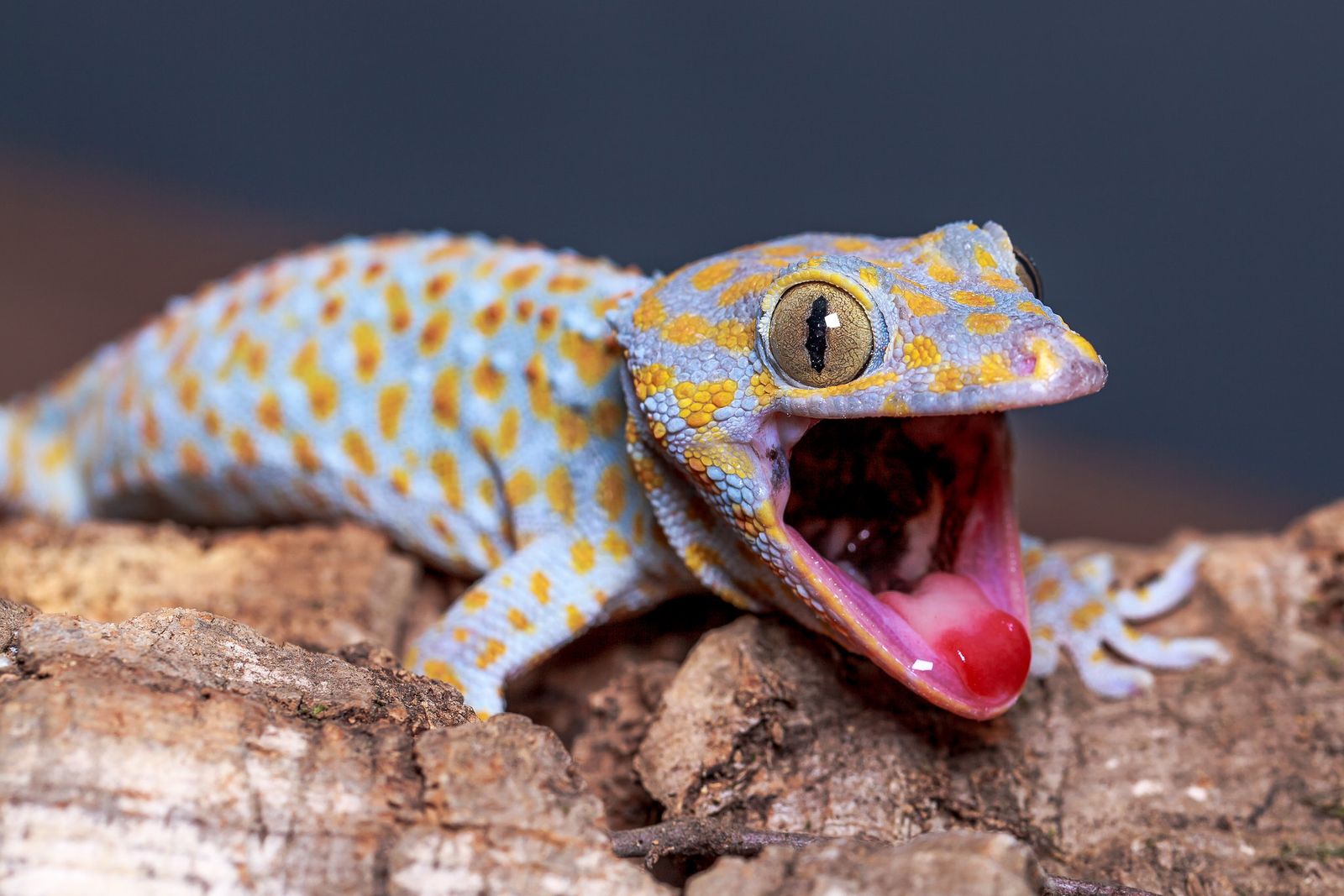
Tokay geckos also adjust their calls in sophisticated ways. Their loud calls, often followed by a series of softer sounds, are generally used to attract mates or defend territory. Like many bird calls, Tokay gecko vocalizations are influenced by testosterone and become more frequent during the breeding season.
Blum wondered whether Tokay geckos automatically make louder calls in noisy environments. This behavior, known as the Lombard effect, has been documented in many birds and some mammals.
To test the idea, Blum and his colleagues played white noise to geckos in the laboratory and measured how the animals changed their calls. The geckos did not simply increase the volume of their entire call. Instead, they changed its structure by reducing the number of softer sounds and extending the main “gecko” syllable.
In particular, the geckos elongated the “o” sound, making a larger portion of the call easier to hear. Humans, monkeys and some birds use similar strategies by drawing out vowels or slowing their speech in noisy surroundings.
“This was completely unexpected,” Blum said. The results reveal a level of flexibility in reptile communication that scientists once thought was unlikely. They also suggest that gecko calls may be more complex and more similar to the communication systems of birds and mammals than previously recognized.
Gharial pops and reptile bellows carry different messages
Some reptile calls vary according to an animal’s size. For example, larger barking geckos tend to produce deeper, lower-frequency calls, which may advertise their size or strength to potential mates.
American alligators also produce bellows that reflect body size. Research shows that the lower the frequency of an alligator’s call, the larger the animal is likely to be. Gharial pops, however, appear to communicate something different: the identity and social context of the individual male.
Conservation biologists working with the Gharial Ecology Project at the Madras Crocodile Bank Trust in India, including Jeffrey Lang and project director Jayladeen A, recorded gharial sounds along the Chambal River.
Underwater, male gharials first produce vibrations that are difficult for humans to hear. These may be followed by one explosive pop or a series of rapid pops. The animal then rises to the surface, repeats a sequence of exhales and inhales, and finally releases a gurgling sound back into the water.
Gharial calls vary according to social circumstances. Some pop patterns appear to alert other animals to activity nearby, while others are associated with territorial patrols. One male produced a 22-millisecond pop during an alarm and a longer, 35-millisecond pop while patrolling.
Male gharials may also pop when confronting potential rivals or courting females. Each male appears to use a distinctive pattern of sounds in different situations.
An individual male’s unique call could help females assess potential partners. Male gharials are attentive and protective fathers, guarding newly hatched young in the water. For females, these paternal qualities may be more important than body size when choosing a mate.
“Pop music” appears to serve several important purposes, Lang says, sending signals to individual males, females or entire groups. Scientists still do not know exactly how gharials produce the sounds.
A bulbous structure at the end of the snout, known as a ghara, or “mud pot” in Hindi, appears to be essential. Males that lose their gharas during fights may no longer be able to produce the calls. Researchers suspect that the structure’s internal flaps and cavities create resistance as water moves through them, eventually generating the characteristic pop. Lang hopes to use a CT scanner to examine the structure and confirm how it works.
Gharial vocalizations are just one of many mysteries emerging as scientists expand the known repertoire of reptile sounds. Doody, Djorgevic Cohen and their colleagues reviewed the diversity of animal vocalizations in a 2025 article for Annual Review of Ecology, Evolution, and Systematics, and they hope more researchers will study reptile communication.
“One of the challenges with reptiles is that they do something interesting and then sit there doing nothing for hours and hours,” Doody says. Studying these animals, he adds, “requires a lot of patience.”

Knowable Magazine is an independent journalistic effort from Annual Reviews.
Source: www.smithsonianmag.com