


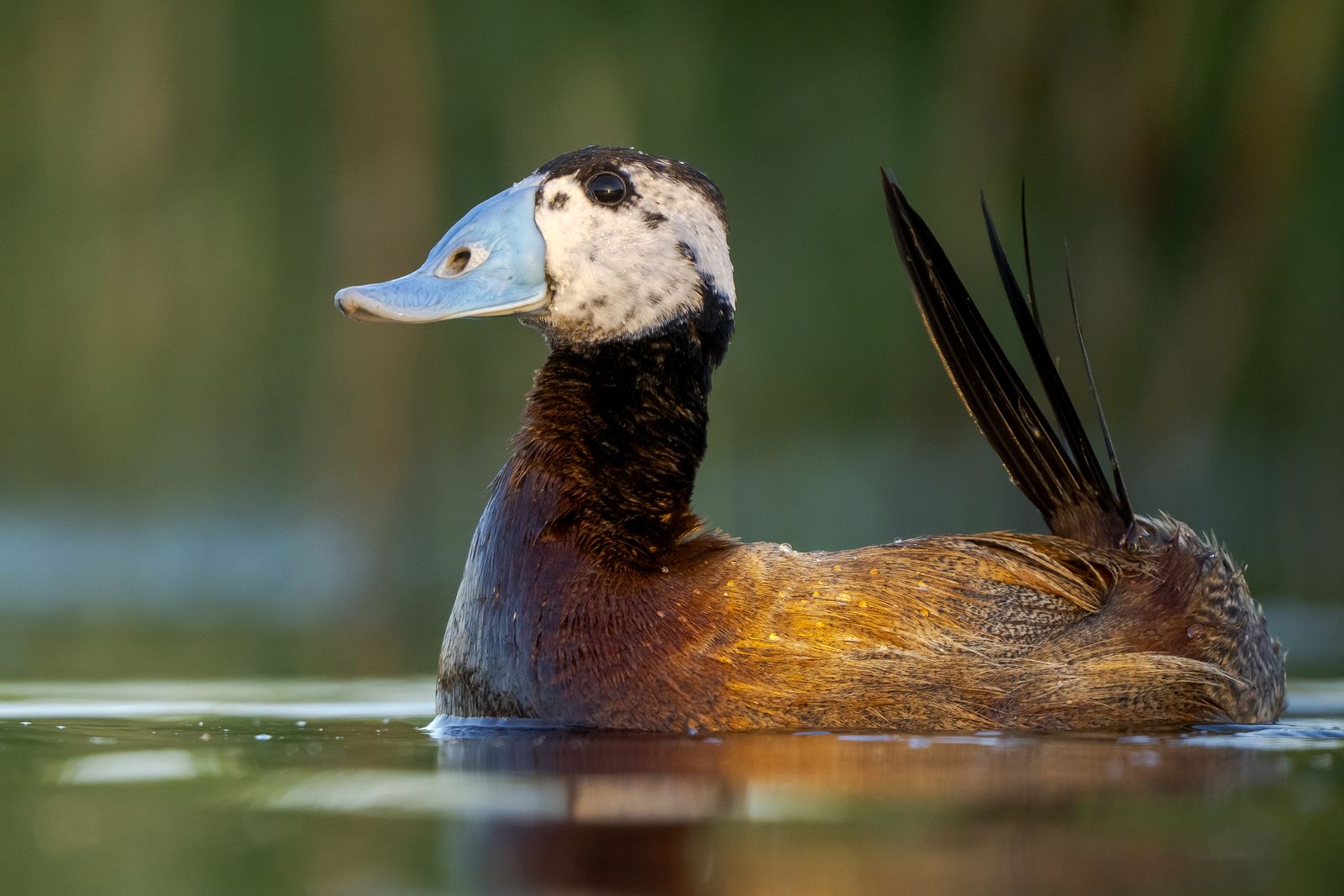
The white-headed duck’s bright blue bill and unusual courtship display make it unforgettable. Its remarkable recovery in Spain also offers hope for wetland conservation—while highlighting the threats that still endanger the species.
Javier Aznar González Rueda
From its whisker-like tail to the male’s bright sky-blue bill, the white-headed duck is one of the most distinctive waterfowl species in the world. Outside the breeding season, these ducks are generally calm and gentle. In spring, however, males perform spectacular courtship displays across wetlands in Europe, North Africa, the Middle East and Central Asia.
During these elaborate displays, males swim sideways, splash across the water and create trails of bubbles by tapping the feathers on their swollen necks with their bills. Their unusually long, stiff tail feathers wave like flags, spread like fans and slap the water like paddles. “Witnessing courtship in white-headed ducks is like watching one of the bird world’s most extraordinary performances,” says Nikki Petkoff, a waterbird expert affiliated with the Bulgarian Bird Conservation Society and BirdLife International, a division of the International Union for Conservation of Nature (IUCN).
In Spain, the white-headed duck is also at the center of an important conservation success story. Over the past several decades, wetlands were drained for agriculture and development, reducing habitat and causing populations to decline throughout the duck’s range. Hunting added to the pressure. The global population, estimated at approximately 100,000 birds in the 1930s, had fallen dramatically by the late 1970s. Most European populations had disappeared, leaving just 22 birds at a single site in Spain.
That alarming total prompted a national effort to restore and protect wetlands, improve water management and prohibit hunting. Spain’s white-headed duck population has since recovered to approximately 2,500 birds and is once again expanding into parts of the country. The rebound demonstrates how targeted conservation programs can help endangered waterfowl recover when habitat protection and enforcement work together.
Elsewhere, however, the outlook remains far less hopeful. The white-headed duck continues to decline globally and is listed as endangered on the IUCN Red List. Important populations in the eastern portion of the species’ range receive limited protection, while pollution, water loss, wetland destruction and other human activities continue to damage its habitat. New environmental pressures are also emerging.
One of the most serious threats comes from the ruddy duck, an invasive species native to North America. Some ruddy ducks escaped from wildlife collections in the United Kingdom and spread eastward. After reaching Spain’s white-headed duck breeding grounds in the 1980s, the introduced birds competed with native males for mates. By the early 1990s, highly fertile hybrids were being found. Because these hybrids could reproduce successfully, conservationists feared that interbreeding could eventually erase the white-headed duck’s genetic identity.
Eradication campaigns have brought the hybridization threat under control in much of Western Europe, but the risk has not disappeared. Continued monitoring is necessary to prevent ruddy ducks from returning to important white-headed duck breeding areas and to protect the species’ genetic diversity.
The white-headed duck’s recovery in Western Europe is encouraging, but its future depends on protecting wetlands throughout its range. To expand conservation efforts, a new multinational initiative was launched in 2026 across southeastern Europe, the eastern Mediterranean and Central Asia. At the same time, climate change, rising temperatures and increasingly severe droughts are placing wetlands around the world at risk of drying out.
“Important caution is needed in describing the white-headed duck as a conservation success story,” Petkoff warns. “The story isn’t over yet.”
Fun fact: Why is the white-headed duck’s bill blue?
-
During the breeding season, hormonal changes alter the microstructure of the outer layer of the bill, creating the male’s striking blue coloration.

Source: www.smithsonianmag.com