


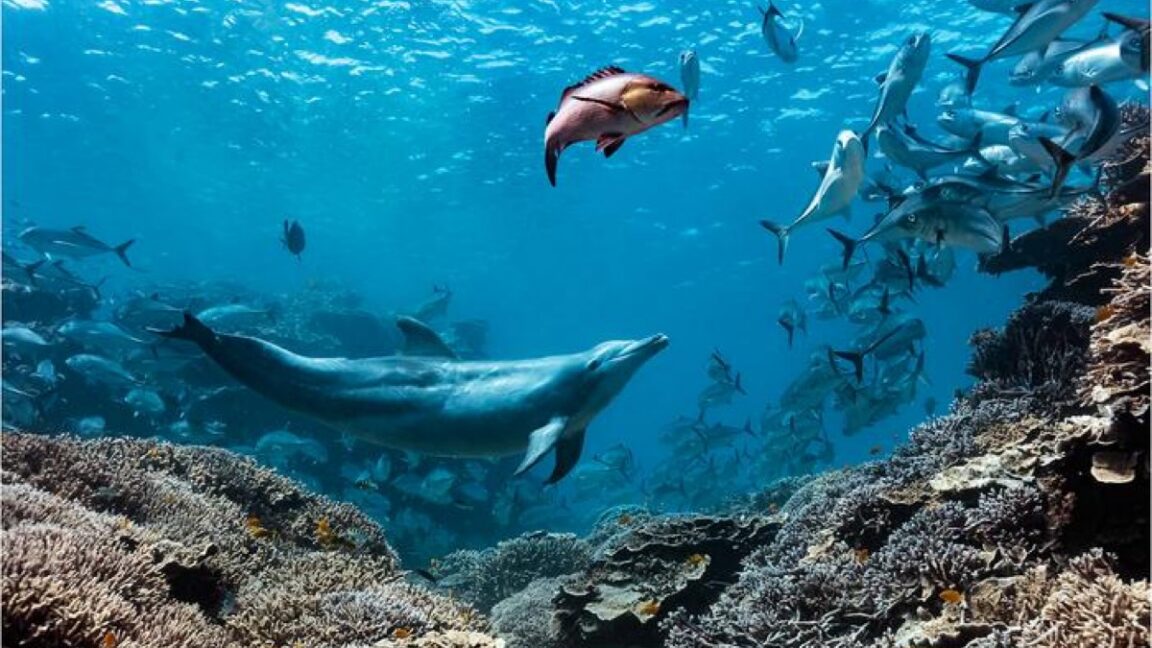
Dolphin Bubbles Has a Strange Strategy for Catching Fish: Making Them Vomit
A dolphin named Bubbles appears to have developed a highly unusual way to forage. Instead of eating the fish it catches, Bubbles uses echolocation to identify a target, chases it away from the pod, and waits for the stressed fish to vomit. The dolphin then eats the regurgitated food as the fish swims away.
How Bubbles uses fish vomiting to find food
First, Bubbles uses echolocation to scan the environment and identify a suitable target fish. The dolphin then pursues that fish while ignoring the rest of the pod. The bubbles produced during the encounter appear to reflect the target’s movement, often following it closely.
The fish escapes only after vomiting, probably as a stress response. Bubbles then consumes the regurgitated food while the target fish swims away. The dolphin can repeat this process as many as 10 times in 30 minutes. The behavior appears to be unique among documented cases involving bigeye mackerel. Bubbles does not appear to eat the fish itself.
A learned, energy-saving foraging behavior
Dolphins typically forage in groups, but Bubbles is sometimes observed with other dolphins and appears to prefer feeding alone. Haynes said the behavior may have been learned over time.
“We observed him repeating this behavior over several years, suggesting that he may have learned to target the fish with a full stomach, providing the most valuable meal,” she said.
By targeting fish that have already eaten, Bubbles may be obtaining a more valuable meal while using less energy than it would take to chase fast-swimming prey.
Can echolocation identify a fish with a full stomach?
The researchers do not yet know how Bubbles identifies which fish contain a satisfying meal. They suspect echolocation may play a role during the scanning phase of the dolphin’s hunting strategy.
Other species are known to use echolocation to distinguish between types of fish because differences in body shape produce different echo patterns. Researchers sampled Bubbles’ vocalizations from video footage and noted intense clicks and continuous low-frequency sounds during the behavior, which they describe as kleptoparasitism.
It remains unclear whether those sounds help Bubbles identify suitable targets or intensify the fish’s stress response, causing it to vomit.
Researchers need more evidence
The evidence currently comes from a single dolphin and a limited dataset. Further observations, especially of other dolphins in the region, are needed before researchers can determine whether the behavior is widespread or whether Bubbles is an exceptional individual.
Haynes and her co-authors believe this type of foraging may be underestimated because it is difficult to record such events in the wild.
“The use of technologies such as animal-borne video camera tags and unmanned aerial vehicles (drones) is likely to provide new insights into the puzzling behavior of these elusive marine predators,” the researchers concluded.
Research: Ecology and Evolution, 2026. DOI: 10.1002/ece3.74270
Source: arstechnica.com