


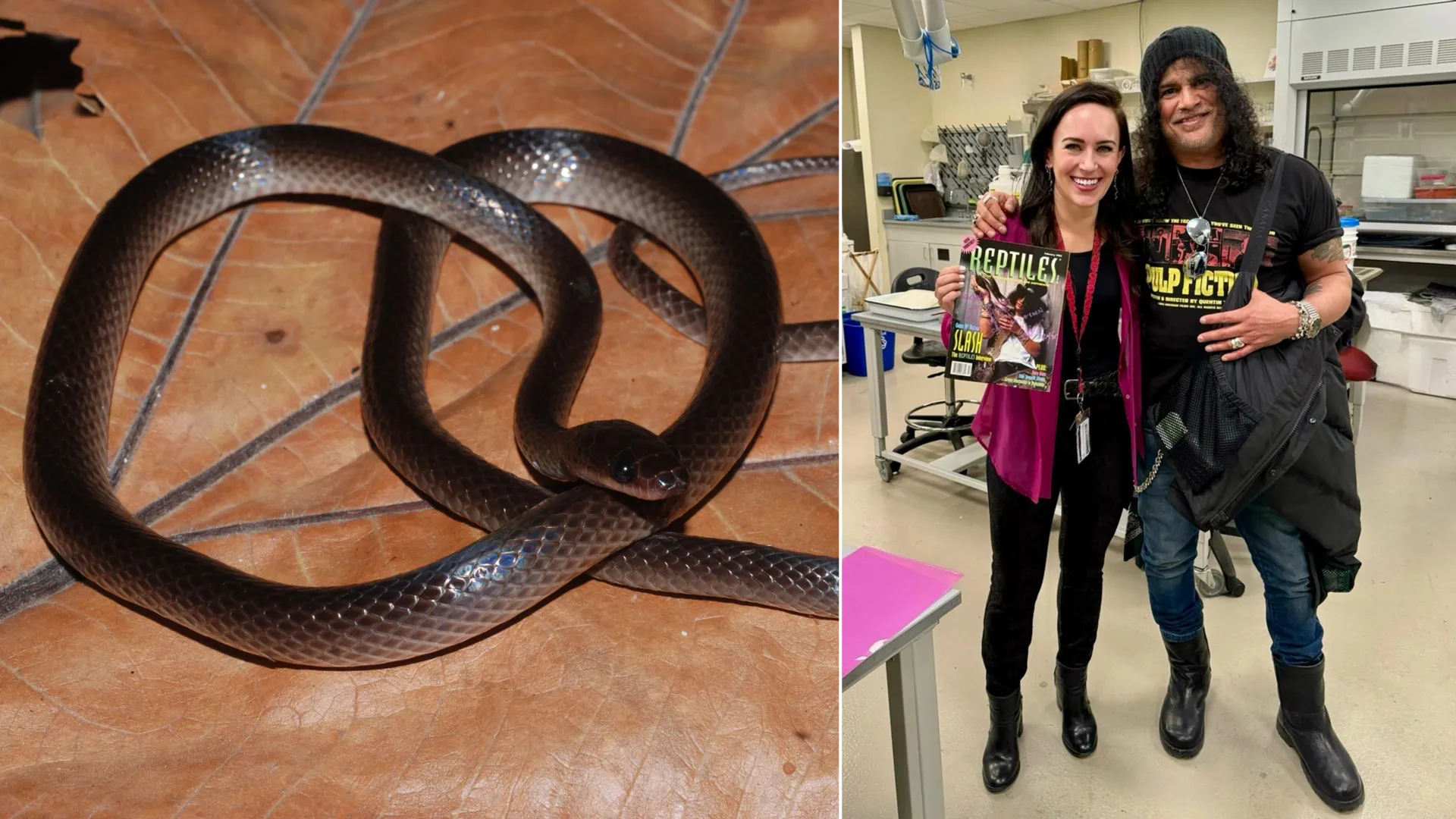
Slash Has a New Snake Species Named After Him
Slash, whose real name is Saul Hudson, is world-famous as the guitarist for Guns N’ Roses. But music is only part of his story. He has also been fascinated by reptiles for most of his life and has supported zoos, museums, and natural history organizations for many years.
Now, that passion has earned him an unusual scientific honor: researchers have named a newly identified snake species from New Guinea Lielafis Thrashi, also known as Slash’s ground snake.
“As a long-time herpetophile, I am extremely honored and humbled by this,” Slash said. “Lielafis Thrashi is from New Guinea and was named after me. It’s really exciting, but I never imagined this moment would come.”
Why the New Guinea Snake Was Named After Slash
The species’ name also has a personal connection for Sarah Ruane, associate curator of herpetology at the Field Museum and lead author of the study.
“Guns N’ Roses has been one of my favorite bands since I was in first grade, and as early as fifth grade I was telling my teacher that I wanted to be a herpetologist, a scientist who studies reptiles, when I grew up,” Ruane said.
“So when Reptile Magazine arrived in the mail when I was 12 years old and had a picture of Slash holding his pet reticulated python on the cover, I thought, ‘This guy is so cool.’”
Years later, Ruane returned to old magazine interviews with Slash while considering who should receive the honor of having a newly recognized reptile species named after him.
“I looked back at his interviews, and he talked about how much he loved museums, zoos, and natural history, and how he used to go out and look for snakes when he was a kid,” Ruane said. “All of that really resonated with me, so I thought he would be a great person to name a new species.”
A Mysterious Snake From New Guinea
Her opportunity came in the form of a 28-inch-long, reddish-brown snake found in the forests of New Guinea.
New Guinea is the second-largest island in the world after Greenland. Located just north of Australia, it is divided between Indonesia and Papua New Guinea. Its tropical forests support extraordinary biodiversity, much of which remains poorly documented by scientists.
Chris Austin, a professor and curator of herpetology at the Louisiana State University Museum of Natural Science, encountered an unfamiliar snake in New Guinea during nighttime fieldwork in 2006.
“These New Guinea ground snakes are nocturnal, so the best way to spot them is at night. They are usually found searching for something to eat at the base of large trees just after sunset,” Austin said, noting that researchers must use extreme caution because some highly venomous species in the region can resemble nonvenomous snakes.
After earning her Ph.D., Ruane worked with Austin at Louisiana State University in 2016. They began studying New Guinea’s understudied snakes and have continued working with the group ever since.
Genetic Evidence Revealed a New Species
At first glance, the snake did not appear to be new to science. Laboratory studies, however, revealed important differences.
Researchers used multiple genetic analyses along with physical characteristics, including differences in scale counts, to distinguish Lielafis Thrashi from related snakes.
Ecological modeling also showed that the new species prefers a different type of habitat from similar snakes in the same genus. Together, the genetic, physical, and ecological evidence led scientists to recognize it as an entirely new species.
What Does Slash’s Ground Snake Eat?
Scientists still know little about the behavior and ecology of Slash’s ground snake.
“It’s incredibly difficult to observe snakes in the wild before they slither away,” Ruane said.
The snake’s anatomy offers some clues about how it lives and feeds.
“Snakes in this genus often have large teeth at the back of their mouths, and the New Guinea ground snake may use those teeth to grab and eat the eggs of small, slippery-scaled lizards or other reptiles,” Ruane said. “This snake does not grab and constrict its prey like boa constrictors do.”
Guns N’ Roses may have been called “the most dangerous band in the world,” but their reptilian namesake is not considered dangerous to people. Lielafis Thrashi does not produce toxins known to cause serious harm to humans.
Threats to New Guinea’s Forests
Although Slash’s ground snake poses little danger to humans, human activity can threaten the species and many other animals that live in New Guinea’s forests.
“Slash’s ground snake’s habitat is threatened by industries such as coffee cultivation and mining,” Ruane said. “That’s part of why it’s important to describe the species that live there. We need to be aware of all species to better understand how ecosystems work and how everything fits into the environment. We can’t protect animals and other living things we don’t know about.”
By formally identifying species such as Lielafis Thrashi, scientists can build a clearer picture of New Guinea’s biodiversity and better understand which organisms may be at risk as their habitat changes.
This research was contributed to by Tianqi Huang of the Field Museum and Rutgers University; Chris Austin of the Louisiana State University Museum of Natural Science; Justin Bernstein of Slippery Rock University and the American Museum of Natural History; Bulisa Iova of the Papua New Guinea National Museum and Art Gallery; Jackson Roberts of the Virginia Museum of Natural History; Jeffrey Frederick of the University of Kentucky; and Sarah Ruane of the Field Museum.
Source: www.sciencedaily.com