


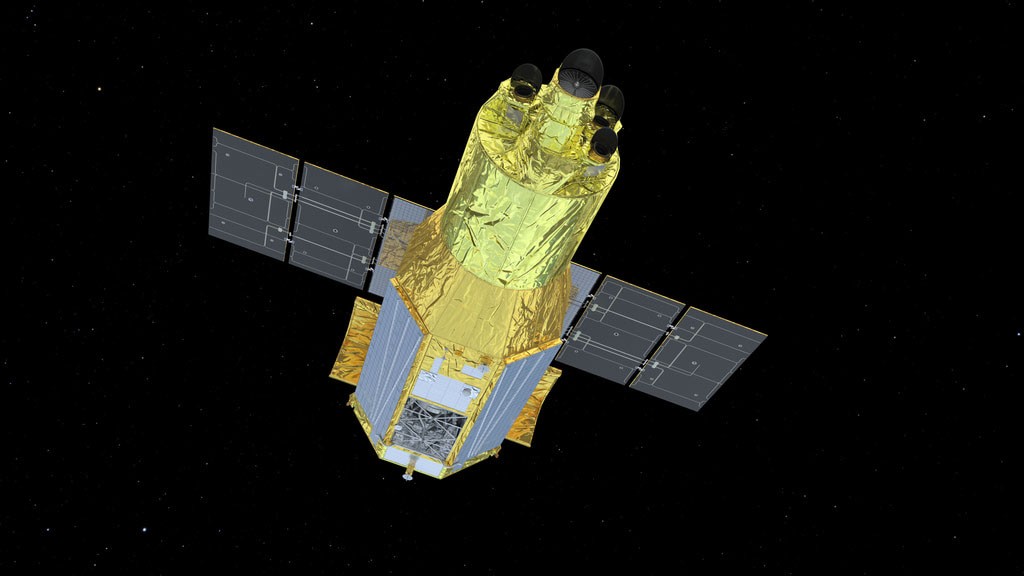
XRISM Directly Observes a Neutron Star Capturing Stellar Wind and Powering X-Ray Flares
Japan-led XRISM observations have revealed how a neutron-star pulsar captures the powerful stellar wind of a massive companion star, triggering intense X-ray flares. The discovery gives astronomers a detailed view of how dense plasma behaves near a compact object and helps test theories about wind-fed accretion.
Using data from the X-Ray Imaging and Spectroscopy Mission (XRISM), astronomers directly observed signs of stellar-wind plasma falling toward a neutron star. The research is part of NASA’s efforts to explore extreme space environments and better understand how the universe works.
“We have never seen clear signs of wind plasma falling onto compact objects,” said Roy Rahin, a researcher at the University of Maryland, Baltimore County (UMBC) and NASA’s Goddard Space Flight Center in Greenbelt, Maryland. “We can now test our understanding of these processes in more detail.”
The findings are described in a study published in the journal Science Advances.
BP Crucis: A Massive Star and a Neutron-Star Pulsar
The target system, BP Crucis, is a massive X-ray binary located approximately 13,000 light-years away in the southern constellation Crux. Its host star, known as Ray 977, is a blue supergiant with about 40 times the mass and 60 times the size of the Sun.
The star is so large, hot and luminous that ionized gas constantly flows away from its surface. This stream of material is known as a stellar wind.
NASA Goddard Space Flight Center/Conceptual Imagery Laboratory
The supergiant’s companion is a small but powerful neutron star called GX 301-2. The shattered core of a star that exploded as a supernova long ago, the neutron star contains more mass than the Sun in a sphere about 12 miles (20 kilometers) across.
GX 301-2 rotates once every 11 minutes and sends a beam of X-rays toward Earth, making it a pulsar.
How Stellar Wind Creates X-Ray Flares
The pulsar follows a 41.5-day orbit around its massive companion. Twice during each orbit, strong X-ray flares occur near the pulsar’s closest and farthest points from the supergiant, with each flare lasting several days.
Astronomers believe the pulsar’s gravity creates a particularly dense stream of plasma in the supergiant’s stellar wind. When the pulsar crosses this stream, it captures some of the material, triggering an X-ray flare. The strongest eruptions occur closer to the supergiant, where the stellar wind is denser.
XRISM Captures Plasma Falling Toward the Pulsar
XRISM observed the system on February 1, 2025, for approximately 16 hours near the end of one of its most powerful flares. The observatory’s Resolve instrument, jointly developed by NASA and the Japan Aerospace Exploration Agency (JAXA), recorded highly detailed X-ray spectra.
The spectra revealed rapidly changing emission and absorption lines. In particular, absorption lines from highly ionized iron showed the speed and direction of plasma relatively close to the pulsar.
NASA’s Goddard Space Flight Center
When Rahin examined the spectra, he realized that he had never seen observations like them before. He searched the scientific literature for similar measurements but found none.
“It was clear that these observations were groundbreaking, but at the same time, this meant that the analysis needed to be done in particular detail,” said Nazma Islam, a former UMBC and NASA co-author who is now an assistant professor at the Manipal Natural Science Center in India. “We were able to observe how dense streams of plasma interact very close to a neutron star.”
Iron Redshift Reveals the Plasma’s Speed
Rahin and his team found that the iron absorption lines had shifted to lower energies compared with laboratory measurements. This shift, known as redshift, indicates that the gas is moving away from the observer and toward the pulsar.
The amount of redshift reveals the plasma’s velocity. According to the researchers’ analysis, the gas is moving toward the pulsar at approximately 335,000 miles per hour (540,000 kilometers per hour).
A Turbulent Accretion Disk Collapses and Reforms
Researchers believe the process unfolds in several stages. When the pulsar enters the dense plasma stream, it stirs the gas into a thick, turbulent accretion disk. The material then spirals inward, heats up and emits X-rays, producing the flare.
As the pulsar moves deeper into the stream, the turbulent disk breaks apart. Astronomers suspect that when the pulsar moves directly into the flow, the plasma no longer has enough angular momentum to sustain the disk. The disk then collapses, allowing the plasma to fall directly onto the neutron star.
The XRISM observations were made near the end of this direct-accretion phase.
As the pulsar approaches the end of its passage through the stream, the messy accretion disk briefly returns. This time, it rotates in the opposite direction. The disk disappears again as the pulsar exits the flow. Altogether, the pulsar takes approximately four days to cross the plasma stream.
“The BP Crucis system is an ideal laboratory to study wind-driven pulsar accretion, and XRISM’s sensitive, high-resolution Resolve spectrometer is the ideal instrument to advance our understanding of the processes involved,” said Brian Williams, NASA Goddard mission project scientist.
More Information About XRISM
For more information about the XRISM mission, visit JAXA or NASA.
Source: science.nasa.gov