


For decades, scientists believed fossilization destroyed the original organic molecules found in bones, teeth, and other tissues. Proteins and other biological materials were not expected to survive for tens of millions of years. However, new research suggests that some dinosaur fossils may still contain traces of ancient organic material.
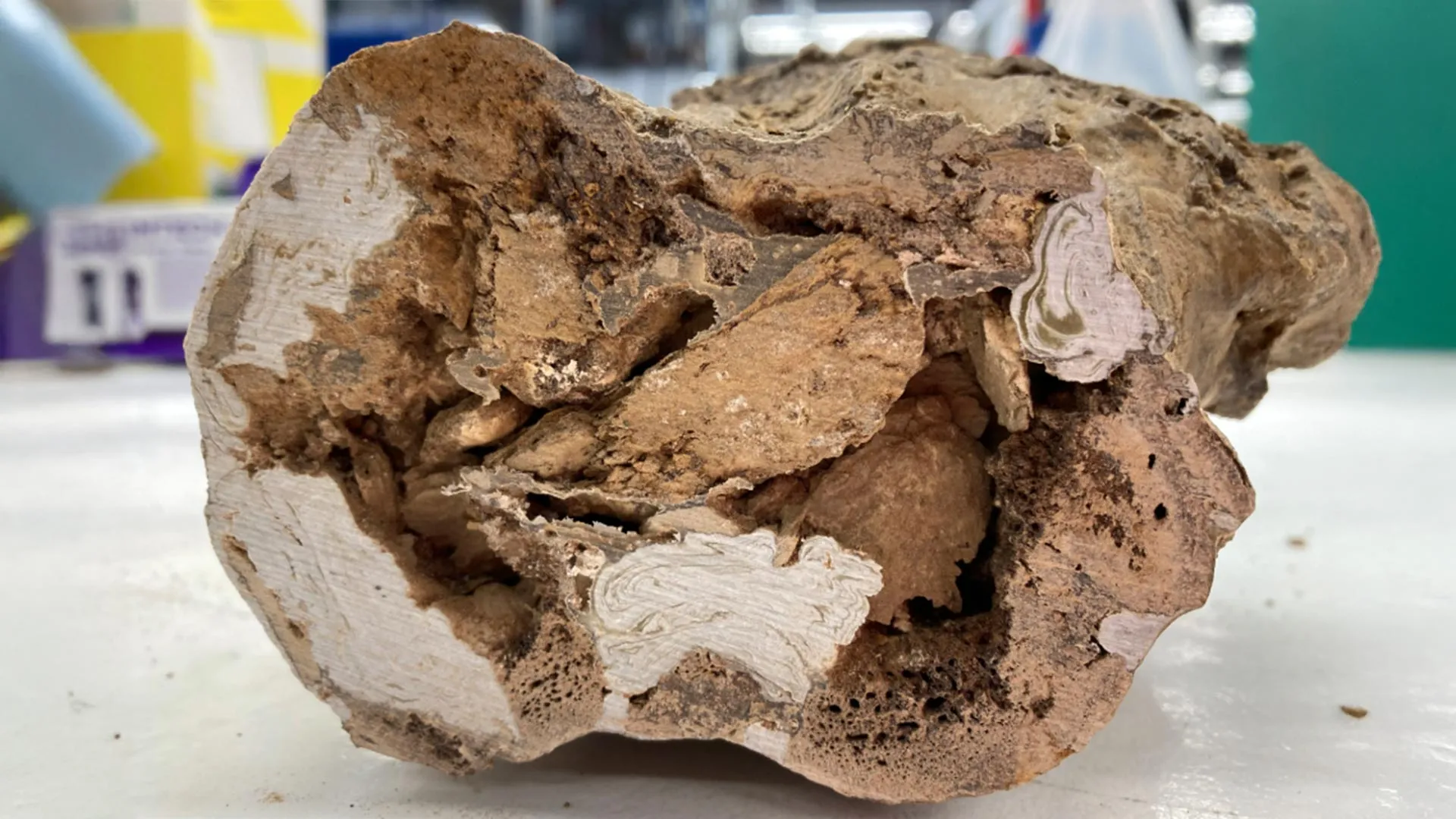
Research led by the University of Liverpool has provided strong evidence that Mesozoic fossils, including dinosaur bones and teeth, can preserve remnants of their original proteins. Using advanced analytical techniques, scientists detected collagen-related material in the sacrum of Edmontosaurus, a duck-billed dinosaur.
The discovery adds important evidence to a scientific debate that has continued for nearly 30 years: can original proteins survive inside dinosaur fossils, or are these molecules the result of later contamination?
Ancient collagen detected in dinosaur fossils
The study used analytical chemistry, protein sequencing, and mass spectrometry to examine a remarkably well-preserved Edmontosaurus sacrum. The fossil weighs approximately 22 kilograms. The sacrum is a series of connected vertebrae that joins the spine to the pelvis and forms part of the animal’s lower back.
The fossil was excavated from Upper Cretaceous rock in the Hell Creek Formation of South Dakota. This famous geological formation preserves fossils from near the end of the dinosaur era. The specimen is now part of the University of Liverpool’s collection.
Because of its unusually well-preserved condition, the fossil allowed researchers to apply several modern scientific techniques, including protein sequencing and mass spectrometry.
Mass spectrometry identifies molecules by measuring their mass and chemical properties. In this study, scientists searched for molecular signatures associated with collagen, the primary structural protein found in bone.
Evidence that fossil proteins can survive
Professor Steve Taylor, Chair of the Mass Spectrometry Research Group in the School of Electrical Engineering and Electronics at the University of Liverpool, said:
“This study shows that organic biomolecules, including collagen-like proteins, are likely present in some fossils.
“Our results have far-reaching implications. First, they challenge the hypothesis that organic matter detected in fossils must have come from contamination.
“Second, the findings suggest that cross-polarized microscopy images of fossil bones collected over the past century should be reconsidered. These images may reveal preserved sections of bone collagen and provide a valuable archive of fossil specimens for further protein analysis. Such research could offer new insights into dinosaurs, including previously unknown connections between different species.”
“Finally, this discovery raises an intriguing question about how these proteins were able to survive for so long inside fossilized bones.”
Contamination is one of the central issues in the debate over ancient fossil proteins. Critics have argued that organic material detected in fossils may have entered the specimens later through microorganisms, soil, handling, or other environmental sources. The new findings strengthen the case that at least some of the detected material is connected to the original fossilized bone.
Old fossil images could reveal new molecular clues
The discovery may give researchers a new way to identify fossils with potential for molecular analysis.
Cross-polarized light microscopy uses filtered light to reveal structures that are difficult to see with a standard microscope. Scientists have collected images of fossilized bones using this technique for approximately 100 years. If distinctive patterns linked to preserved collagen can be identified in these historical images, researchers may already have access to a large archive of fossils suitable for modern protein analysis.
This approach could help scientists investigate questions that traditional fossil anatomy cannot fully answer, including possible biological relationships between dinosaur species.
The research also raises a broader scientific mystery. Proteins are generally expected to break down over extremely long periods, so scientists must determine how collagen and its fragments can persist in fossils for tens of millions of years.
Multiple scientific methods support the findings
The project brought together experts from several institutions and scientific disciplines.
Researchers from UCLA used tandem mass spectrometry to detect and quantify hydroxyproline, an amino acid strongly associated with collagen in bone. Its presence provided additional chemical evidence that degraded collagen remained in the fossil.
Hydroxyproline is closely linked to collagen structure. Detecting this amino acid in fossilized bone offers an important molecular clue that collagen-derived material is present.
Scientists from the University of Liverpool’s Mass Spectrometry Research Group carried out protein sequencing and mass spectrometry analyses.
Experts from the university’s Materials Innovation Factory performed additional testing to help confirm the results.
The Center for Proteome Research at the University of Liverpool identified fragments of collagen alpha-1, the main type of collagen found in bone tissue.
Taken together, the findings provide compelling evidence that original biomolecules can persist in some extremely old fossils. The research also creates new opportunities to study extinct animals at the molecular level, potentially revealing biological information that scientists once believed had been lost during fossilization.
Source: www.sciencedaily.com