


Close Menu
HitechubHitechub
    What's Hot
    Technology

    The Race to Become Your Personal AI Agent Has Begun

    Science

    Ancient DNA Reveals the Rise of Germanic and Celtic Languages

    Technology

    DEA Banned a “Miracle Drug” That Helped Opioid Users Quit Smoking

    Important Pages:
    • About Us
    • Privacy Policy
    • Terms & Conditions
    Facebook X (Twitter) Instagram Pinterest
    Facebook X (Twitter) Instagram
    HitechubHitechub
    Friday, November 27
    • Shop
      • Fashion
        • Mens
        • Womens
        • Accessories
          • Handbags
          • Keychain
          • Masks
          • Money clicps
          • Neck Pillow
          • Rings
          • Towels
          • Wallets
        • Jewelry
        • Watches
        • T-shirts
        • Hawaiian shirts
        • Vests
        • Swim trunks
        • Swimsuits
      • Fun
        • Magic cubes
        • Magnifiers
        • Misc
        • Photo books
        • Puzzles
        • Toys
      • Home
        • Cleaning/Care
        • Mailbox covers
        • Mugs
        • Pot Holders
        • Spoon
      • Office and Electronics
        • Chairs
        • Office Supplies
        • IPad cases
        • Laptop stickers
        • Mouse pads
        • Notebooks
        • Pencil bags
        • Pens
        • Phone cases
      • Personalized
      • Pets
      • Sports
        • Cycling
          • Balaclava Mask
          • Bike Bell
          • Bike Computer
          • Bike Fender
          • Bike Grips
          • Bike Kickstand
          • Bike Light
          • Bike Locks
          • Bike Mitts
          • Bike Pumps
          • Bike Repair Stand
          • Bike Seat
          • Bike Trainer
          • Bike Wheels
          • BIKES
            • Folding Bikes
            • Road Bikes
          • Carbon Fiber Bike Products
          • Cycling Mask
          • Kid’ Bike Helmets
          • Inner Tube
          • Motorcycle Bag
          • Nylon Pedals
          • Adult Helmets
          • Photochromic Sunglasses
          • Soft Coolers
          • Suction Cup Bike Rack
          • Tool accessories
          • Winter Cloth
          • Heart Rate Monitor
        • Outdoors/Camping
          • Outdoor Bags
        • Sweatband
    • Technology
      1. AI
      2. Gadgets
      3. View All

      This is the most popular CEO in the world

      Sectors in which “Chat-GPT” is most often used

      Artificial intelligence has begun to “swallow” professions

      The unusual robot conductor of a concert in Seoul

      Here’s how you can tell if your phone is being tapped

      PlayStation 5 becomes a completely silent console and gets more space

      This is the first phone that can be used to park a car

      Best Gaming Laptops 2023: Powerful Portables for PC Games

      Lead Azide Explosion in Iowa Raises Concerns About Potential Health Risks

      SYS010 Malware Exploits Browser Management Systems to Spy on Gmail and Outlook Accounts

      Fake Paid Expert Interviews Impersonate Brands and Steal Google Login Credentials

      Huawei Found Guilty and Faces Heavy Fines for Stealing Trade Secrets from T-Mobile and Cisco

    • Science
      1. Space
      2. Wheels
      3. View All

      Space Perspective: A Journey to the Edge of Space

      5 Fascinating Facts About Space

      Space Exploration: Unveiling the Wonders of the Universe

      Toyota wants to make a new generation battery with a range of up to 1,200 km

      Meet Toyota’s lunar “baby” that could make exploring the Moon easier

      What does a night drive look like with one of the most beautiful cars in the world: the Rolls-Royce Ghost

      Why Certainty Can Be a Failure in Science

      Chromosomal Glue May Improve Fertility by Stabilizing Aging Eggs

      Thanksgiving Storm Brings Flooding and Flight Delays Across the U.S.

      Iowans Face Thanksgiving Horror After Chemical Plant Explosion

    HitechubHitechub
    Home » US and Indian Satellites Capture Time-Lapse Video of Volcanic Eruption
    Science

    US and Indian Satellites Capture Time-Lapse Video of Volcanic Eruption

    Share Facebook Twitter Pinterest WhatsApp
    Share
    Facebook Twitter LinkedIn Pinterest WhatsApp

    NASA-ISRO Satellite Tracks Lava Erupting From Russia’s Krasheninnikov Volcano

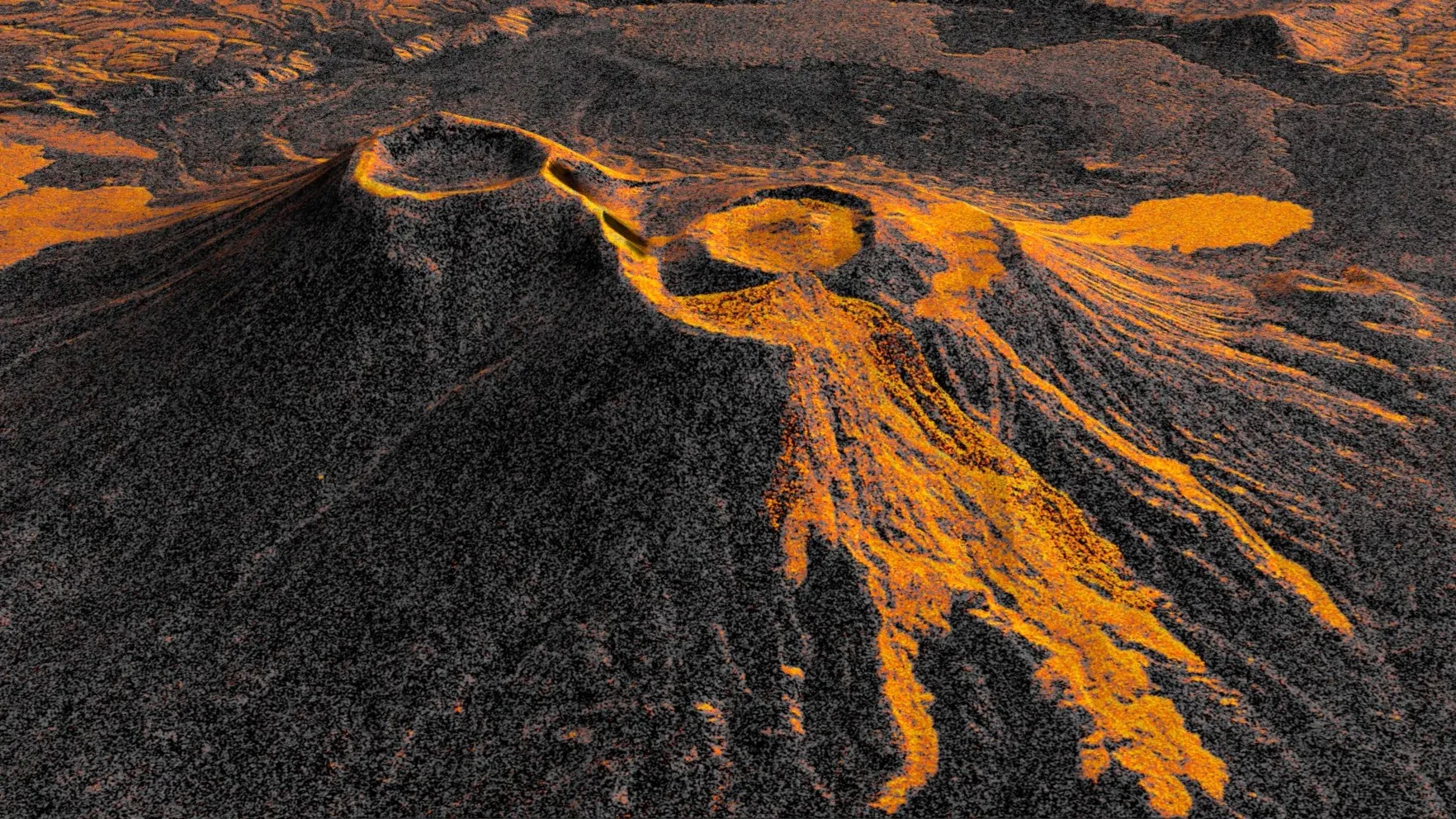
    This animation uses NISAR data collected from December 2025 through August 2026 to show lava spreading from the northern craters of Krasheninnikov, a pair of volcanoes on Russia’s Kamchatka Peninsula. The lava field in the foreground appears brighter than the surrounding surface. Credit: NASA’s Scientific Visualization Studio

    Lava is spreading from the northern craters of Krasheninnikov, a pair of volcanoes on the Pacific coast of Russia’s Kamchatka Peninsula. NASA and the Indian Space Research Organisation’s (ISRO) NISAR satellite is tracking the eruption and mapping changes in the volcano’s topography from orbit.

    On July 30, 2025, a magnitude 8.8 earthquake struck the nearby ocean. The powerful earthquake shook one of the two volcanoes, which appeared to awaken. A few days later, Krasheninnikov erupted for the first time in almost five centuries.

    Since then, the northern volcano has produced a steady eastward flow of lava and debris. From a vantage point 464 miles (747 kilometers) above Earth’s surface, NISAR captured an image of Krasheninnikov on December 25, 2025, just as the satellite was about to begin operations after completing its post-launch inspection.

    Since that first observation, NISAR has returned to the same location twice every 12 days—once while traveling from south to north and once while traveling from north to south—to collect detailed radar images.

    NISAR Time-Lapse Shows Lava Spreading Across the Volcano

    Researchers stitched together 17 consecutive frames collected through mid-August 2026 to create a time-lapse of the eruption. The animation shows lava filling the interior of a small caldera, fanning outward, and then spilling into a wider crater.

    The sequence demonstrates how NISAR observations can track natural disasters over time, supporting scientific research and potentially helping with emergency response.

    Many of Kamchatka’s dozens of volcanoes are remote but erupt often enough to be monitored by ground instruments. Krasheninnikov had not been closely monitored in the same way and had remained silent since about 1550.

    NISAR’s L-band radar detected the eruption while providing near-global coverage of Earth’s surface at a resolution of a few tens of feet. Following an erupting volcano over time highlights the accuracy and reliability of the satellite’s measurements.

    “Consistency is key. This high-resolution mode and two acquisitions in two viewing directions, twice every 12 days, demonstrate NISAR’s commitment to closely monitoring natural hazards,” said Cornell University geophysicist Matthew Pritchard, a member of the NISAR science team who analyzed the data used to create the animation.

    How NISAR Radar Images Earth’s Surface

    The detailed images produced by NISAR use synthetic aperture radar (SAR), a specialized processing technique developed by NASA’s Jet Propulsion Laboratory in Southern California to observe Earth from space.

    As NISAR orbits Earth, its radar sends thousands of microwave pulses toward the ground every second and receives the returning signals. Each signal acts as a snapshot containing information about the properties and features of the surface below.

    SAR processing combines multiple images of the same area to sharpen the field of view, similar to how a lens brings a blurry object into focus. Each pixel in the Krasheninnikov time-lapse represents an area of approximately 10 meters by 10 meters (30 feet by 30 feet), about half the size of a tennis court.

    The lava appears bright because it reflects the microwave signals more strongly than the surrounding surface, which may be snow or bare ground depending on the season. In addition to the expanding lava field moving eastward, the video shows another flow to the northwest that likely formed before NISAR captured its first image.

    Satellite Monitoring Is Transforming Volcano Research

    When Pritchard conducted his doctoral research on Kamchatka more than 20 years ago, radar data was difficult to obtain and analyze. Satellites revisited locations infrequently, and the available images had relatively low resolution.

    Today, researchers have frequent and comprehensive coverage of nearly all of Earth’s approximately 1,300 active volcanoes above sea level. Satellite images are clear down to a scale of several meters and are readily accessible through the cloud.

    “We’re starting to see volcanoes all over the world that we’ve never looked at like this before,” Pritchard said.

    NISAR’s Dual-Radar Technology

    NISAR is the first free-flying space mission to carry two radar instruments: an L-band system and an S-band system. The instruments complement each other because they operate at different wavelengths.

    For example, the longer-wavelength L-band radar can pass through tree canopies to image the ground below. Depending on leaf size, the S-band radar can collect observations of the forest canopy.

    NISAR is also the first satellite to carry two SAR instruments at different wavelengths. Its giant drum-shaped reflector measures 39 feet (12 meters) across, making it the largest radar antenna reflector ever sent into space by NASA.

    Accessing NISAR Data

    Data products from NISAR’s L-band radar are available through the Alaska Satellite Facility Distributed Active Archive Center in Fairbanks. The center hosts and distributes NASA’s synthetic aperture radar data.

    JPL, managed by the California Institute of Technology for NASA, led the U.S. component of the project and provided the satellite’s L-band SAR and antenna reflector. ISRO provided the spacecraft bus and its S-band SAR.

    For more information about NISAR, please see below.

    Media contact

    Andrew Wang / Andrew Good
    Jet Propulsion Laboratory, Pasadena, California
    626-379-6874 / 818-393-2433
    [email protected] / [email protected]

    2026-064

    Source: www.nasa.gov

    Share. Facebook Twitter Pinterest LinkedIn WhatsApp
    Previous ArticleDownload: How AI Can Break Down Virtual Walls and Advance Climate Action at Climate Week
    Next Article Google Gemini Now Lets You Make Calls on Pixel Phones

    Related Posts

    Science

    Why Certainty Can Be a Failure in Science

    Science

    Chromosomal Glue May Improve Fertility by Stabilizing Aging Eggs

    Science

    Thanksgiving Storm Brings Flooding and Flight Delays Across the U.S.

    Science

    Iowans Face Thanksgiving Horror After Chemical Plant Explosion

    Science

    NASA Hubble Observes a Sea of Stars During Roman Space Telescope Construction

    Science

    Live Science Readers Reveal the Archaeological Discoveries They Want to Find, Including Attila’s Tomb

    Science

    Alpha-Gal Syndrome: Why Tick-Bite Red Meat Allergy Is Puzzling Scientists

    Science

    How to Overcome Sadness in Academia and Find Balance

    Add A Comment
    Leave A Reply Cancel Reply

    Stay In Touch
    • Facebook
    • Twitter
    • Instagram
    • Pinterest
    Top Picks
    Technology

    What will you do if the world remains without internet?

    It’s an interesting question what would happen if the internet disappeared, that is, if the whole world lost its connection to the network for some reason.

    Fake Paid Expert Interviews Impersonate Brands and Steal Google Login Credentials

    Transforming Polystyrene with Sunlight and Sulfur: Innovative Upcycling Techniques – Sciworthy

    Popular Brain Supplement Linked to Shorter Lifespan in Men, Study Finds

    Pubs in England and Wales to Accept Digital ID Apps for Age Verification

    Most Popular
    Technology

    Manchester Airport Group Hack Exposes Data of 8.7 Million People

    Technology

    Google Workspace Security Controls That Matter Most: Webinar

    Categories
    • AI (9)
    • Gadgets (6)
    • Science (3,607)
    • Space (3)
    • Technology (3,038)
    • Wheels (3)
    Our Picks
    Science

    Scientists Discover Why Some Frogs Resist Deadly Fungi: Key Insights Unveiled

    Science

    Breakthrough Cancer Strategy: Preventing Tumor Resistance Before It Develops

    © 2026 Hitechub.
    • Home
    • About Us
    • Privacy Policy
    • Terms & Conditions

    Type above and press Enter to search. Press Esc to cancel.

    GDPR Cookie Banner

    We are using cookies to give you the best experience on our website.

    You can find out more about which cookies we are using or switch them off in .

    Ad Blocker Enabled!
    Ad Blocker Enabled!
    Our website is made possible by displaying online advertisements to our visitors. Please support us by disabling your Ad Blocker.