


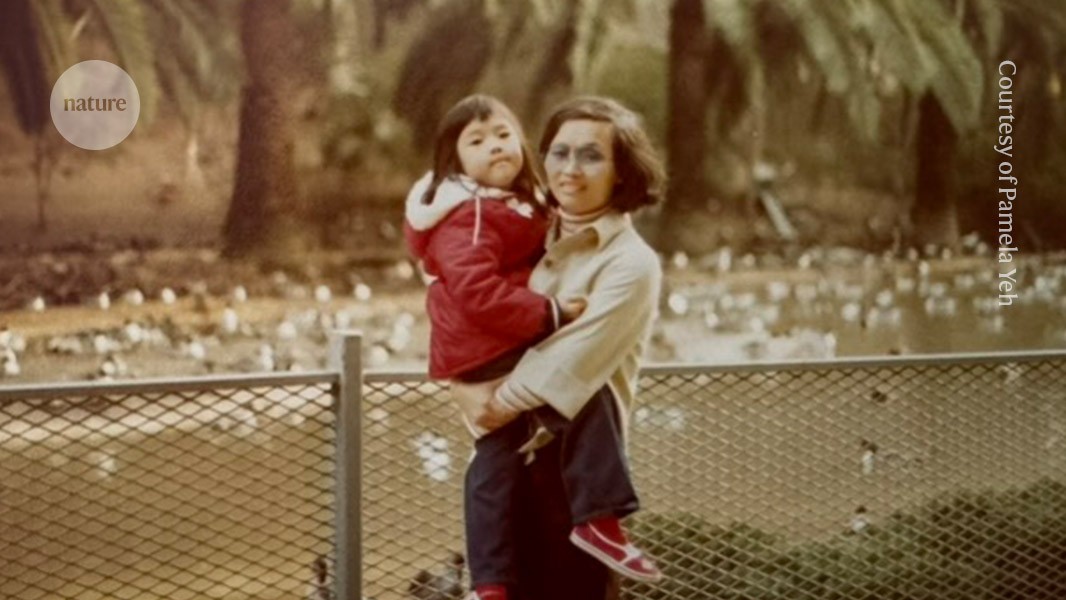
After losing her mother, evolutionary biologist Pamela Yeh reflects on grieving while working in academia. Drawing on her experience at the University of California, Los Angeles, she describes the practical steps that helped her cope with shock, brain fog and reduced capacity, including learning about institutional support, asking colleagues for help and accepting that research, teaching and mentoring may temporarily fall below normal standards.
Sadness is universal, but each person’s grief can feel unique. Although I had worked in academia for decades, I had heard little about grief when my mother died last year. I wanted to share some of the advice that helped me through the early stages of mourning.
My mother grew up in extreme poverty in Taiwan and worked tirelessly throughout her life to create more opportunities for me and my siblings. She was the first person in her family to attend university and immigrated to Canada at the age of 23 to work as a nurse. After several years of Canadian winters, she moved to sunny California, where she met my father. A few years later, she gave birth to my sister, then me, then my brother.
She raised us while working several jobs as a nurse and supported all three of us throughout our lives. That did not mean she fully understood my background. She once described my work as an evolutionary biologist specializing in birds and bacteria at the University of California, Los Angeles, as “counting birds”.
Although she loved adventure, family and work commitments left her little time to travel. After she retired, I took her on fieldwork and conference trips whenever possible, including to China, the Netherlands, Italy, Mexico, Japan and locations across the United States.
When her grandchildren were born, she helped them read, write, do mathematics and learn to speak Chinese. Late in her life, I had a small house built for her in my backyard in Los Angeles so that she could remain close to me. When someone very close to you dies, your world never returns to what it was.

When a loved one dies: how can academia support the bereaved?
In the weeks and months after her death, I found myself in a fog of shock and grief. I felt compelled to keep moving, whether by running, walking the dog or cleaning the house. At times, I lacked confidence in my ability to do the abstract and conceptual thinking that academic work often requires.
I turned to Trevor Price, my former doctoral adviser at the University of California, San Diego, who is now at the University of Chicago in Illinois. After I explained my brain fog and profound sadness, he reviewed my papers to ensure that I had not overlooked important scientific arguments. More than 20 years had passed since I graduated, but he helped me without hesitation.
People cannot know that you need help unless you reach out. The sooner you do so, the more time and energy you can devote to yourself, and the easier it becomes for others to help. These are the strategies that helped me navigate academia while grieving.
Find out what support your institution offers
Ideally, learn what support is available before you need it. Institutions often provide resources and benefits for people experiencing grief, including bereavement leave, leave to care for a family member, counselling and time away from classes.
Before my mother died, I did not know that I could take paid leave to care for her when she was ill. She suffered a debilitating stroke five months before her death. Read your labour contract carefully and ask questions about the support your employer provides.
Talk to colleagues and plan for the worst-case scenario
Family illnesses can happen suddenly, or one illness can lead to another. Speak with your department chair or colleagues as soon as possible about taking part in a course or committee. Think creatively about whether colleagues, former advisers, former students or postdocs could step in to give conference talks, deliver guest lectures or handle other activities that require assistance.

I learned this the hard way. I did not contact people early enough because I was unrealistically optimistic about my mother’s health. While waiting for her to recover, I became panicked and helpless at the thought of losing her. At times, I struggled to concentrate and could barely manage simple tasks such as replying to emails or booking meetings.
I told myself that I would catch up with her once she felt better. When she died, I had made no practical plans.
Do not expect perfection from yourself
Accept that grief may affect your research productivity, mentoring and teaching. Ask someone to help advise your students, and rely on colleagues and former students. You might need to meet with students less often, hold fewer lab meetings, collaborate less frequently or offer advice by email or video call. In some cases, you might not be able to provide detailed comments on a student’s work.
I did all of these things during the first weeks and months of grief. I found it particularly difficult to advise graduate students conducting fieldwork. Ellie Diamant, a former doctoral student of mine who is now a biologist at Bard College in Annandale-on-Hudson, New York, generously stepped in to meet many of my students.
It took me time to understand and accept that I could not meet the usual standards I set for myself while going through such a difficult period.
Cancel non-urgent appointments
Source: www.nature.com