


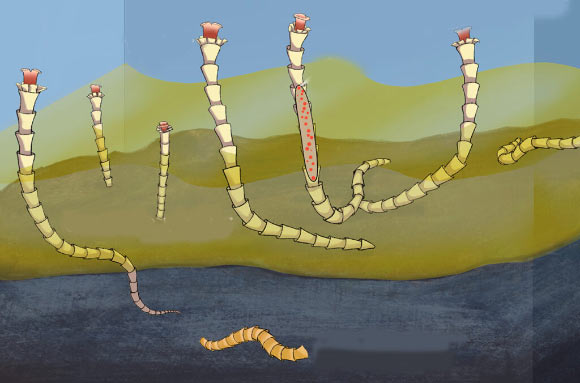
540-Million-Year-Old Tubular Animal May Have Partnered With Sulfur-Eating Bacteria
A tubular marine creature that lived on the ocean floor more than 540 million years ago may have relied on sulfur-oxidizing bacteria to survive in waters containing toxic sulfide.
An Ediacaran Animal With an Uncertain Family Tree
Conotubus hemiannulatus lived during the final part of the Ediacaran Period, shortly before the Cambrian explosion, when animal life diversified rapidly.
“The phylogenetic affinity of Conotubus hemiannulatus remains uncertain,” said Dr. Yongbo Peng of Nanjing University, Dr. Shuhai Xiao of Virginia Tech, and their colleagues.
Because of its funnel-within-funnel tubular morphology, the species has been assigned to the family Cloudinidae or to the informal cloudinid group. Cloudinids were tubular fossils that lived in oceans around the world.
The fossils were discovered in the Dengying Formation in Shaanxi Province, southern China. They were preserved as pyrite, sometimes called fool’s gold, which formed soon after the organisms were buried.
The specimens range from 3 to 80 mm in length. Their openings measure 0.3 to 12 mm in diameter, while the tips measure 0.1 to 4 mm in diameter, according to the researchers.
Some specimens have transverse annular structures or open margins, features that may reflect periodic growth or changes during fossilization.
Molybdenum Isotopes Reveal a Sulfur-Rich Habitat
For the new study, the researchers analyzed molybdenum isotopes preserved in the fossils.
Compared with contemporary Ediacaran seawater, the fossils were significantly depleted in molybdenum-98, by more than 4.6 parts per thousand.
Similarly low values are known from modern tubeworms living at deep-sea cold seeps, where sulfur-oxidizing bacteria inhabit their tissues.
The fossil sulfur signatures suggest that Conotubus hemiannulatus lived in an environment where oxygen and sulfide overlapped. The evidence also indicates that bacteria were actively processing sulfur in that habitat.
Could Bacteria Have Fed the Ancient Animal?
The scientists concluded that the Ediacaran animal may have participated in a form of chemical symbiosis. In this type of partnership, microbes convert chemicals such as hydrogen sulfide into energy or nutrients that can support their animal hosts.
The researchers describe the finding as the oldest geochemically supported example of this kind of relationship in the fossil record.
Such a partnership may also have helped Conotubus hemiannulatus cope with sulfide, a chemical that is toxic to most animals.
“Today’s environment is full of organisms that form partnerships like this,” said co-author Professor David Fike, a researcher at Washington University in St. Louis.
“Before, we didn’t know whether it was a relatively recent evolutionary event or whether it appeared much further back when animals first evolved.”
The study, “Chemo-symbiotic nutritional strategies in Ediacaran tubules,” appears in Proceedings of the National Academy of Sciences.
_____
Wang Zhenfei et al. 2026. Chemo-symbiotic nutritional strategies in Ediacaran tubules. PNAS 123 (35): e2526201123. doi: 10.1073/pnas.2526201123
Source: www.sci.news