


JWST Reveals How Planet-Forming Disks Lose Their Gas
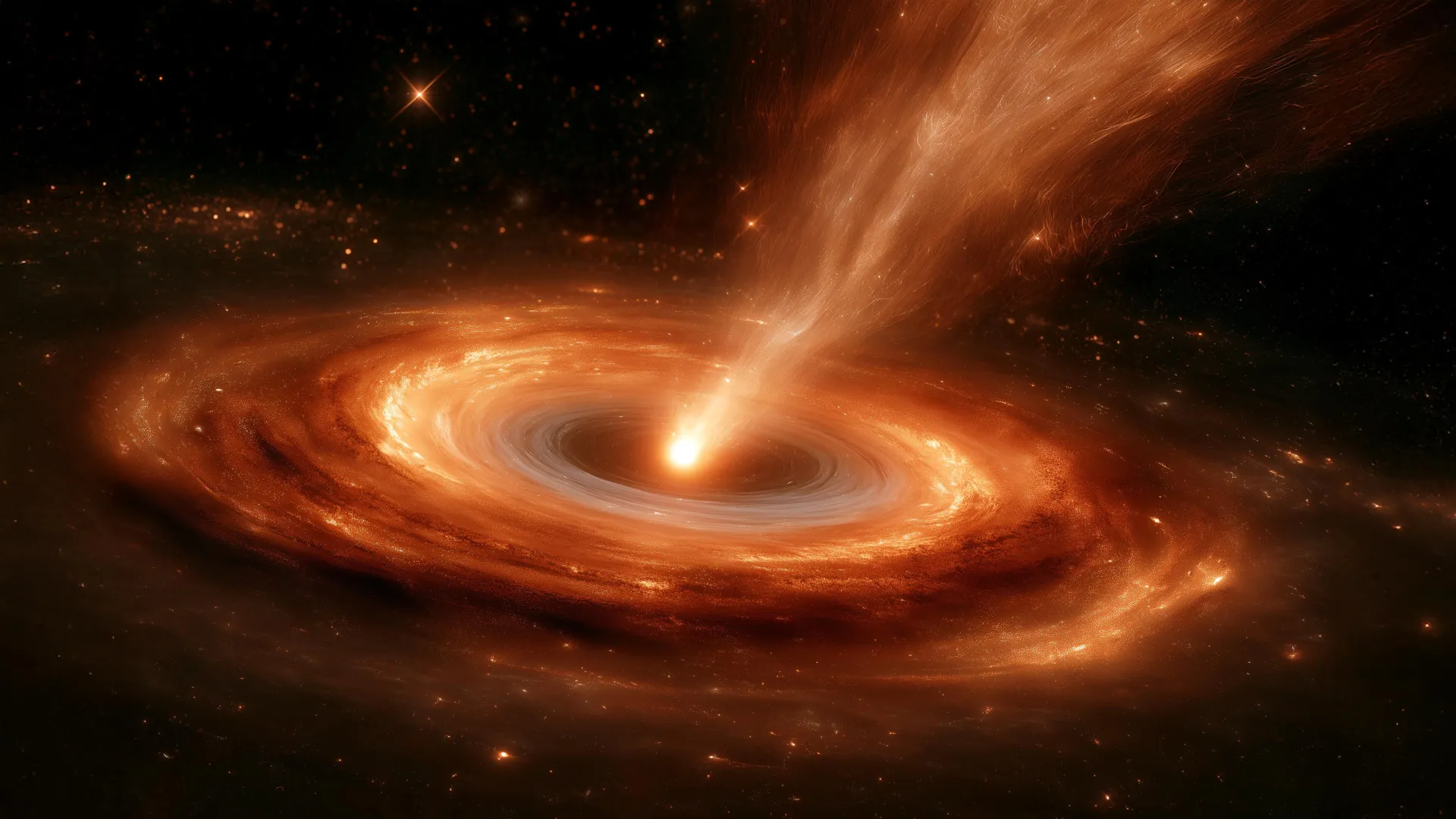
Planets form in disks of gas and dust surrounding young stars, but the gas supply they depend on is temporary. New observations from NASA’s James Webb Space Telescope (JWST) are giving astronomers a clearer picture of how that gas escapes—and how the main gas-loss mechanisms change as planetary systems mature.
Planet formation has a deadline
The study, led by Naman Bajaj of the University of Arizona and co-authored by Uma Golti, a scientist at the SETI Institute, examined 72 young Sun-like stars and their protoplanetary disks. It is one of the largest JWST studies of planet formation and suggests that different types of winds dominate at different stages of a system’s early development.
The survey results appear in The Astronomical Journal.
“What’s interesting about this study is that across a large sample of young star systems, we can see how the mechanisms that remove gas from the planet-forming disk change over time. The dispersion of the disk sets the fundamental clock for planet formation. Once the gas runs out, the opportunity to build gas-rich planets essentially ends,” Gorti said.
Our solar system is now about 4.5 billion years old and consists mostly of empty space. During the first few million years of its history, however, the young Sun was surrounded by a dense protoplanetary disk containing about 100 times more gas than dust. Eventually, almost all of that gas disappeared.
Gas is essential for forming giant planets such as Jupiter and Saturn, making it important to understand how and when this material is lost. If a disk loses gas too quickly, a developing planet may not have enough time to accumulate the massive atmosphere needed to become a gas giant.
JWST tracks gas escaping from young planetary systems
Bajaj and his colleagues investigated this process using archival observations from JWST’s Mid-Infrared Instrument (MIRI). The 72 systems represent various stages of planetary development. Together, they provide a series of snapshots that allow researchers to reconstruct how gas distributions change as planetary systems age.
In 2020, LPL professor Ilaria Pascucci, the paper’s second author and Bajaj’s advisor, led a related study examining how jets and winds evolve. Before JWST, researchers could not directly observe molecular hydrogen. The team predicted that a molecular wind must exist and could initially be dense enough to block X-ray photons. Bajaj’s team confirmed those predictions in JWST images by directly tracking hydrogen molecules.
The researchers focused on two indicators of material outflow: molecular hydrogen, the most abundant molecule in protoplanetary disks, and ionized neon. JWST’s sensitivity and resolution allowed the team to distinguish between broad winds containing molecular hydrogen and the jets and winds traced by neon.
In the youngest systems, where material is still falling onto the central star, researchers detected powerful jets and widespread winds containing both molecular and atomic gas. These outflows are consistent with winds generated by magnetic fields penetrating the disk. Gas follows the magnetic field lines outward, removing both matter and angular momentum from the disk.
Stellar radiation becomes more important as disks age
As a planetary system matures and the flow of material to its star decreases, the jets become weaker and the escaping gas becomes increasingly atomic. At this stage, high-energy radiation from the young star can penetrate the thinned material and heat it until gas escapes from the disk. This process is known as photoevaporation.
Golti has spent decades studying the evolution and dispersal of protoplanetary disks, including the role of ultraviolet and X-ray radiation from young stars in driving photoevaporative winds. The latest JWST observations provide an observational link to theoretical studies across dozens of systems. They show that photoevaporation becomes more important as disks age and magnetically driven jets and winds weaken.
The findings suggest that no single mechanism is responsible for removing planet-forming disks. Instead, young systems appear to begin with powerful magnetically driven jets and winds before transitioning to a later stage in which atomic winds, including photoevaporative winds, become increasingly important.
That transition could have major implications for developing planets.
“Planet formation is therefore a race against time,” Bajaj said. “Gas giants like Jupiter have to build up huge atmospheres while their disks are still large enough to supply the gas before winds and jets carry the raw materials away into space.”
Study finds molecular winds and neon jets across dozens of disks
The researchers detected widespread emissions from molecular hydrogen and ionized neon in 66 of the 72 disks. Cone-shaped molecular hydrogen winds appeared in 46 systems, while fast-moving neon jets were found in 40 systems. Every system containing neon jets also showed evidence of winds traced by molecular hydrogen or oxygen.
A broader view of how planetary systems evolve
This study expands on earlier observations by the same research group. In 2024, Bajaj, Gorti, and their colleagues used JWST to image gas being carried away from a planet-forming disk surrounding the young star T Cha.
That initial work demonstrated that JWST can directly investigate disk dispersal in individual planetary systems. The new study extends this approach to dozens of young stars and reveals how the balance of jets, molecular winds, and atomic winds changes as planetary systems age.
Researchers now hope to determine exactly how much gas these winds remove over time and where in the disk the ejected material originates. These measurements could reveal not only how quickly the planet-forming window closes, but also which regions of a disk can produce different types of planets before its gas supply runs out.
Source: www.sciencedaily.com