


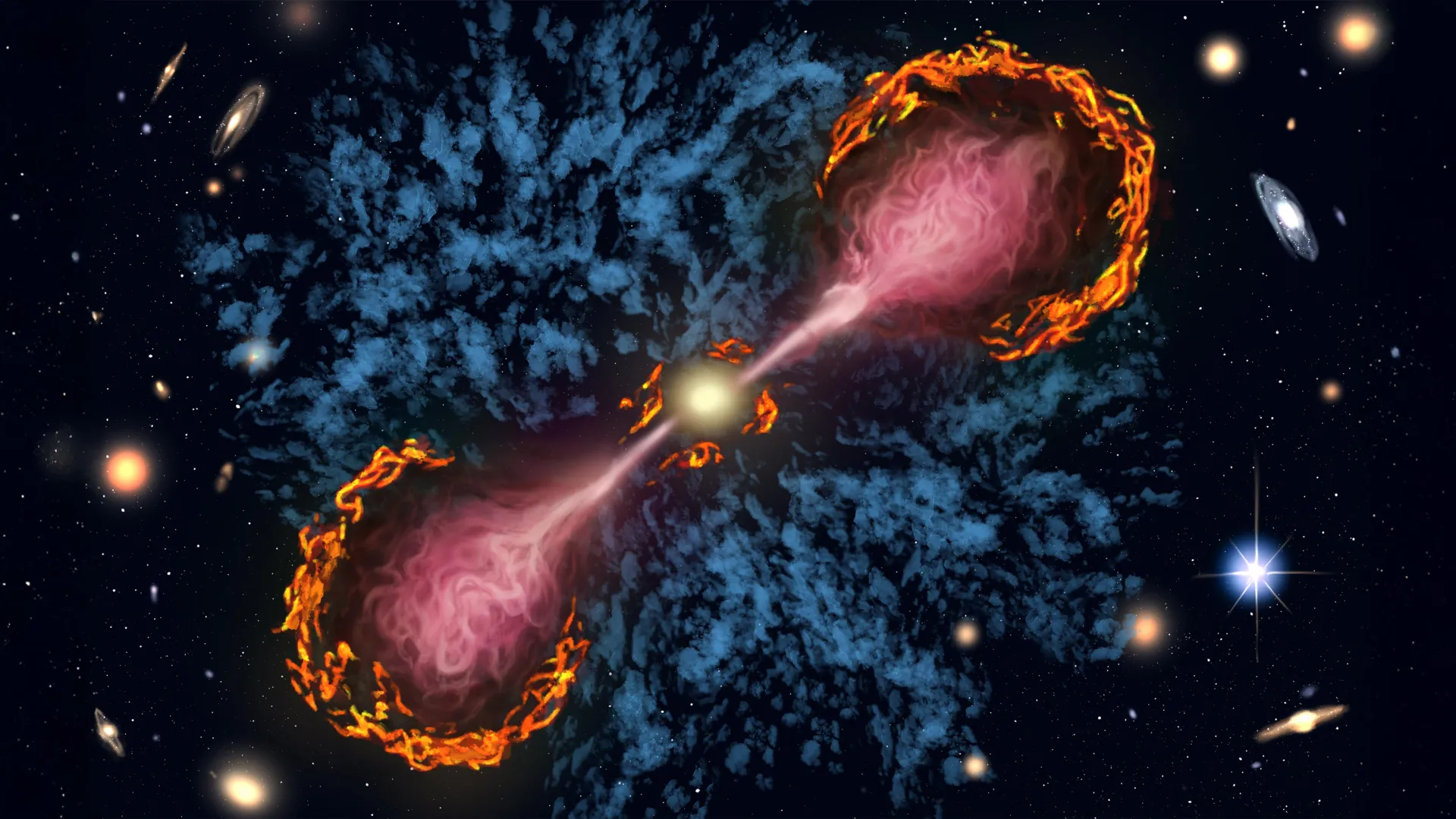
Black Hole Jets May Suppress Star Formation Across Entire Galaxies
Galaxies can contain hundreds of billions of stars, all of which begin as cold, dense gas. Large galaxies such as the Milky Way are surrounded by a vast reservoir of this material called the circumgalactic medium (CGM).
The CGM extends roughly 10 to 20 times farther than the visible part of a galaxy. Over time, some of its gas cools and flows inward, collecting in dense clouds that may eventually form new stars. Because stars create the conditions needed for planets and life, the CGM plays an important role in the long-term evolution of galaxies.
But astronomers face a longstanding mystery: If galaxies are surrounded by so much potential star-forming material, why do they not produce more stars? Something appears to prevent most of the gas from cooling and falling into the galaxy.
Black hole jets may be the missing piece
A new study led by Arizona State University astronomer Sanchayeeta Borthakur and Namrata Roy, now at the Raman Research Institute, provides evidence for one possible explanation.
The researchers found that narrow jets of extremely hot plasma launched by supermassive black holes at the centers of galaxies can affect gas far beyond the visible galaxy. These jets disturb the reservoir of material that galaxies rely on for future growth, potentially influencing whether they continue forming stars.
The findings were published in Astrophysical Journal Letters.
How can a small black hole affect an entire galaxy?
When a black hole actively consumes gas, it can release enormous amounts of energy and heat nearby matter. Despite their extraordinary power, supermassive black holes are small compared with the galaxies that surround them. A supermassive black hole may be roughly the size of our solar system, while its host galaxy can contain about 100 billion solar systems.
“The surprising question is how something so small can energetically affect something so huge,” said Roy, an assistant professor at the Raman Research Institute and a former ASU Exploration Award postdoctoral fellow.
Astronomers have long known that active black holes emit vast amounts of energy. However, exactly how that energy travels across the surrounding gas and changes the environment over such great distances has remained unclear.
Researchers searched for glowing hydrogen along black hole jets
The team studied active black holes that produce powerful jets. These narrow streams of hot, fast-moving plasma can extend far beyond the visible boundaries of their host galaxies.
Researchers looked for evidence that the jets were changing the ionization state of gas in the surrounding CGM. In particular, they searched for the faint glow produced by ionized hydrogen, known as H-alpha emission.
The signal was too weak to detect clearly around a single galaxy. To overcome that limitation, the researchers combined observations from hundreds of galaxies with active jets. They used data from the Dark Energy Spectroscopic Instrument (DESI) survey and radio-jet measurements from the LOFAR Two-Metre Sky Survey (LoTSS).
By combining measurements along the jets’ axes, the team searched for H-alpha, a characteristic signature of ionized hydrogen gas.
When the researchers averaged observations from all directions around the galaxies, the signal remained weak. Along the radio jets, however, the H-alpha signal became much stronger and easier to detect.
This pattern shows that the gas does not glow evenly in every direction. Instead, the strongest emissions appear along the paths of the jets. Rather than acting like a lamp that illuminates everything around it, a black hole jet behaves more like a focused beam that lights up the gas along its route.
Black hole jets leave distinctive signatures in the CGM
The results indicate that black hole jets have a highly directional influence on the gas surrounding galaxies. When a radio jet passes through the CGM, it ionizes the gas, causing it to emit light.
The researchers also identified two regions where the ionized-hydrogen glow was especially bright. One lies relatively close to the galaxy, where the jet first encounters the CGM. The other appears much farther away, near the outer edge of the CGM, where the jet seems to deposit much of its energy.
Together, these observations show how jets can alter and irradiate gas thousands of light-years from a galaxy’s center. By changing the surrounding environment, black hole jets may influence how galaxies grow and evolve, including whether they continue forming stars or become relatively inactive.
“What I’m most excited about is the scale of the connections,” Roy said. “Although black holes are incredibly small compared to galaxies, their impact can extend hundreds of thousands of light-years to the outer edges of galaxies. The jets carry energy outward, causing gas to glow along their path.”
As an additional check, the research team examined cold-gas tracers based on the absorption properties of magnesium. Unlike the directional H-alpha emission, magnesium was distributed more uniformly and showed no clear correlation with the direction of the jet.
This suggests that the warm gas component may already exist as a reservoir surrounding the galaxy on all sides. The jet then brightens, heats, and ionizes the gas along its own path, illuminating its trajectory.
How black hole jets could slow galaxy growth
The results provide some of the clearest evidence that supermassive black holes can influence galaxies far beyond their central regions.
By heating and stirring the gas in the CGM, black hole jets can make it more difficult for that material to cool and fall toward the galaxy. Without a steady supply of cold gas, galaxies have less fuel available to form new stars.
In this way, a black hole jet can act as a brake on galaxy growth. Over time, jets may help push a galaxy toward a quieter state with much lower levels of star formation.
Supermassive black holes therefore do more than consume matter near galactic centers. Their effects can spread through the surrounding environment and influence the long-term fate of their host galaxies.
Why direction was the key to the discovery
Previous studies searched for similar signals but did not detect them. The new research suggests that the directional nature of black hole jets may explain why.
H-alpha signatures are most visible when astronomers examine the gas specifically along the direction of the jet. The effect could have remained hidden if researchers had assumed that the CGM behaved identically in every direction.
Instead, the observations show that jets ionize hydrogen along their paths, producing a highly directional H-alpha glow.
The study also demonstrates the power of combining large optical and radio surveys, including DESI and LoTSS. By adding together many individually weak signals, astronomers can reveal patterns that would otherwise be impossible to observe.
The discovery gives astronomers and theorists another way to test how black hole jets interact with galaxies and influence their evolution.
Co-authors include Timothy Heckman of Johns Hopkins University and Tanmay Singh of Arizona State University.
This research is supported by NASA, STScI, and NSF.
Source: www.sciencedaily.com