


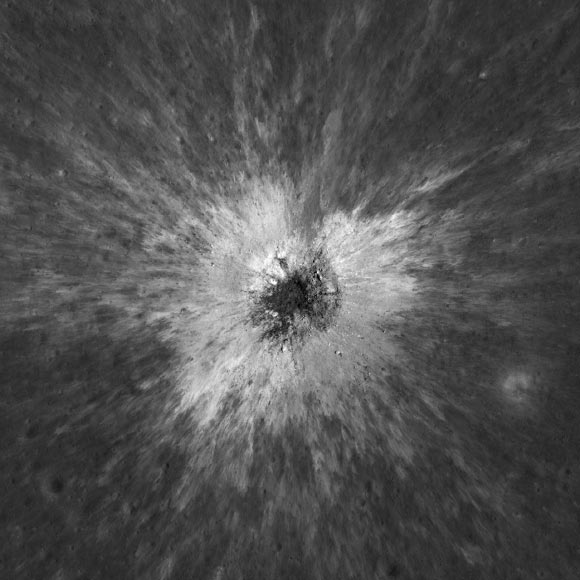
McGechin: The Largest Newly Formed Impact Crater Discovered in the Solar System
Scientists have discovered the largest newly formed impact crater ever identified in the solar system using images from the Lunar Reconnaissance Orbiter (LRO). The crater, named McGechin, appeared on the eastern edge of the Moon in 2024.
This close-up of McGechin Crater was captured by the Narrow Angle Camera aboard NASA’s Lunar Reconnaissance Orbiter on December 5, 2025. Image credit: NASA Goddard / Intuitive Machines.
McGechin Crater is 222 meters wide
The newly discovered lunar crater is approximately 222 meters (728 feet) wide and 43 meters (141 feet) deep. It was named after pioneering lunar scientist Tom McGeachin.
Researchers estimate that the crater formed when a comet or asteroid measuring roughly the height of a three- to six-story building struck the Moon sometime between April 11, 2024, and May 22, 2024.
How scientists discovered the new lunar crater
The discovery was made during a routine review of lunar data on October 24, 2025. Robert Wagner, an image-processing specialist at Intuitive Machines who works with data from the Lunar Reconnaissance Orbiter Camera (LROC), was scanning a map of the Moon when he noticed something unusual.
Large bright areas surrounded by a dark halo suggested that surface material had been thrown outward by a recent impact.
“I just stopped, dropped everything, and started looking at what the place was about,” Wagner said.
Follow-up images from LRO’s Narrow Angle Camera confirmed the size and shape of McGechin Crater. The observations also provided detailed views of the crater’s structure and surrounding terrain.
A six-kilometer thermal impact zone
Data from the Lunar Reconnaissance Orbiter’s Diviner thermal instrument revealed a “cold spot” extending about 6 kilometers (4 miles) around the crater. At night, the area is approximately 9 degrees Celsius cooler than the surrounding terrain.
The impact appears to have loosened and aerated the lunar soil, making it less dense and reducing its ability to retain heat. This finding suggests that large impacts can alter the Moon’s surface well beyond the crater rim.
“These images show that the crater exposes a complex geology, informs current models of the crater’s mechanism, and records extensive surface changes over more than 1,000 crater radii,” the researchers said.
Studies of McGechin Crater
The findings are presented in two papers published in Science Advances:
- A new lunar crater with a diameter of 222 meters
- New lunar craters reveal widespread distal regolith changes
_____
Mark S. Robinson et al. 2026. “A new lunar crater with a diameter of 222 meters.” Science Advances 12(38). doi: 10.1126/sciadv.aeh7812
Tyler M. Powell et al. 2026. “New lunar craters reveal widespread distal regolith changes.” Science Advances 12(38). doi: 10.1126/sciadv.aeh9568
Source: www.sci.news