


Editor’s note: This release was updated on September 30, 2026, to correct the name of the DISCO payload.
NASA Selects Three Lunar Payloads to Support Future Moon Bases
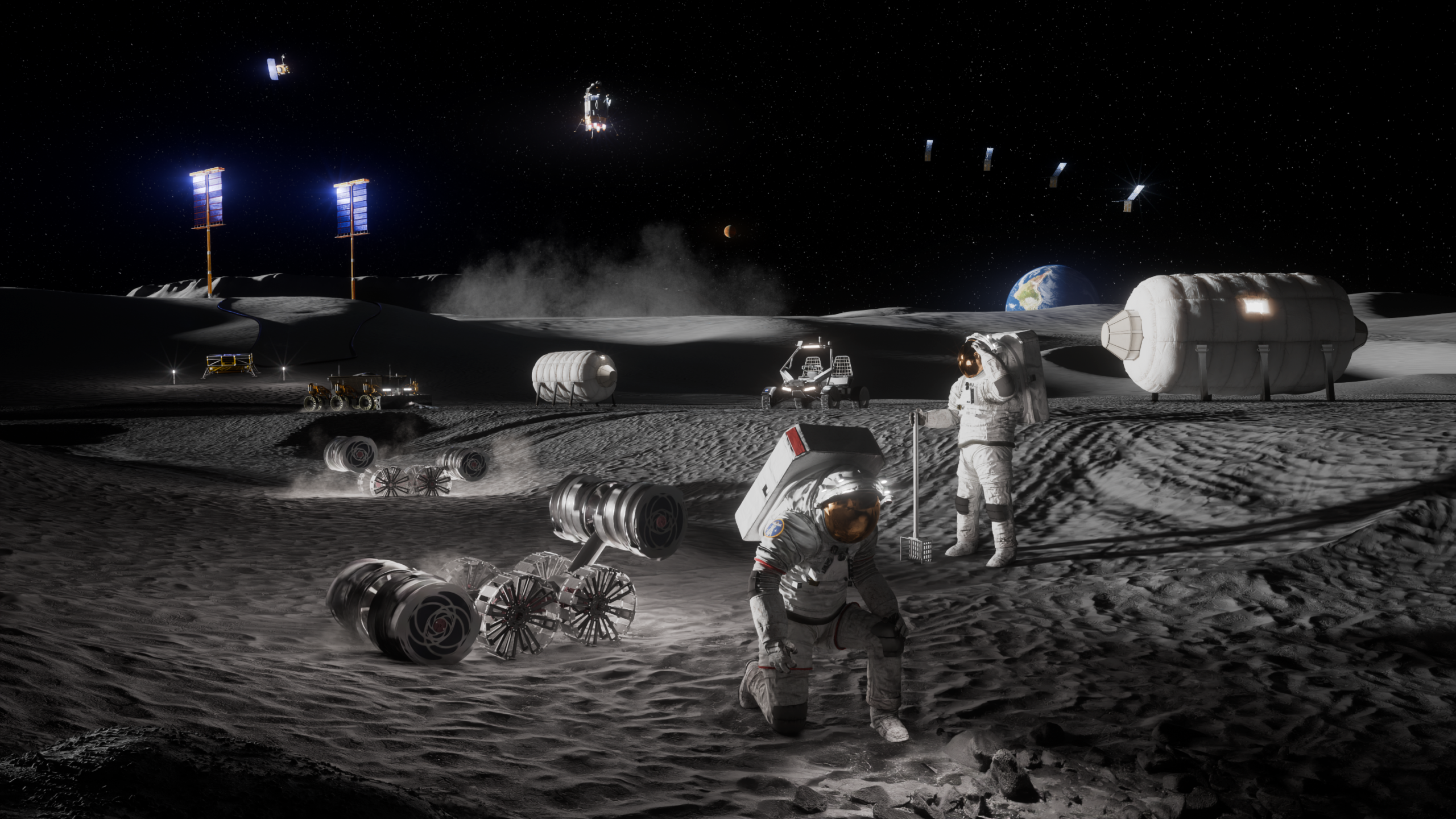
NASA has selected three new scientific investigations and their payload suites to advance knowledge of the Moon and help pave the way for humanity’s first lunar outpost.
Selected through NASA’s Lunar Payload and Survey Research (PRISM) program, the payload suites will be delivered to the lunar surface through the Commercial Lunar Payload Services (CLPS) initiative as part of NASA’s Lunar Stations Program.
The investigations will help researchers study lunar resources, map potential natural shelters, assess environmental hazards, and lay the groundwork for a safe and sustainable human presence under NASA’s Artemis and Lunar Base programs.
“NASA Science is building the Ultimate Interplanetary Survival Guide to help science reach the Moon’s surface first and proactively provide future astronauts with the critical information, resources, and safety measures they need to survive a lunar night,” said Nicki Fox, deputy administrator for the Science Mission Directorate at NASA Headquarters in Washington. “These PRISM selections will directly help NASA maximize its goals while minimizing risk to astronauts as it establishes humanity’s first lunar outpost in preparation for sending the first astronauts to Mars.”
Three NASA Payloads Selected for Lunar Surface Research
Lunar Environmental Monitoring Station–Antarctica (LEMS-SP)
- The autonomous LEMS-SP instrument suite will serve as a long-term environmental and hazard monitoring station. It is designed to help build a picture of the Moon’s environment by monitoring falling micrometeorites and tracking volatile materials—materials that can easily turn into gas—as they drift into the Moon’s thin outer gas layer. Short-period seismometers will detect seismic events, providing hazard assessments that could help protect lunar base hardware.
Principal investigator: Dr. Mehdi Benna, University of Maryland, Baltimore County
Geophysical Survey for Mapping the Lunar Interior (GIMLI)
- The GIMLI payload will be deployed to the Marius Hills Pit to explore underground lava tubes and improve understanding of lunar volcanic processes. It will scan beneath the Moon’s surface to determine whether the pit is connected to a large underground lava tube. If these natural underground spaces exist, they could provide future astronauts with protection from extreme temperatures and harmful radiation.
- Identifying these potential shelters could influence future habitat plans by revealing natural spaces that may offer thermal stability and protection from ionizing radiation and micrometeorite impacts.
Principal investigator: Dr. Nathaniel Putzig, Planetary Science Institute
Depth Imager with Spectral and Color Optics (DISCO)
- The DISCO payload will provide the first direct on-ground measurement of ice hidden in the Moon’s microcold traps. It will also support future lunar resource utilization and surface operations by studying how the lunar surface responds to rocket exhaust and assessing the stability of movement across the terrain.
- By pinpointing where ice exists and how much is present, the investigation will help NASA design safer ground operations and develop technology to turn lunar ice into a usable resource for future lunar bases.
Principal investigator: Dr. Ariel Deutsch, NASA Ames Research Center, Silicon Valley, California
Preparing for Long-Term Human Exploration of the Moon
“Each new PRISM selection strengthens our ability to deliver ambitious, innovative science to the lunar surface,” said Brad Bailey, director of the Exploration Science Strategic Integration Office in NASA’s Science Mission Directorate. “These studies exemplify how Artemis and the Lunar Base are expanding the frontiers of lunar exploration, advancing innovative technologies, deepening our understanding of the lunar environment, and paving the way for future astronaut missions.”
NASA is increasing the pace of lunar missions to build lunar bases, deliver scientific research and technology payloads that contribute to U.S. scientific excellence, strengthen a sustained presence on the Moon, and advance future human exploration.
NASA’s CLPS initiative supports the Lunar Base Program as the agency works with U.S. companies to deliver science, exploration, and technology payloads to the Moon’s surface and orbit.
See below for more information.
-end-
Tiffany Blake
Headquarters, Washington
202-358-2546
[email protected]
Source: www.nasa.gov