


Mars’ Exposed North Pole Ice Contains Less Than 3% Dust, Study Finds
A new analysis of Mars orbiter and lander data suggests that exposed water ice in the planet’s Arctic contains less than 3% dust—far below previous estimates of up to 25%.
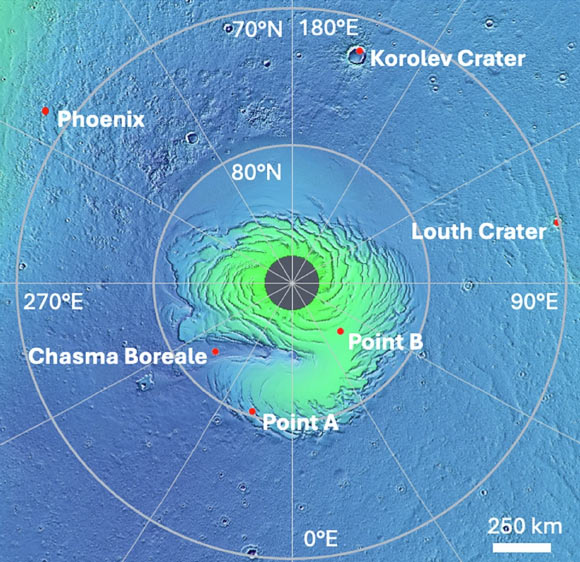
Map of six North Pole locations with exposed water ice on Mars analyzed in the study. Image credit: P. Mohan and A. R. Khuller, doi: 10.1038/s44453-026-00054-9.
New estimate of dust in Martian Arctic ice
Planetary scientists study Mars’ water ice by analyzing how it reflects light. These measurements come from spacecraft such as ESA’s Mars Express, NASA’s Mars Reconnaissance Orbiter, and NASA’s Phoenix lander.
However, the reflectance of ice depends on several factors, including particle size, dust content, and the arrangement of layers. As a result, earlier studies have matched similar spectra with very different combinations of these characteristics.
At the Phoenix landing site, for example, estimates of the amount of dust in the ice have differed by as much as a factor of 25.
“We know that there is water ice in the region surrounding Mars’ north pole, but there is wide disagreement about how dusty that ice is,” the researchers said.
Dust makes ice darker. Darker ice absorbs more sunlight, becoming warmer and potentially evaporating faster. Determining the dust content is therefore important for understanding how stable Mars’ near-surface water ice may be.
Physics-based model reveals cleaner surface ice
The researchers applied a physics-based model originally developed for snow and ice on Earth to observations from six locations in the Martian Arctic. The sites included two areas on the remaining polar cap, Korolev Crater, Louth Crater, Boreale’s Chasma, and the Phoenix landing site.
The results differ significantly from some earlier interpretations. For example, analysis of Mars Express observations from Korolev Crater had suggested a dust content of approximately 15–22% by mass. The new study estimated that only about 0.2–0.4% dust was present in the top layer represented by the same observations.
Mars’ north polar ice may be layered like an “ice cream sandwich”
The findings suggest that Mars’ North Pole is built from alternating layers of relatively clean ice and dustier ice—similar to an “ice cream sandwich.”
Each winter, a layer of dusty frost forms on the polar ice. During summer, that frost disappears, exposing older and cleaner ice beneath it.
By tracking seasonal changes in brightness, the researchers found evidence for more frost and dust during the Martian winter. In summer, the surface ice becomes cleaner as the seasonal layer evaporates.
These layered deposits may preserve important information about Mars’ climate thousands of years ago, when some of the ice is thought to have formed from snowfall.
What the ice reveals about Mars’ climate history
Mars experienced a major ice age that deposited shallow ice across approximately one-third of the planet. The planet’s dramatic climate cycles are linked in part to changes in its orientation.
Unlike Earth, which is stabilized by the Moon’s gravitational influence, Mars has only two small moons. This allows its axis to vary more significantly over time, contributing to major changes in climate and the formation of extensive ice deposits.
The study, “Correcting dust content and particle size in exposed water ice at the Martian north pole,” was published in npj Space Exploration.
_____
P. Mohan and A. R. Haller. 2026. Correcting dust content and particle size in exposed water ice at the Martian north pole. npj Space Exploration 2, 36; doi: 10.1038/s44453-026-00054-9
Source: www.sci.news