


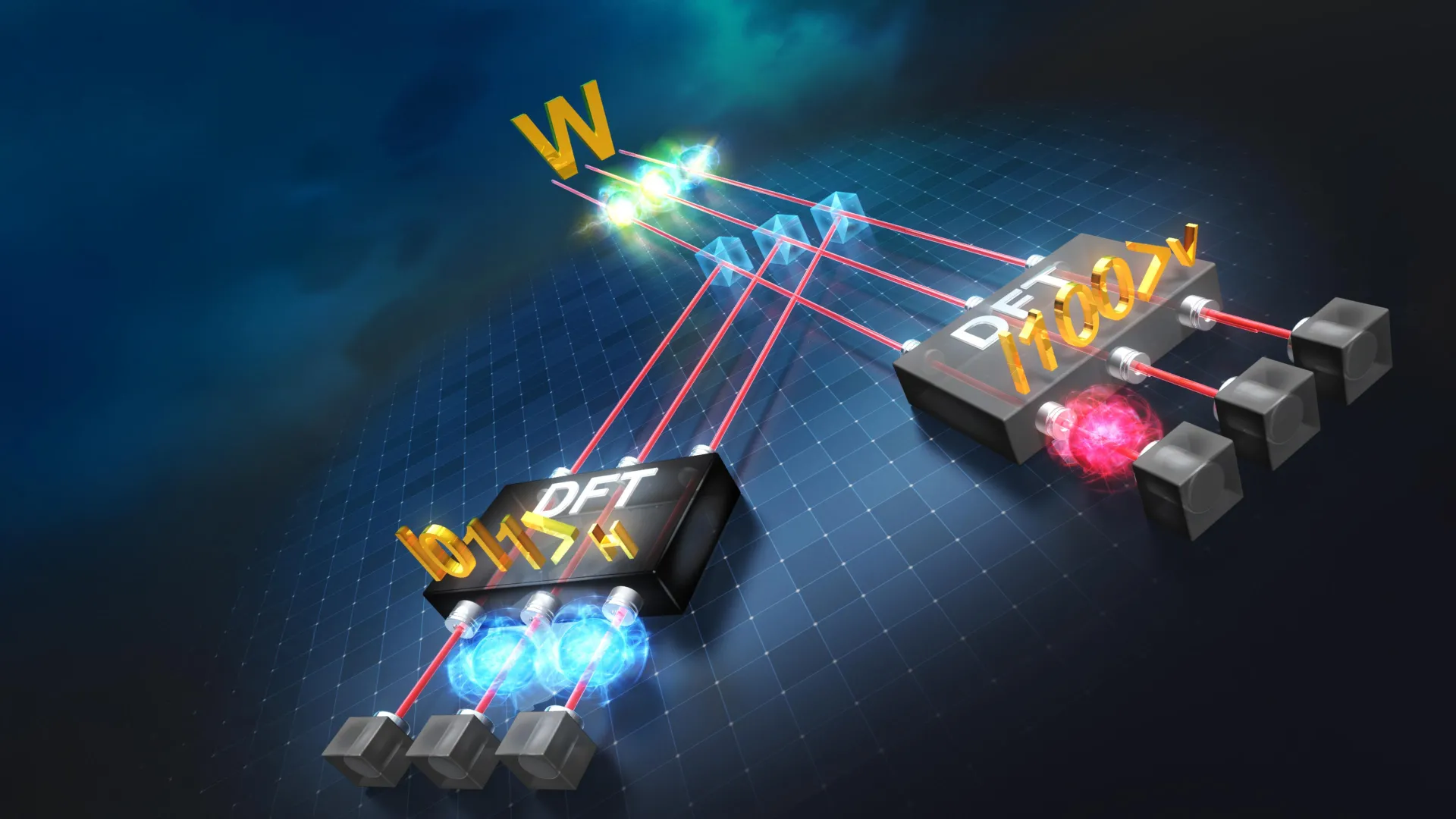
Scientists Demonstrate a New Way to Measure Three-Photon W-State Entanglement
Quantum entanglement is one of the clearest examples of how different the quantum world is from everyday physics. In an entangled system, particles such as photons can become so deeply connected that their properties cannot be fully described independently. Instead, the particles must be treated as one combined system.
This concept challenges the classical expectation that every particle has its own separate physical reality. It also famously troubled Albert Einstein. Today, however, quantum entanglement is viewed as a foundation for emerging technologies, including advanced communication, quantum computing and quantum information transfer.
The challenge of measuring quantum entanglement
To develop these technologies, scientists must do more than create multiphoton entangled states. They also need efficient ways to determine which type of entangled state has been produced.
One standard method is quantum tomography, a technique that reconstructs and estimates quantum states through many measurements. However, the amount of data required increases exponentially as more photons are added. Even a small increase in the number of photons can therefore require dramatically more measurements.
Entanglement measurement offers a potentially more efficient alternative. It can identify entangled states using a one-shot approach, rather than requiring scientists to collect extensive data and reconstruct the states afterward.
Scientists have already achieved this type of measurement for the Greenberger–Horne–Zeilinger, or GHZ, state, one of the best-known forms of multiphoton entanglement. Until now, however, no comparable method had been proposed and experimentally demonstrated for the W state, another important type of multiphoton entangled state.
Researchers at Kyoto University and Hiroshima University set out to address this gap. Their work produced a new entanglement measurement method capable of identifying W states.
“More than 25 years have passed since the first proposal for entanglement measurements of the GHZ state, and with a true experimental demonstration of the three-photon W state, we have finally obtained an entanglement measurement of the W state as well,” said corresponding author Shigeki Takeuchi.
Using symmetry to identify W states
The researchers based their approach on a mathematical property of the W state known as circular shift symmetry. Put simply, the arrangement of photons can be repeatedly shifted in a cycle while preserving the important underlying pattern.
Using this symmetry, the team theoretically developed an entanglement measurement based on optical quantum circuits. The circuit performs a Fourier transform, a mathematical operation that rearranges quantum information and can reveal patterns that are otherwise difficult to detect.
In principle, the proposed method can be applied to W states containing any number of photons.
The researchers then built a device to test the method with three photons. They used high-stability photon quantum circuits designed to operate for long periods without active control.
By sending three individual photons into the device with carefully selected polarization states, the researchers showed that the system could distinguish between different types of three-photon W states. Each state represents a specific non-classical correlation shared by the three photons.
The team also measured the fidelity of the entanglement measurements. Fidelity describes how reliably a quantum system performs its intended task. In this experiment, it represents the probability that the device will produce the correct result when given a pure W-state input.
Potential applications in quantum teleportation and computing
This advance could support several areas of quantum technology.
One potential application is quantum teleportation, the transfer of quantum information from one location to another. Despite its name, quantum teleportation does not transport matter. Instead, it uses entanglement to transfer quantum states that contain information.
Improved entanglement measurement methods could also contribute to new quantum communication protocols, techniques for transferring multiphoton entangled states and new approaches to measurement-based quantum computing.
“To accelerate research and development in quantum technology, it is important to deepen our understanding of fundamental concepts and generate innovative ideas,” Takeuchi said.
Extending the technique to larger quantum systems
The researchers now plan to extend their approach beyond the three-photon demonstration.
Their long-term goal is to apply the method to larger and more general multiphoton entangled states. The team also plans to develop on-chip photonic quantum circuits capable of performing entanglement measurements. Such circuits could make the technology more compact and easier to integrate into future quantum systems.
Source: www.sciencedaily.com