


Nature Briefing: Test Your Nobel Prize Knowledge, Meet a Feathered Dinosaur and Explore Today’s Science News
Hello Nature readers. Would you like to receive this briefing free in your inbox every day? Sign up here.
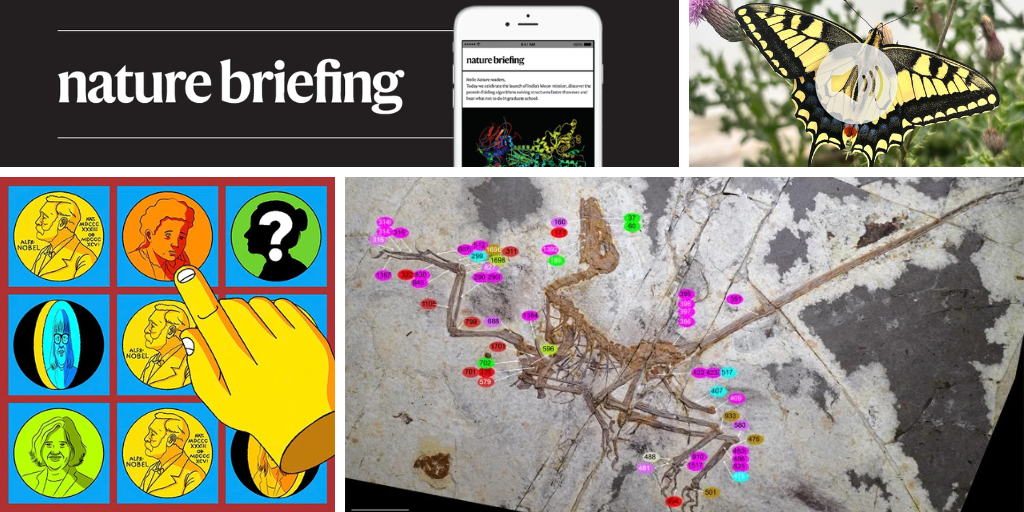
Quiz: Can You Name These Women Nobel Prize Winners?
Illustration: DAQ
The academy that awards the Nobel Prizes is committed to better recognizing the achievements of women scientists. However, the awards’ 125-year history remains dominated by men.
As we prepare for the first awards presentation on Monday, test your expertise: can you name the women who won Nobel Prizes in science?
Science News: Feathered Dinosaurs, Cancer Prevention and the Anthropocene

The fossil of Norellaptor Barboldi shows evidence of feathers on the front and hind legs and at the end of the tail.
Credit: Shuri Wang Others/Nat. Commune.
A feathered dinosaur offers clues about the evolution of flight
The discovery of a complete fossil from a feathered dinosaur species adds to evidence that birds evolved the ability to fly multiple times, rather than through a single lineage.
The newly described species belongs to a group of dinosaurs called microraptorids, which are closely related to birds. Researchers found that some flight-related adaptations in microraptorids also evolved in birds. However, the adaptations did not develop in the same order in the two groups and therefore “could not be considered expressions of a common developmental regime,” the researchers wrote.
Nature | 4-minute read
Reference: Nature Communications paper
Could “cancer arrest” help prevent pancreatic cancer?
Cancer researchers are exploring “cancer arrest”: techniques designed to treat people at high risk and prevent them from developing cancer.
Surgeon and researcher Diane Simeone said that combining early-detection techniques with pancreatic-cancer prevention “could be a game-changing strategy that could make a huge difference in survival rates.” The approval of daraxone lasib (Lasonc), a breakthrough pancreatic-cancer drug that disables cancer-causing proteins, could be key to an interception approach.
Nature | 8-minute read
AI vocabulary enters the Merriam-Webster Dictionary
“Agent” and “vibecoding” are among the artificial-intelligence terms added to the online version of the Merriam-Webster Dictionary.
Scholars say the additions are notable because they also include technical phrases such as “rapid engineering”, which require advanced knowledge to understand. “This particular batch feels like more of a meta-commentary on language than any other batch I’ve seen,” says Peter Sokolowski, a lexicographer at Merriam-Webster.
The sophistication of these entries, he says, reflects the growing access to specialized terminology among non-specialists.
Nature | 4-minute read
Why the Anthropocene is still debated
“Anthropocene” has become a useful shorthand for humanity’s impact on Earth, and it is also the name of a briefing newsletter. However, the proposal to recognize it as an official geological era was rejected in 2024.
Some scholars now argue that unpublished documents show the proposal’s rejection was unfair and that the rationale was not fully explained. Researchers involved in the vote insist that the process was fair and point to a technical explanation for the rejection published in the journal last month.
Nature Reviews Earth & Environment | 7-minute read
Nature Reviews Earth & Environment comment
or read the entire featured issue.
Features and Analysis
How to push back against online hate speech
“If you see hate speech online, consider it your duty to oppose it,” says psychologist Mirta Galecik. “Just say, ‘I disagree.’ Don’t feel pressured to make an elaborate argument.”
She says the goal is to reinforce prevailing moderate social norms, so people should ask their friends to join them in disagreeing. The advice is based on a study that analyzed more than 1 million Twitter/X posts published between 2015 and 2018.
The study found that excessive discussion, adversarial attitudes and “us versus them” rhetoric can increase the harm.
Nature | 7-minute read
Reference: PNAS Nexus paper
A scientist’s unusual exchange of messages
A tired scientist exchanges enlightening messages with himself in The Expense Stops with Me. A man tries to evade loaded questions in Von Neumann’s Party.
Nature | 5-minute read & Nature | 6-minute read
Butterflies use visual illusions to confuse birds
The bright, intricate patterns of butterflies can create visual illusions that confuse birds.
After analyzing slow-motion videos of butterflies taking flight, researchers found that markings on the insects can make it appear that they are moving in one direction when they are actually traveling in the opposite direction.
“At first I thought, ‘Oh, I made a mistake, the code is wrong,’” says visual ecologist Jolyon Troscianko, who discovered the deception. “So I double-checked it over and over again, and no, it was true.”
Nature Podcast | Listen for 18 minutes
Subscribe to the Nature Podcast on Apple Podcasts,
Spotify,
YouTube Music
or the RSS feed.
Can You Find the Penguin?
Today, Leaf Penguinson explores the winding boardwalk at Felsenmeer — the “Sea of Stones” — in Germany.
According to legend, this landscape of rocks and crevices is the remains of a battle between giants and dwarves. A more common explanation is that the formations were created by the collapse of caves or early medieval mines.
Either way, can you find the penguin?
The answer will be in Monday’s email. Many thanks to briefing photo editor and penguin wrangler Tom Horton.
Source: www.nature.com