


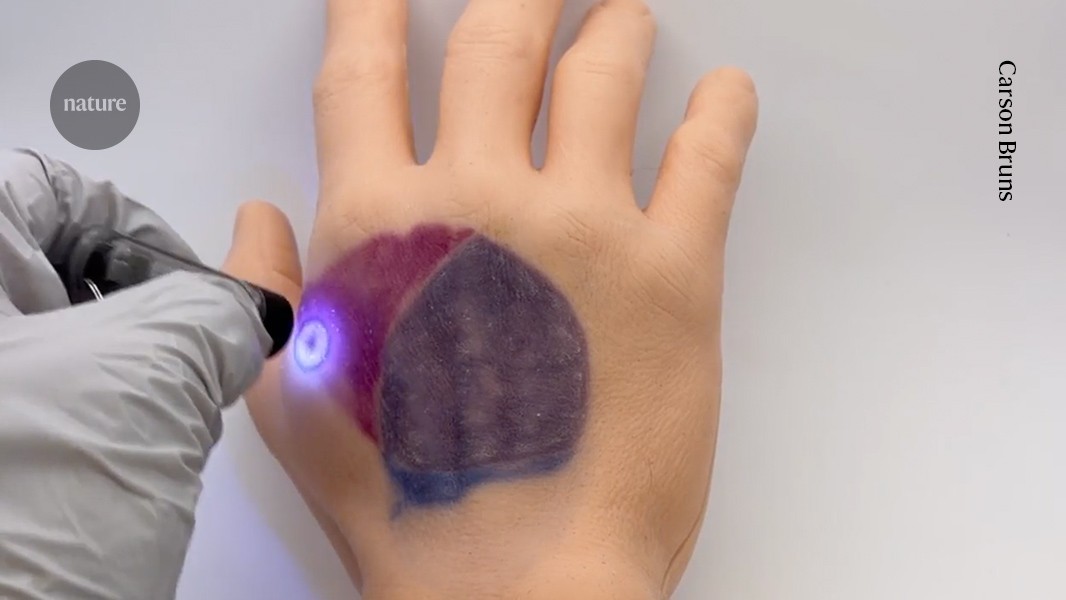
Invisible Tattoo Ink Appears Under UV Light and Disappears in Visible Light
The invisible ink becomes visible when UV light is shined on the silicone hand.
Credit: Carson Bruns
Carson Bruns, a nanoscientist at the University of Colorado Boulder, has joined a long list of scientists experimenting on themselves. In Bruns’s case, he had his leg tattooed with invisible ink. The ink appears only under ultraviolet light and can be erased with bright visible light, creating potential applications for medical tattoos, including markers that identify specific areas of the body for radiation therapy.
The ink contains photochromic dyes, compounds that reversibly change color when exposed to particular wavelengths of light. Photochromic dyes that respond to ultraviolet light are already used in textiles and transition lenses. Adapting these materials for permanent implantation in living skin is a new application, says Haihui Joy Zhang, a chemist and materials scientist at the University of Sydney in Australia.
Bruns and his team developed three ink dyes—magenta, yellow and blue—and tested them on pig skin and silicone skin. The results will be published in the magazine Matter and Light. Bruns previously developed a tattoo ink called Magic Ink, which turns magenta under ultraviolet light. The ink was commercialized in 2024 through HYPRSKN, his Boulder, Colorado-based startup.
UNSW Sydney chemist Jake Violi says that color-changing ink capable of becoming invisible is an exciting development with potential applications in cosmetic and medical tattoos.
How the invisible tattoo ink reacts to light
Like traditional tattoo dyes, the invisible ink is injected into the dermis, the inner layer of skin. The dyes are contained in small spheres made of clear acrylic glass. Each sphere contains photochromes that react when they absorb photons at wavelengths corresponding to the dye’s color.
The reaction forms chemical bonds that change the shape of the photochrome, making it flatter and more visible. The photochrome remains visible until it absorbs a photon of visible light. That absorption breaks the bonds and returns the molecule to its original shape, causing the tattoo to disappear.
Source: www.nature.com