Tegaza 001: Ancient Mars Meteorite Reveals Clues About the Red Planet’s Habitability
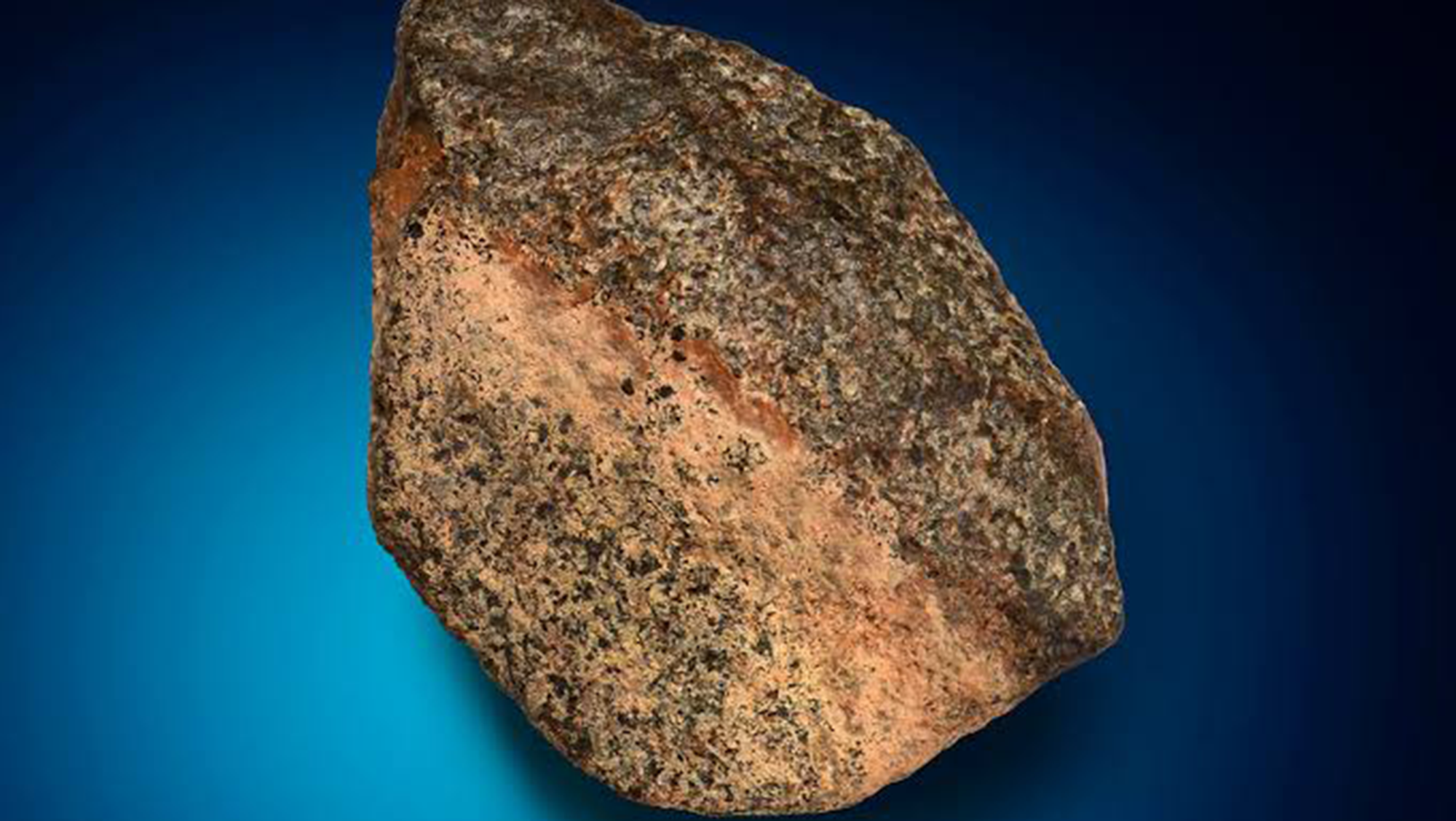
A small, brownish rock may be one of the most scientifically valuable objects on Earth. Known as Tegaza 001, this rare Martian meteorite is a fragment of ancient Mars that offers scientists an unprecedented opportunity to study the planet’s oldest crust, early water and potential habitability.
Recent studies of Martian meteorites are helping planetary scientists reconstruct Mars’ geological history and determine whether the Red Planet once had the conditions necessary for life.
Earth and Mars formed about 4.5 billion years ago from a protoplanetary disk of gas and dust surrounding the young Sun. Over billions of years, powerful impacts blasted rocks from Mars into space, sending some of those fragments on trajectories that eventually carried them to Earth.
These naturally delivered samples provide scientists with a rare alternative to a dedicated Mars sample-return mission. By studying Martian meteorites, researchers can investigate the planet’s ancient minerals, atmosphere and water history in laboratories on Earth.
From the latest videosLive Science
Two well-known examples are the Allan Hills 84001 meteorite, which contains organic molecules dating back roughly 4 billion years, and NWA 7034, a 4.4-billion-year-old Martian meteorite that preserves evidence of ancient water.
However, both meteorites have limitations. Allan Hills 84001 does not contain a broad variety of minerals, while NWA 7034 appears to be a breccia — a rock made from fragments of several older rocks. Neither provides a complete representation of Mars’ oldest crust.
Tegaza 001 could help close that gap.
Tegaza 001 preserves Mars’ ancient history
Tegaza 001 contains approximately 28 ounces (800 grams) of Martian material. The meteorite was divided into eight pieces after being recovered near the Taghaza ruins in Mali in 2022. The specimens are owned by the Maine Mineral and Gem Museum.
Get the world’s most fascinating discoveries delivered straight to your inbox.
In a preprint uploaded April 14, researchers dated zircon crystals and other minerals embedded in Tegaza 001. Their measurements indicated that the meteorite formed at least 4.1 billion years ago, during the Noachian period — one of the earliest and most geologically active chapters in Martian history. Because the paper has not yet been peer-reviewed, its conclusions will require further study.
The meteorite is also rich in silica. This composition suggests that ancient Mars may have produced rocks similar to granite, a light-colored rock associated on Earth with melting, cooling and the recycling of crustal material.
That finding is significant because modern Mars does not have Earth-like plate tectonics. Much of the planet’s surface is covered by basalt, a dark volcanic rock formed when lava cools quickly. Tegaza 001 therefore raises questions about how Mars generated chemically diverse crust without the global plate movements that shape Earth’s continents.
Could Mars have developed a habitable crust without plate tectonics?
(Image credit: Mackay-Champion et al., Nature Astronomy, 2026)
A study published in Nature Astronomy on June 26 found evidence that Mars may have been capable of supporting complex geological processes even without Earth-style plate tectonics.
Using seismic data collected by NASA’s InSight lander, researchers modeled the planet’s interior and identified evidence of a vast, interconnected magma system beneath the northern hemisphere. The network may have extended for thousands of miles and could have helped create different types of crust.
“One of the big questions in planetary science is whether Earth is unique,” said John Wade, an associate professor of planetary materials at the University of Oxford, in a statement.
“If Mars is able to develop this kind of complex crust without plate tectonics, the conditions necessary for habitability could emerge on more planets than we imagine,” Wade added.
These geological processes may have helped early Mars maintain an atmosphere, form extensive bodies of water and create environments that were potentially suitable for life. Similar processes could also occur on other rocky planets beyond our solar system.
Tegaza 001 also records the loss of Martian water
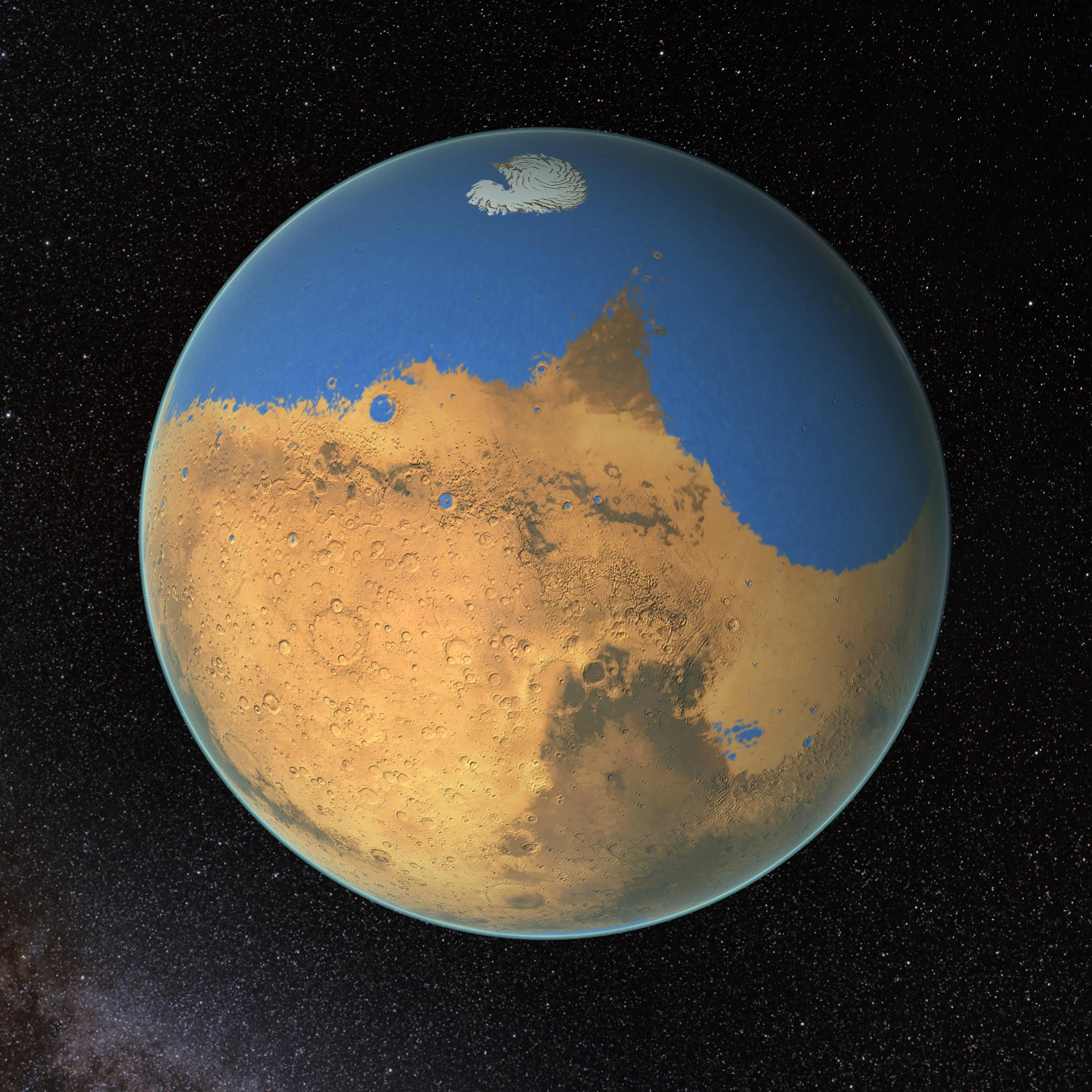
While Tegaza 001 offers evidence of a wetter and more geologically active early Mars, it also indicates that the planet began losing water and atmosphere relatively soon after its formation.
An illustration of what a primordial ocean on Mars may have looked like.
(Image credit: NASA/GSFC)
In a separate study published in Science Advances on June 10, researchers chemically analyzed Tegaza 001 and compared it with two younger Martian meteorites. By examining hydrogen and its heavier isotope, deuterium, they reconstructed how water and the atmosphere evolved on early Mars.
Hydrogen is lighter than deuterium, so it escapes into space more easily. As hydrogen disappears, the remaining water and atmosphere become enriched in deuterium. This isotope ratio acts as a record of atmospheric loss.
The results suggest that Mars lost a substantial part of its primordial atmosphere within a few hundred million years after its global magma ocean cooled and solidified. The findings indicate that Mars was already losing hydrogen to space by approximately 4.1 billion years ago.
That atmospheric loss would have made it increasingly difficult for liquid water to remain stable on the Martian surface, helping transform the planet from a potentially habitable world into the cold, dry desert seen today.
Although Tegaza 001 provides an important window into Mars’ earliest history, scientists caution that much more evidence is needed. The conclusions are based largely on a single meteorite, and additional Martian samples will be necessary to determine whether its chemistry represents the planet as a whole.
James Day, a professor of geosciences at the Scripps Institution of Oceanography at the University of California, San Diego, who was not involved in the research, emphasized that the conclusions rely on a small and unusual sample. “All of these arguments will be based on a single small stone,” he told Live Science by email.
Saper, L., Liu, Y., Guan, Y., Ma, C., Bell, E. A., and Agee, C. B. (2026). 4.1 Ga Noachian hydrosphere components in the Martian meteorite Tegaza 001. Science Advances, 12(24), eaea3420.
How much do you know about the Red Planet? Test your knowledge with our Mars quiz!