


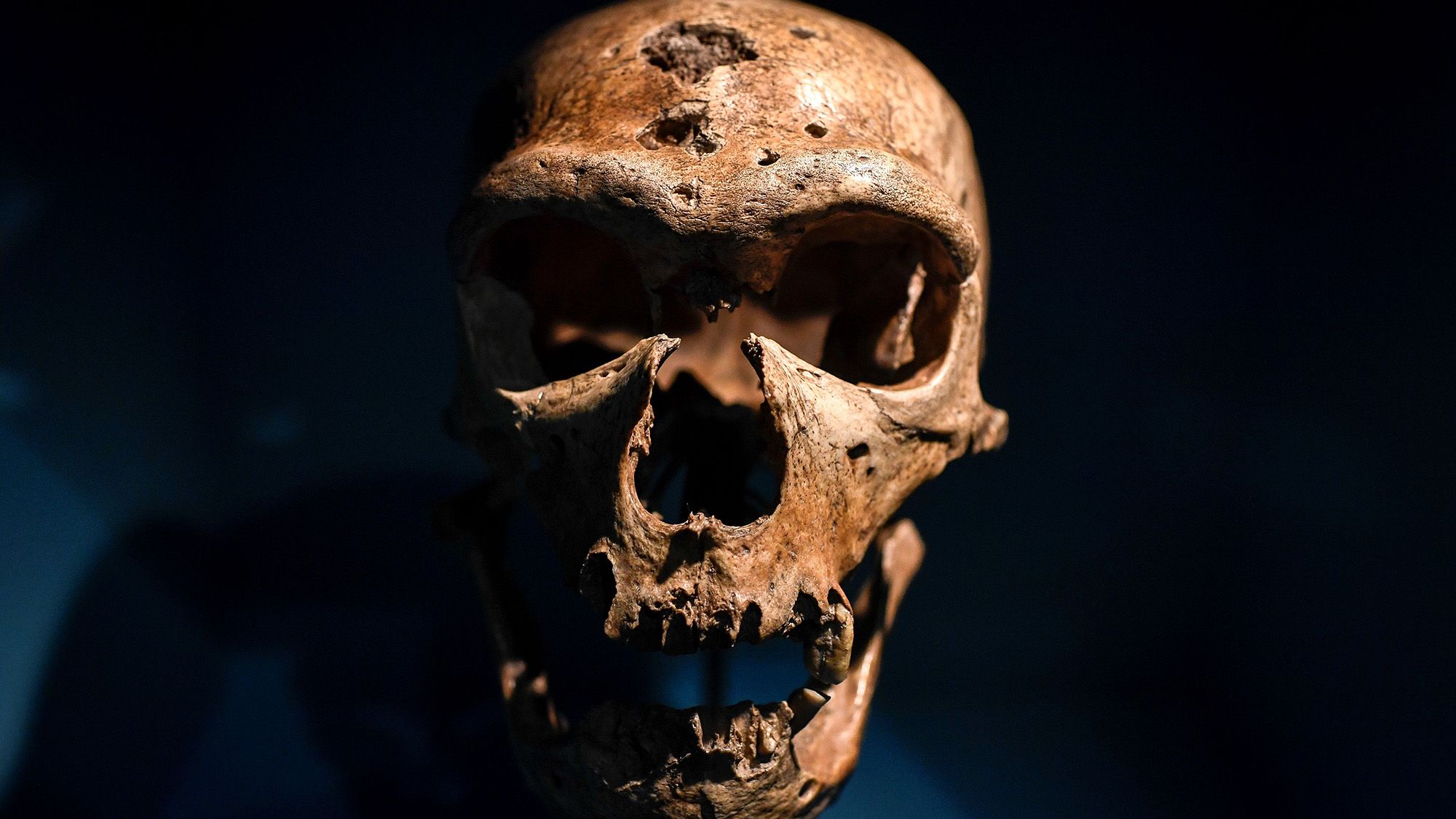
Why Did Neanderthals Go Extinct? Theories Shaped by Science, Climate and Human Bias
Since their remains were discovered in the 19th century, Neanderthals have fascinated scientists and the public alike. Our understanding of these ancient humans has changed significantly over time. The way we view this lost human lineage has also influenced how we see our own species, with geopolitical events and contemporary debates shaping the language used to describe Neanderthals.
In his book The Neanderthals Among Us: The Origins of Prehistoric Humans, historian and writer Peter Sahlins examines how cultural and political ideologies have shaped our understanding of Neanderthals. The following discussion considers theories about why they disappeared—and the philosophical assumptions behind those theories.
How did Neanderthals go extinct?
Researchers have proposed a wide range of explanations, from violent replacement to peaceful absorption accompanied by cultural exchange. Just as ideas about race and gender have been projected onto Neanderthals, contemporary concerns have influenced how scientists and the public imagine their extinction.
Sometimes newspapers translate relatively neutral scientific findings into headlines that reflect modern anxieties. On July 29, 2011, The Glasgow Herald announced that “immigration halted the Neanderthal era” and claimed that Europe’s early inhabitants may have been displaced by unchecked immigration. The coverage simplified a specialized study by Cambridge archaeologist Paul Mellars, which examined a dramatic increase in population during the Upper Paleolithic.
Science itself can also be framed by current events. The pathogen theory of Neanderthal extinction gained attention during and after the COVID-19 pandemic. A 2024 study involving a 50,000-year-old herpes case and viral-genome sequencing was presented as supporting the possibility that pathogens carried by Homo sapiens spread to Neanderthal populations that lacked immunity.
In Popular World History, Jonathan Kennedy argued that Homo sapiens arrived in much larger numbers and possessed a more developed immune system, having evolved in a tropical environment. This, he suggested, may have made modern humans less vulnerable to diseases carried by Neanderthals.
Did climate change wipe out the Neanderthals?
Over the past two decades, climate change has become one of the most prominent explanations for Neanderthal extinction. The theory takes several forms, including an updated version of French geologist Georges Cuvier’s “catastrophism”—the idea that species can disappear because of sudden geological disasters such as earthquakes or volcanic eruptions.
Since 2007, researchers have pointed to a Campanian eruption near Naples, Italy, dated to around 39,280 years ago, with an uncertainty of approximately 110 years. The event was later fictionalized in the 2013 animated film The Croods.
Some scientists have argued that arriving Homo sapiens populations were less affected by the eruption, perhaps because fewer people were directly exposed to its enormous winds and the estimated 500 cubic kilometers of magma released. Other waves of modern humans may have arrived later, after the effects had subsided.
Most living people share a small portion of the Neanderthal genome. However, the human lineage inherited directly from Neanderthals settled in Europe much later, after the Ice Age. Most of our ancestry comes from Neolithic rather than Paleolithic populations.
Another climate-based explanation emerged from research into extreme instability during the late Pleistocene. In 2004, National Geographic reported on an international team of 30 scientists whose research identified a severe cooling event lasting roughly six centuries about 41,000 years ago. The period corresponds approximately to Greenland ice-core intervals GIS 13 to 7.
Image credit: UCG, Getty Images
This prehistoric “mini ice age”—the climatic opposite of modern global warming—would have reduced vegetation and food supplies for herbivores. Neanderthals may have been pushed toward warmer regions, including southern Spain.
Clive Finlayson, a zoologist and early contributor to ecological modeling of Neanderthal extinction, argued that the “last Neanderthal” may have lived in Gibraltar no later than 29,000 years ago. Other candidates have been proposed, however. Bones dated to around 30,000 years ago have been found in Zafarraya, Granada, although some researchers remain skeptical. Another possible late Neanderthal has been identified at Mezmaiskaya Cave in the Caucasus.
Were Neanderthals less innovative than modern humans?
Some explanations focus not on disease or climate, but on technology and behavior. These theories suggest that Neanderthals lacked the flexibility or innovation needed to survive changing conditions, while Homo sapiens adapted more successfully.
However, theories that blame climate change or technological limitations must explain why modern humans survived many of the same harsh conditions. Recent research has increasingly reconsidered Neanderthals as archaeologically comparable to Homo sapiens.
Some experts argue that Neanderthals were not naturally adapted to cold climates because they originated during a warm interglacial period. Others question the assumption that they lacked complex, warm clothing. Their biological adaptations to cold may even have delayed the development of such technology.
This has contributed to a broader narrative of Neanderthal “technological inertia” and conservatism. In An Unpredictable Species: What Makes Humans Unique?, Philip Lieberman argued that Neanderthals disappeared because they were conservative, while modern humans mastered innovation and ultimately spread across the world.
The outdated idea of the “conservative” Neanderthal
The emphasis placed on innovation reflects the ideological values of contemporary neoliberalism and late capitalism. Within this framework, Neanderthals appear to have become extinct simply because they were Neanderthals: conservative, backward and unable to adapt to a changing world.
The idea of Neanderthal conservatism as an inherent personality trait can be traced to 19th-century anthropological judgments about “primitive” peoples. Augustus Pitt-Rivers, an early innovator in British archaeology, referred to the “enduring forms of conservatism” attributed to Indigenous peoples and cited the work of E. B. Tylor in Primitive Culture (1871).
In the past, so-called “savages” were incorrectly portrayed as descendants of Neanderthals. Their supposed conservatism was treated as a cultural inheritance. Modern anthropology has moved beyond these outdated comparative methods and no longer considers Indigenous peoples to be “savages” or Neanderthals’ descendants.
The question of why Neanderthals disappeared therefore remains more complicated than any single theory suggests. Disease, population pressure, cultural exchange, volcanic eruptions, climate instability and differences in technology may all have played a role—but the stories told about those possibilities also reveal the assumptions of the societies proposing them.
The Neanderthals Among Us by Peter Sahlins examines the changing reputation of Neanderthals and the ways science, popular culture and politics have shaped our image of this ancient human lineage.
Source: www.livescience.com