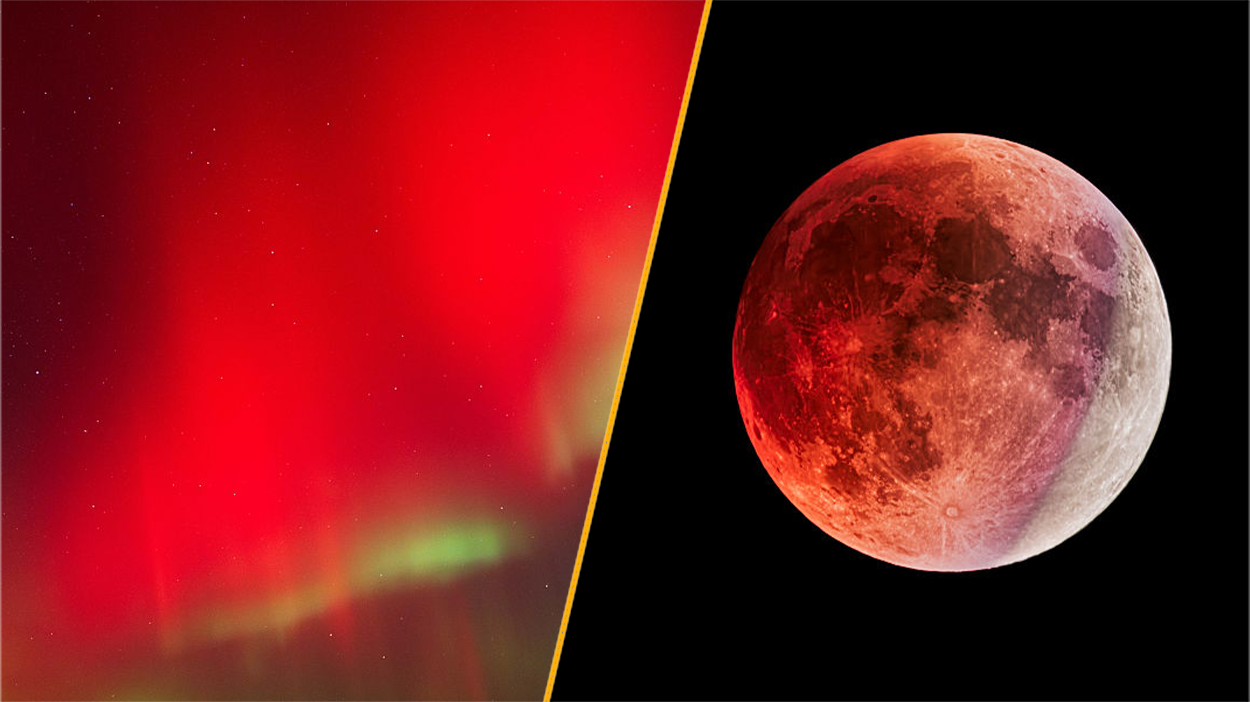
Rare Combination of a Partial Lunar Eclipse and Aurora Borealis May Light Up the Sky
Skywatchers may have the chance to see two remarkable celestial events at once: a deep partial lunar eclipse and a vivid display of the aurora borealis.
During the night of August 27–28, Earth’s shadow is expected to cover approximately 96% of the full moon. The eclipse could give the moon a dramatic copper or blood-red appearance, while a forecast moderate G2 geomagnetic storm may produce northern lights across parts of the United States.
NOAA’s space weather forecast indicates that auroras could be visible in several northern states, potentially extending from New York westward to Idaho.
Observers at higher latitudes will have the best opportunity to view both the partially eclipsed moon and the aurora during the same night.
Latest videos from
Live Science
“Although the moon and aurora are unlikely to appear in the same part of the sky, observers in Canada and Alaska have the strongest chance of seeing both events together,” astronomer Tom Kerss told Live Science. Kerss is also the co-author of Little Book of Eclipses: An Indispensable Partner for Solar and Lunar Events (Octopus Publishing Group, 2026).
The farther west viewers travel, the deeper the partial lunar eclipse is expected to appear. The moon will also sit lower in the eastern sky, where it could overlap with the brightest portion of the auroral oval.
The aurora borealis is created when charged particles from the solar wind interact with Earth’s magnetic field. Most of these particles are deflected by the planet’s magnetic shield, but some are guided toward the polar regions, where they collide with atmospheric gases and produce colorful glowing curtains.
The brightness and visibility of the northern lights depend on the strength of the solar wind. A powerful M6.9 solar flare erupted on August 25 from an active sunspot known as Region 4513. The flare was followed by a coronal mass ejection, or CME—a large cloud of magnetized solar plasma.
According to Space.com, the CME is expected to reach Earth between August 27 and 28, potentially increasing aurora activity during the lunar eclipse.
NOAA has forecast G1- and G2-level geomagnetic storm conditions from approximately 5 p.m. to 11 p.m. EDT on August 27. The partial lunar eclipse is expected to begin at around 9:23 p.m. EDT, reach its maximum shortly after midnight and end at approximately 3 a.m. EDT on August 28.
Because the moon will not pass completely into Earth’s darkest central shadow, this event is technically a partial lunar eclipse rather than a total lunar eclipse, so it may not officially qualify as a “blood moon.” Nevertheless, with 96% of the lunar surface entering Earth’s shadow, it could be the deepest partial lunar eclipse visible before the next total lunar eclipse on December 31, 2028.
“A full moon typically brightens the night sky and can make faint auroras harder to see,” Kerss said. “When the moon moves into Earth’s shadow, however, it becomes significantly dimmer, improving the contrast and making the aurora easier to spot.”
The combination of a green aurora arc and a copper-colored eclipsed moon could create an especially striking night-sky display. Under the strongest conditions, some observers may even see a rare red aurora above the horizon.
“If the aurora appears along the horizon, you may also be able to see a high-altitude red aurora glowing alongside the reddened moon,” Kerss said.
Aurora colors are determined by the gases involved and their altitude in Earth’s atmosphere. Oxygen at lower altitudes commonly produces green light. During powerful geomagnetic storms, auroras can reach oxygen molecules more than 120 miles (200 kilometers) above Earth, where the oxygen can emit a deep red glow, according to NASA.
The eclipsed moon appears red for a different reason. As sunlight passes through Earth’s atmosphere, blue and yellow wavelengths are scattered or absorbed, while red light is refracted toward the moon. This filtered sunlight can illuminate the lunar surface with a warm orange, bronze or blood-red color, according to the European Space Agency.