


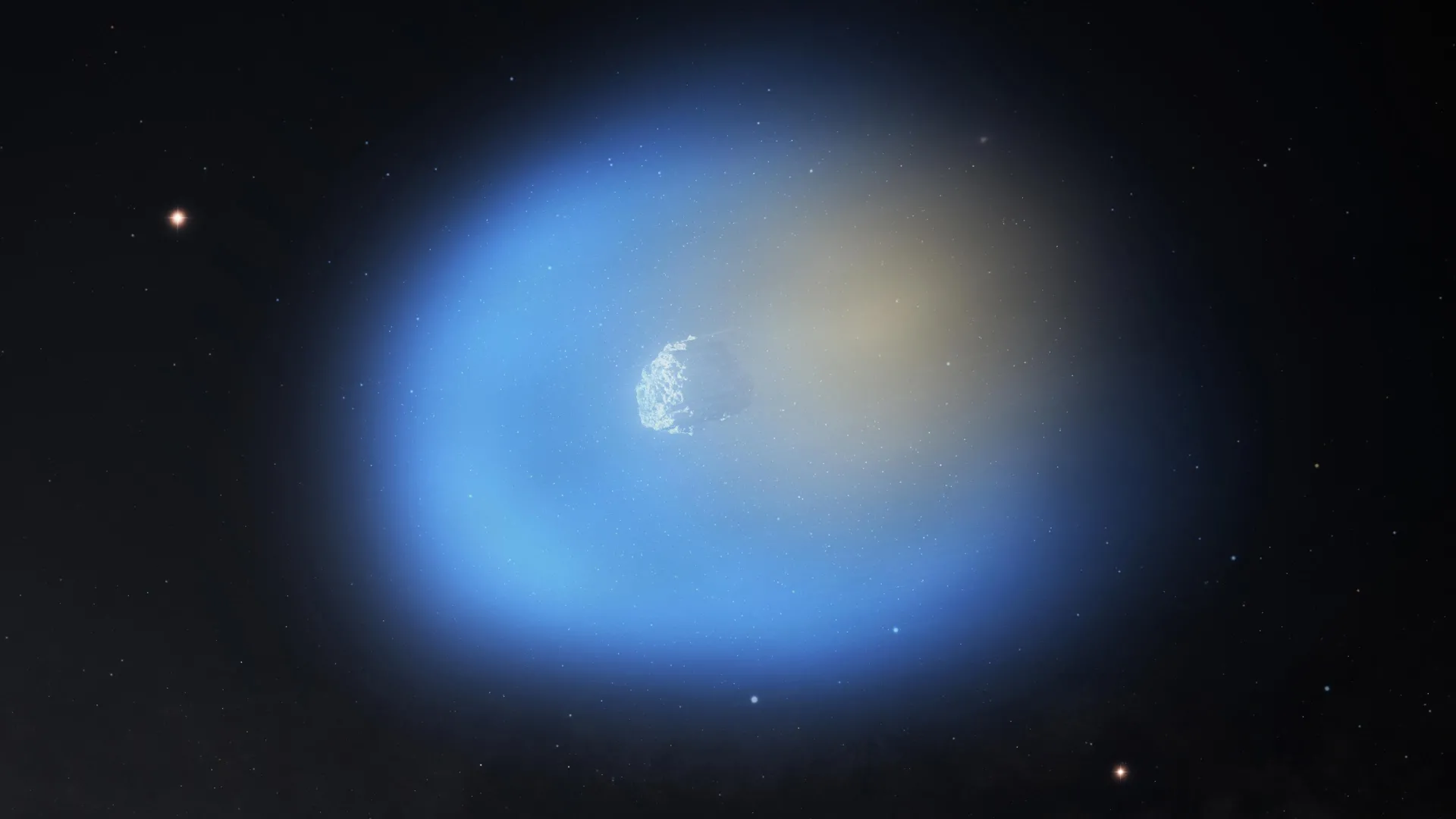
Interstellar comet 3I/ATLAS is giving astronomers an unprecedented look at the chemistry of a distant planetary system. New observations from the Atacama Large Millimeter/submillimeter Array (ALMA), in collaboration with the National Science Foundation National Radio Astronomy Observatory (NSF NRAO), reveal that the comet contains exceptionally high levels of methanol. Its methanol abundance is greater than that measured in nearly every known comet in our Solar System.
“Observing 3I/ATLAS is like taking a fingerprint from another solar system,” said Nathan Ross, lead author of the study and a professor at American University. “A closer examination reveals what this interstellar comet is made of, including methanol released in a way that is rarely seen in comets from our Solar System.”
ALMA reveals chemical fingerprints from another planetary system
Using ALMA’s Atacama Compact Array in Chile, the research team observed 3I/ATLAS for several days in late 2025 as the interstellar comet approached the Sun. Increasing sunlight warmed its icy surface, causing gas and dust to escape and create a bright cloud, known as a coma, around the comet’s nucleus.
By analyzing molecules within the coma, astronomers determined the chemical composition of material released by 3I/ATLAS. Because the comet originated beyond our Solar System, these observations offer a rare opportunity to study how icy bodies form and evolve in another planetary system without leaving our own.
The researchers detected methanol (CH3OH), an alcohol, and hydrogen cyanide (HCN), a nitrogen-containing organic molecule commonly found in comets.
ALMA data showed that 3I/ATLAS contains an unusually high amount of methanol relative to hydrogen cyanide. On the two observation dates, scientists measured methanol-to-HCN ratios of approximately 70 and 120. These results place 3I/ATLAS among the most methanol-rich comets ever observed in the Solar System.
Unusual comet chemistry may reveal its origins
The findings suggest that the ice inside 3I/ATLAS formed under conditions that differed significantly from those experienced by most comets in our Solar System. Alternatively, the comet may have undergone chemical processing that altered its composition after formation.
Earlier observations with the James Webb Space Telescope showed that 3I/ATLAS has a coma dominated by carbon dioxide while still far from the Sun. The new ALMA results add abundant methanol to the growing list of unusual chemical characteristics associated with this interstellar visitor.
ALMA’s high-resolution imaging also enabled astronomers to track how different molecules were released from the comet and transported through its coma. The observations revealed a notable difference between the behavior of methanol and hydrogen cyanide.
Hydrogen cyanide appears to originate mainly from the comet’s central nucleus, a pattern commonly observed in comets within our Solar System. Methanol, however, seems to be released from both the nucleus and icy dust particles suspended in the coma.
Small ice particles act like miniature comets
These tiny ice particles effectively behave like miniature comets. As 3I/ATLAS moves closer to the Sun and temperatures rise, ice within the particles sublimates into gas, releasing additional methanol into the surrounding coma.
Astronomers have observed comparable activity in some Solar System comets. However, this is the first time researchers have traced the detailed physics of this type of outgassing in an object that originated in interstellar space.
Comet 3I/ATLAS is only the third confirmed object observed entering the Solar System from interstellar space, following 1I/’Oumuamua and 2I/Borisov. Earlier studies of those visitors also revealed unusual properties.
As astronomers discover and study more interstellar objects, each one provides a valuable opportunity to compare our Solar System with planetary systems elsewhere in the galaxy. The unusual chemistry of 3I/ATLAS offers another important clue about how planets, comets, and other icy bodies form around distant stars.
Source: www.sciencedaily.com