


New Belemnite Species Discovered in Wyoming May Be the Thickest Ever Found
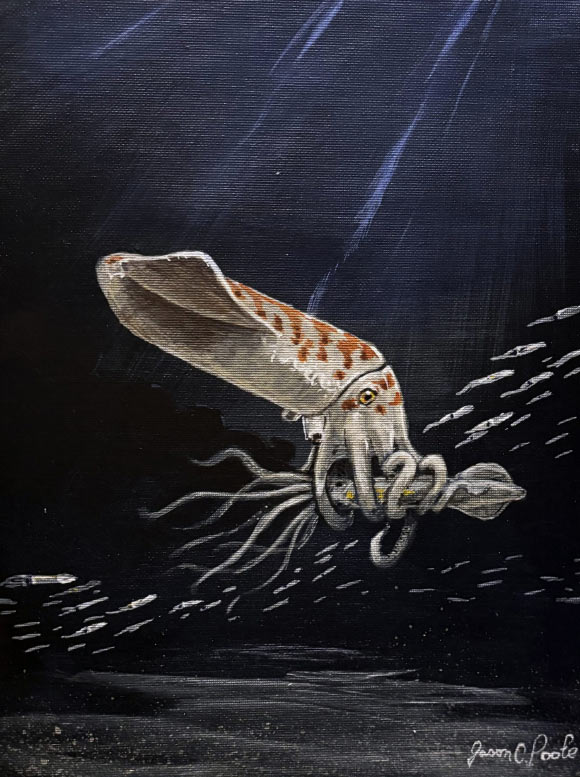
Two bullet-shaped fossils discovered in Wyoming have revealed a new species of belemnite, an extinct relative of modern squid and cuttlefish. Named Woteutis linsterorum, the animal belonged to a family thought to have disappeared about 20 million years before it lived.
A remarkably broad belemnite fossil
Belemnites lived in the seas of the Jurassic and Cretaceous periods. Although they had soft bodies, the part most likely to fossilize was the rostrum—a dense, pointed calcite structure at the rear of the body that is thought to have helped the animals balance in the water.
The fossilized rostra of Woteutis linsterorum were discovered in the Sundance Formation. This geological formation records a shallow seaway that covered parts of the western United States about 160 million years ago, during the Late Jurassic period.
“Most of Wyoming’s belemnites are bullet-shaped, about 5 to 10 centimeters (2 to 4 inches) long and only 1 to 2 centimeters (0.4 to 0.8 inches) wide,” said Victoria University of Wellington student Alexei Ippolitov and his colleagues.
“In contrast, the newly discovered species had an unusually wide, barrel-shaped rostrum, about 10 centimeters long and up to 6 centimeters (2.4 inches) wide, making it the thickest belemnite ever recorded.”
CT scans reveal the fossil’s internal structure
The fossil was filled with hardened sediment, so paleontologists used computed tomography (CT) scans to examine its internal structure without damaging the specimen.
The rostrum’s shape, the angle of its internal cavity, and the fine grooves and stripes near the tip led the researchers to classify the animal as a member of the Megateutidae family.
Megateutid belemnites flourished during the Early and Middle Jurassic periods but were long thought to have become extinct around the Bathonian, approximately 166 million years ago.
A surviving lineage in the Northeast Pacific?
The researchers suggest that Woteutis linsterorum descended from an older genus called Brevibellas. The discovery may point to a previously unrecognized refuge for the family in the Northeast Pacific.
“We were very surprised to find fossils from such a well-studied group that are fundamentally different from anything previously known,” Ippolitov said.
“Even after more than 200 years of paleontological research on belemnites, discoveries like this are extremely rare.”
The scientists suggest that Woteutis linsterorum may have been highly specialized or may have lived primarily along the open ocean shelf, entering the Sundance Sea only occasionally.
“After spending years fossil hunting in Wyoming and collecting countless fossils of common creatures, including Pachyteuthis belemnites, this is unlike anything I’ve ever seen,” said Jessica Lippincott, a paleontologist with the Wyoming Dinosaur Project.
“This shows that we are discovering new fossil species all the time, and that people who observe rocks or collect invertebrate fossils can also contribute to science.”
Dr. Dean Lomax, honorary research fellow at the University of Manchester, said: “This discovery is incredibly rare. This may be due to some ecological adaptation to the environment of the time. Perhaps its rarity is the result of narrow specialization.”
The team’s paper was published in Papers in Palaeontology.
_____
Alexei P. Ippolitov et al. 2026. “Big Chunky Belemnites”: A new relict megateutidid from the Oxfordian (Late Jurassic) of Wyoming, USA, and its place in the evolutionary history of this group. Papers in Palaeontology 12 (5): e70123. doi: 10.1002/spp2.70123
Source: www.sci.news