


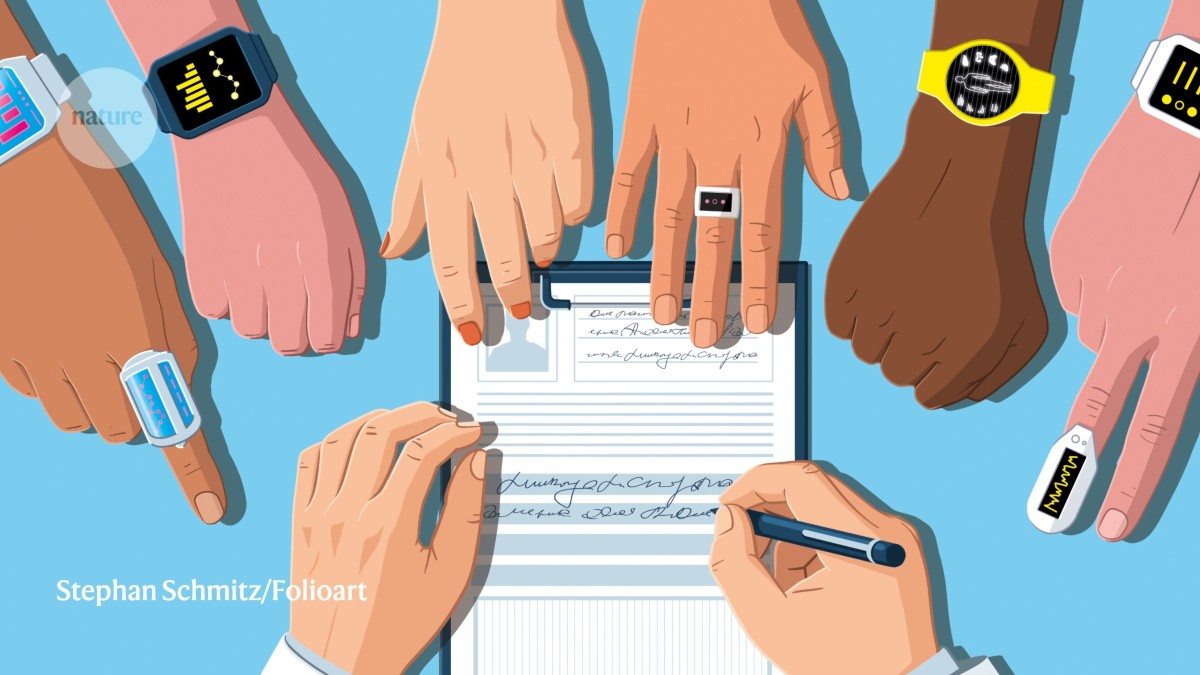
How Smartwatches Could Transform Heart and Neurological Disease Care
Wearable devices that track health data are opening a promising new frontier in medical research. But a case study published in 2020 illustrates one of the field’s central challenges: how patients and clinicians can manage the enormous volume of data generated by smartwatches and other wearable devices.1
The study describes a 70-year-old woman with paroxysmal atrial fibrillation, a condition involving episodes of fast, irregular heartbeats that may or may not cause symptoms. These episodes often resolve without treatment. However, because the patient had other risk factors for stroke, doctors prescribed anticoagulants to reduce the risk of a potentially fatal blood clot.
Nature Index 2026 Biomedical Engineering
The patient wore a smartwatch with an app that monitored her heartbeat and generated electrocardiogram (ECG) readings. During the year after her diagnosis, she checked the readings 916 times. Lindsey Rothman, co-author of the case report, said she consulted an electrophysiologist—a clinician who specializes in heart rhythm disorders—once, and he arrived with a stack of printed ECGs.
“When we say stacks, we mean hundreds of stacks,” Rothman, a clinical health psychologist at Northwestern University in Chicago, Illinois, said.
The case highlights a major challenge for wearable health technology: the vast amount of data it produces. Many consumer devices are not approved for medical use, yet they are worn by hundreds of millions of people worldwide. Patients, clinicians and researchers increasingly need ways to interpret this growing volume of information without becoming overwhelmed.
If that challenge can be addressed, consumer devices and clinically developed “medical-grade” wearables could support new approaches to diagnosing, managing and preventing heart disease, neurological disorders and metabolic diseases.
Using wearable devices to monitor and manage atrial fibrillation
For physicians who specialize in heart rhythm disorders, smartwatches represent a significant technological opportunity. “For the first time, we can monitor patients for long periods of time with an inexpensive device,” said Rod Passman, a cardiac electrophysiologist and director of the Center for Arrhythmia Research at Northwestern Medical School in Chicago, Illinois.
This could be particularly useful for people with atrial fibrillation. Chronic or worsening irregular heartbeats can cause blood to pool in the left atrium, increasing the risk of blood clots that can travel to the brain and cause a stroke.
Approximately one in three people with atrial fibrillation will have a stroke and may take blood-thinning medication for the rest of their lives. However, anticoagulants can cause side effects, including excessive bleeding.
Despite differences in disease severity and the use of other treatments, Passman said the traditional approach is to keep patients with atrial fibrillation and additional stroke risk factors on blood thinners indefinitely—whether they experience an episode daily or annually, or whether their atrial fibrillation improves after weight loss or an ablation.

Rod Passman’s REACT-AF trial is investigating whether wearable data can help fine-tune anticoagulant treatment for people with atrial fibrillation.Credit: Northwestern Medicine
Passman and his colleagues are studying whether wearable devices can track the frequency of atrial fibrillation episodes and help adjust treatment. In the REACT-AF trial, a multicenter US study being conducted at Northwestern University, patients with atrial fibrillation are randomly assigned either to continue their usual anticoagulant dose or to wear a smartwatch with an app that alerts them when they need to temporarily restart their medication.
Many smartwatches can measure heart rate using photoplethysmography, which uses light to detect changes in blood volume, or electrocardiography, a simplified version of the ECG technology used in clinical settings. The innovation in the trial is an app that interprets those signals.
“We hope to show that this strategy is equally effective in preventing stroke,” Passman said. “However, because patients only take blood thinners for a fraction of the time, there is less bleeding, lower drug costs and an improved quality of life.”
Can smartwatches detect undiagnosed heart rhythm problems?
Researchers are also investigating whether wearable devices can screen for and predict undiagnosed cardiac arrhythmias, including rare arrhythmias associated with sudden arrhythmic death syndrome. Approximately 4,000 children and adolescents die each year in the United States from cardiac arrhythmias. Sudden arrhythmic death syndrome can result from a range of genetic disorders, many of which cause no symptoms. In some cases, the first warning is the last.
A review found evidence that consumer smartwatches can detect several types of arrhythmia beyond atrial fibrillation, but it also warned that inaccurate readings could produce false-positive results.2
Passman said smartwatches are not routinely used to identify people at risk because their effectiveness has not been proven. However, the widespread use of these devices makes their potential medical value clear.
Doctors and researchers are becoming more cautious about using standard consumer smartwatches as screening and diagnostic tools, while consumers are increasingly embracing them. Patients are sending smartwatch measurements related to heart rate, stress and sleep to doctors through patient portals, bringing the data to appointments and visiting emergency departments after receiving alerts.
Wearable devices can sometimes identify a genuine health problem. Passman described a patient who was diagnosed with an arrhythmia after a smart device detected an abnormality. However, detecting atrial fibrillation does not necessarily improve health outcomes.
“Intuitively it makes sense that it would be great to do that because you could catch atrial fibrillation early and give patients blood thinners and prevent strokes, but that hasn’t been proven to be the case yet,” he said.
The three-year Heartline study aims to investigate this question. Supported by Apple and pharmaceutical company Janssen, US researchers are recruiting about 28,000 people aged over 65, some with atrial fibrillation and some without. The study is examining whether early detection and symptom monitoring with the Apple Watch can improve cardiovascular outcomes.3
Wearables for falls and seizure monitoring
Wearable devices are also creating new possibilities for neurological care. Consumer smartwatches are already widely used to detect falls, which may be associated with frailty or neurological conditions.
In one controlled trial involving 22 healthy adults, a wearable device correctly identified 77% of falls and had a false-positive rate of 1.7%.4 Researchers are also increasingly interested in devices that can monitor seizures and alert wearers or caregivers.
“Seizures have traditionally been reported based on other people witnessing the seizure,” said Anup Patel, a pediatric neurologist at Nationwide Children’s Hospital in Columbus, Ohio. People who are alone when a seizure occurs may not realize that it is happening.
A small number of regulatory-approved wearable devices designed specifically for seizure detection are available in the United States and Europe. These devices, including armbands and patches, are increasingly being used in clinical trials to collect more accurate information.
However, Patel said detection accuracy remains a concern. Algorithms in approved medical devices that analyze movement, body temperature and heart rate may be around 90% accurate, creating a risk of false-positive alerts. In his experience, some families stop using seizure warning devices after repeated false positives.
Another obstacle is that seizure-monitoring devices are clearly medical products rather than familiar consumer devices such as smartwatches. Their appearance can attract attention and create stigma, meaning that patients may prefer consumer devices if they can provide comparable monitoring.
Researchers are also exploring whether consumer wearables could alert people to an impending seizure, giving them time to move to a safe position or take medication that could prevent or reduce the seizure.
“Are there any biometric parameters that can help us say, ‘If X, Y and Z happens, I’m going to have a seizure?’” Patel said.
The idea is not limited to epilepsy. Across neurology and other areas of medicine, wearable devices might one day alert people when they face a higher risk of an adverse event. Potential applications could include identifying warning signs of migraine or predicting when someone is at increased risk of falling.
“Are there parameters that we can know in advance to say, ‘You’re at risk of falling,’ or ‘Today’s not a good day to go out, so maybe you should take it easy?’” Patel said.
How can wearable health data be integrated into healthcare?
The growing number of potential applications raises a broader question: how can wearable devices be integrated into healthcare systems in ways that improve outcomes at a population level?
Clinicians have the expertise to interpret the large amounts of information generated by wearables, but they must also consider their responsibility for unregulated data from unapproved devices. Patients may send readings to doctors after hours, often because they are anxious about what the data means.
Patel said there were early concerns that doctors could face lawsuits if they failed to review wearable data quickly and a patient later experienced an adverse outcome. He said those concerns have eased because a clear legal condition states that doctors are not responsible for monitoring such information.
Wearable devices could eventually help clinicians monitor chronic disease, detect health problems earlier and personalize treatment. But their wider use will depend on reliable measurements, effective algorithms, clinical evidence and clear systems for turning continuous health data into appropriate medical decisions.
Source: www.nature.com