


Atomic Steps Guide Quantum Vortices Through Ultrathin Superconductors
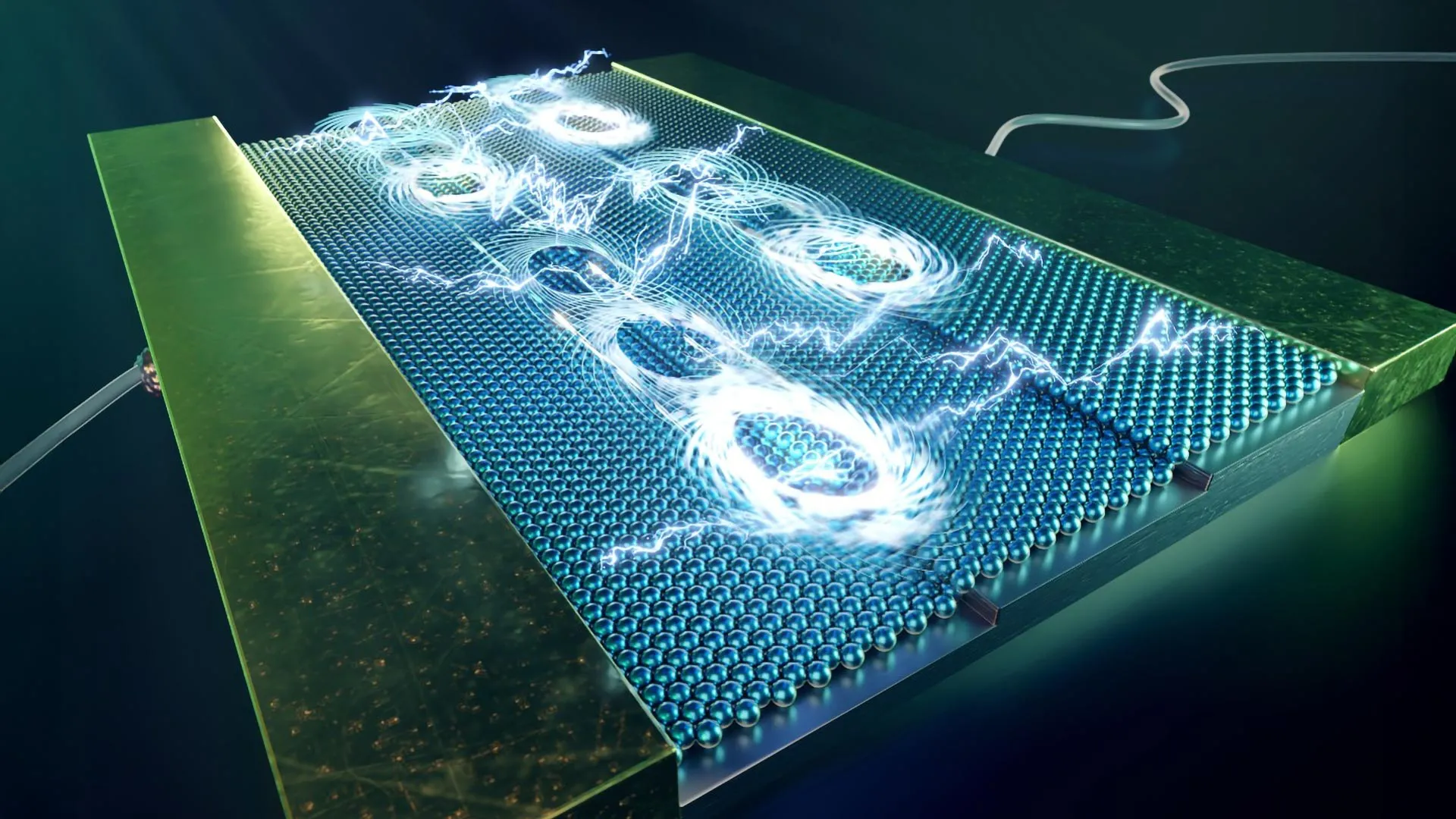
Japanese scientists have discovered that tiny steps just one atom high can act like microscopic tracks, guiding the movement of quantum vortices inside an ultrathin superconductor. Under certain conditions, the vortices moved more than 1,000 times more easily along the atomic steps than across them. The researchers also found that this striking effect could be tuned by changing the temperature or magnetic field.
The discovery was made by researchers at the National Institute for Nanoarchitectonics (MANA), part of Japan’s National Institute for Materials Science (NIMS). Their findings offer a promising new way to control quantum behavior and could eventually help engineers develop superconducting electronics that process information more efficiently while using less energy.
Why controlling quantum vortices matters
Superconductors are materials that can conduct electricity without electrical resistance when cooled below a critical temperature. This property makes them attractive for highly energy-efficient electronics and other advanced technologies.
However, superconductors also contain small quantum structures known as vortices. These structures form when a magnetic field penetrates the material, creating a small region surrounded by circulating currents. When vortices move, they generate electrical resistance, which can reduce the performance of superconductors.
Controlling where these vortices move could therefore help scientists improve superconducting devices. Until now, controlling vortex motion in ultrathin, two-dimensional superconductors has been particularly challenging.
To investigate the problem, a team led by Takashi Uchihashi at MANA studied ultrathin superconductors with surfaces containing regularly spaced atomic steps. Using scanning tunneling microscopy, a technique capable of imaging surfaces at the atomic level, the researchers confirmed that the steps ran parallel to one another and directly observed vortices located along them.
The research results were published in Physical Review B.
One-atom-high steps act like rails for quantum vortices
The experiments revealed a major difference in how easily vortices move in different directions.
Using four-wire resistance measurements, which enable precise measurements of electrical resistance, the team found that vortices moved more than 1,000 times more easily along the atomic steps than across them when exposed to intermediate magnetic fields.
In effect, the steps acted like microscopic rails, creating a preferred path for the quantum vortices to follow.
“Our study shows that atomic-scale steps can act as effective rails to guide superconducting vortices, and that this guiding effect can be tuned simply by changing temperature or magnetic field,” Uchihashi said.
Vortices flow freely within a specific magnetic-field range
The researchers identified especially interesting behavior when the magnetic field was between about 0.10 and 0.20 T, or tesla, the unit used to measure magnetic-field strength. Within this range, vortices could flow freely along the atomic steps without becoming trapped by imperfections in the material.
This behavior is known as one-dimensional unpinned vortex flow. It means that a vortex can move along a defined path without encountering the usual obstacles that restrict its movement.
Quantum tunneling controls vortex motion at low temperatures
At the lowest temperatures, the researchers observed another unusual effect: the vortex motion was governed by quantum tunneling. This phenomenon allows quantum objects to pass through energy barriers that would normally prevent movement according to classical physics.
A potential route to more efficient superconducting technologies
The discovery demonstrates that surface features only one atom high can have a powerful effect on the movement of quantum vortices.
By using atomic steps as natural guiding paths, scientists may be able to control vortex motion with considerable precision. The ability to tune this motion through temperature and magnetic fields provides additional ways to influence the behavior of ultrathin superconductors.
Although further development is needed before practical applications are possible, this atomic-scale approach could eventually help researchers manage vortex motion and heat flow in future superconducting technologies. In turn, it may support the development of more efficient devices that consume less power.
Source: www.sciencedaily.com