


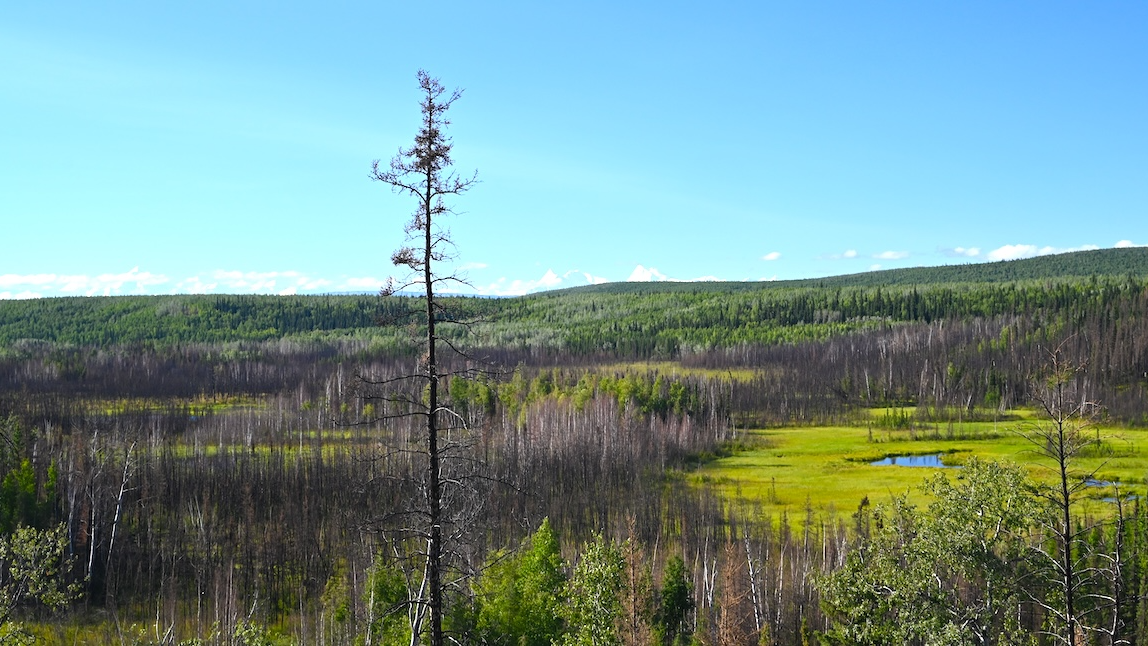
13,800-Year-Old Alaska Site May Reveal the Americas’ Earliest Dog Owners
Archaeologists excavating a 13,800-year-old site in interior Alaska have uncovered thousands of artifacts and animal remains, including evidence of an early settlement, the oldest known needles in the Western Hemisphere and what may be the bones of one of the Americas’ earliest domesticated dogs.
The discoveries at Shégˊ Xdaltthˊíˊ, a site in eastern Beringia, also reveal cultural connections between ancient people in Alaska, Siberia and regions farther south in North America.
A remarkable base camp in ancient Beringia
Beringia was a vast region that connected northeast Asia and northwestern North America during the last ice age. Genetic and archaeological research suggests that the ancestors of today’s Native Americans entered the continent at least 21,000 years ago. However, much remains unknown because many Beringian sites were small, seasonal hunting camps scattered across a huge and remote landscape.
Researchers initially expected to find hunting tools and a small amount of debris at Shégˊ Xdaltthˊíˊ. Instead, they discovered what appears to have been a substantial residential base camp containing tens of thousands of artifacts.
“I expected to find hunting tools and little else,” study lead author Kelly Graf, an archaeologist at the University of Kansas, told Live Science via email. “I was really surprised!”
The findings were detailed in a study published in the journal Science Advances.
Archaeologists found traces of a hearth, a small hole and a wooden post. Together, these features may represent the remains of a lean-to or an early tentlike structure. Nearby, an earthen oven containing charcoal and animal bones may have been used to slow-cook meat for large families.
The site also contained stone tools, bone needles and pendants made from animal horn. The researchers describe its complex arrangement of features as the earliest possible example of a settlement structure in North America.
“Early Alaskans were very aware of their surroundings,” the researchers wrote.
Stone tools point to connections across the continent
The stone tools recovered at Shégˊ Xdaltthˊíˊ have a distinctive form associated with central Alaska. One type, made from rhyolite and basalt, has a diamond-shaped or dihedral handle and resembles tools found across Beringia, including areas in what is now northern Siberia.
Obsidian artifacts provide another clue about the movement of people and materials. The volcanic rock came from geological sources hundreds of miles to the northwest, suggesting that people either traveled widely or maintained exchange networks across the region.
Researchers also found the bones of more than a dozen wolf-like animals. Analysis of one jaw showed that it did not belong to a dire wolf, a Pleistocene Beringian wolf or a typical gray wolf. Instead, it came from a group of wolf-like animals endemic to central Alaska.
Could these be the bones of an early domesticated dog?
The animal remains may also offer clues about the history of dogs in North America. Current genetic evidence suggests that early domesticated dogs in the Americas descended from Siberian wolves.
The age and location of Shégˊ Xdaltthˊíˊ provide circumstantial evidence that the people living there may have kept dogs. However, the researchers have not established definitively that the wolf-like remains belonged to domesticated animals.
“Like humans, the canids at Shégˊ Xdaltthˊíˊ and other early Alaskan sites could potentially be recent immigrants from Beringia in Asia,” the researchers wrote.
The oldest needles in the Western Hemisphere
The site’s bone artifacts also reveal cultural links between ancient Alaskan communities and people living farther south.
Archaeologists recovered eight bone needle fragments from Shégˊ Xdaltthˊíˊ. The researchers say these are the oldest needles discovered in the Western Hemisphere. Their presence suggests that the people at the site used sewing technology and shared cultural practices with communities in temperate North America.
Another artifact, a horn pendant, had a hole at one end and a pointed shape at the other. Similar personal ornaments have been found at early sites farther south, providing additional evidence of cultural connections across the continent.
“The co-occurrence of these cultural features at a single site is truly remarkable,” the researchers wrote, highlighting cultural ties between early peoples in Beringia and the Americas.
It remains unclear whether the people who lived at Shégˊ Xdaltthˊíˊ traveled regularly to maintain these connections or whether the similarities reflect broader shared traditions. “It’s hard to tell if they came and went throughout their lives, but we can at least say they’re related,” Graf said.
More excavations could transform our understanding of Beringia
Future archaeological work in Alaska could help researchers better understand the earliest people to live in the Americas. Although Alaska is enormous, its remote landscape means that only a few areas have been studied intensively.
Spencer Pelton, an archaeologist at the University of Wyoming who was not involved in the study, wrote in an accompanying perspective that early Indigenous sites in Beringia are essential to understanding the peopling of the Americas.
“Shégˊ Xdaltthˊíˊ is remarkable because it is the oldest archaeological site in the Americas containing a large and rich assemblage of features, artifacts and animal remains that indicate long-term residential occupation,” Pelton wrote.
Graf is planning additional excavations in the area. The project will incorporate local knowledge and involve young Alaska Native participants. Two co-authors are Alaska Native elders from communities closest to the site, and they helped name the location and identify areas for excavation.
There is still much to learn about life in Beringia around 14,000 years ago. Researchers note that only a small number of archaeological sites from this period have been identified, including one in the Yukon Territory that dates to approximately 24,000 years ago. Continued work may reveal how early communities moved through the region, exchanged materials and interacted with the animals that accompanied them.
Study details
Graf, K. E., Goebel, T., Henry, A., Hockett, B., Sherry, N., Antonosian, M., Meachen, J., Sewing, M., Herbert, M., Esdale, J. A., Araun, S. A., Gore, A. K., Lasic, J. T., Roberts, P., Combs, E., and Charlie, D. (2026). Highlights of Beringia’s early basecamp 13,800 years ago: Shégˊ Xdaltthˊíˊ and the late Pleistocene Alaskan people. Science Advances.
How much do you know about the first people to reach the Americas? Test your knowledge with our First Americans quiz.
Source: www.livescience.com