


Close Menu
HitechubHitechub
    What's Hot
    Science

    AI Identifies Over 250,000 Questionable Cancer Research Papers: Unveiling Critical Issues in Oncology

    Science

    New Diabetes Implant Uses Electrical Stimulation to Remove Excess Blood Sugar

    Science

    Uncovering New Zealand’s Giant Birds: Rare Goose Fossil Redefines Their History

    Important Pages:
    • About Us
    • Privacy Policy
    • Terms & Conditions
    Facebook X (Twitter) Instagram Pinterest
    Facebook X (Twitter) Instagram
    HitechubHitechub
    Thursday, November 26
    • Shop
      • Fashion
        • Mens
        • Womens
        • Accessories
          • Handbags
          • Keychain
          • Masks
          • Money clicps
          • Neck Pillow
          • Rings
          • Towels
          • Wallets
        • Jewelry
        • Watches
        • T-shirts
        • Hawaiian shirts
        • Vests
        • Swim trunks
        • Swimsuits
      • Fun
        • Magic cubes
        • Magnifiers
        • Misc
        • Photo books
        • Puzzles
        • Toys
      • Home
        • Cleaning/Care
        • Mailbox covers
        • Mugs
        • Pot Holders
        • Spoon
      • Office and Electronics
        • Chairs
        • Office Supplies
        • IPad cases
        • Laptop stickers
        • Mouse pads
        • Notebooks
        • Pencil bags
        • Pens
        • Phone cases
      • Personalized
      • Pets
      • Sports
        • Cycling
          • Balaclava Mask
          • Bike Bell
          • Bike Computer
          • Bike Fender
          • Bike Grips
          • Bike Kickstand
          • Bike Light
          • Bike Locks
          • Bike Mitts
          • Bike Pumps
          • Bike Repair Stand
          • Bike Seat
          • Bike Trainer
          • Bike Wheels
          • BIKES
            • Folding Bikes
            • Road Bikes
          • Carbon Fiber Bike Products
          • Cycling Mask
          • Kid’ Bike Helmets
          • Inner Tube
          • Motorcycle Bag
          • Nylon Pedals
          • Adult Helmets
          • Photochromic Sunglasses
          • Soft Coolers
          • Suction Cup Bike Rack
          • Tool accessories
          • Winter Cloth
          • Heart Rate Monitor
        • Outdoors/Camping
          • Outdoor Bags
        • Sweatband
    • Technology
      1. AI
      2. Gadgets
      3. View All

      This is the most popular CEO in the world

      Sectors in which “Chat-GPT” is most often used

      Artificial intelligence has begun to “swallow” professions

      The unusual robot conductor of a concert in Seoul

      Here’s how you can tell if your phone is being tapped

      PlayStation 5 becomes a completely silent console and gets more space

      This is the first phone that can be used to park a car

      Best Gaming Laptops 2023: Powerful Portables for PC Games

      Top 30 Early Black Friday Deals 2026: Best Picks and Ultimate Buying Guide

      Kagi Announces Gmail Rival After Challenging Google Search

      European Spacecraft Discovers Chaotic Asteroid Impact Site After Deflection Test

      Iowa Lead Explosion Investigation: Scientists Begin Studying Its Environmental Impact

    • Science
      1. Space
      2. Wheels
      3. View All

      Space Perspective: A Journey to the Edge of Space

      5 Fascinating Facts About Space

      Space Exploration: Unveiling the Wonders of the Universe

      Toyota wants to make a new generation battery with a range of up to 1,200 km

      Meet Toyota’s lunar “baby” that could make exploring the Moon easier

      What does a night drive look like with one of the most beautiful cars in the world: the Rolls-Royce Ghost

      Coherent Fermion-Parity Oscillations in Coupled Minimal Kitaev Chains

      Iowa Explosion Lead Contamination Concerns Persist Despite Official Assurances

      Einstein’s 120-Year-Old Theory May Be Missing a Major Clue About the Big Bang

      Physicists Use Gravity to Send Unblockable Messages Through Brick Walls

    HitechubHitechub
    Home » Antarctic Sea Ice Reversal Surprises Scientists
    Science

    Antarctic Sea Ice Reversal Surprises Scientists

    Share Facebook Twitter Pinterest WhatsApp
    Share
    Facebook Twitter LinkedIn Pinterest WhatsApp

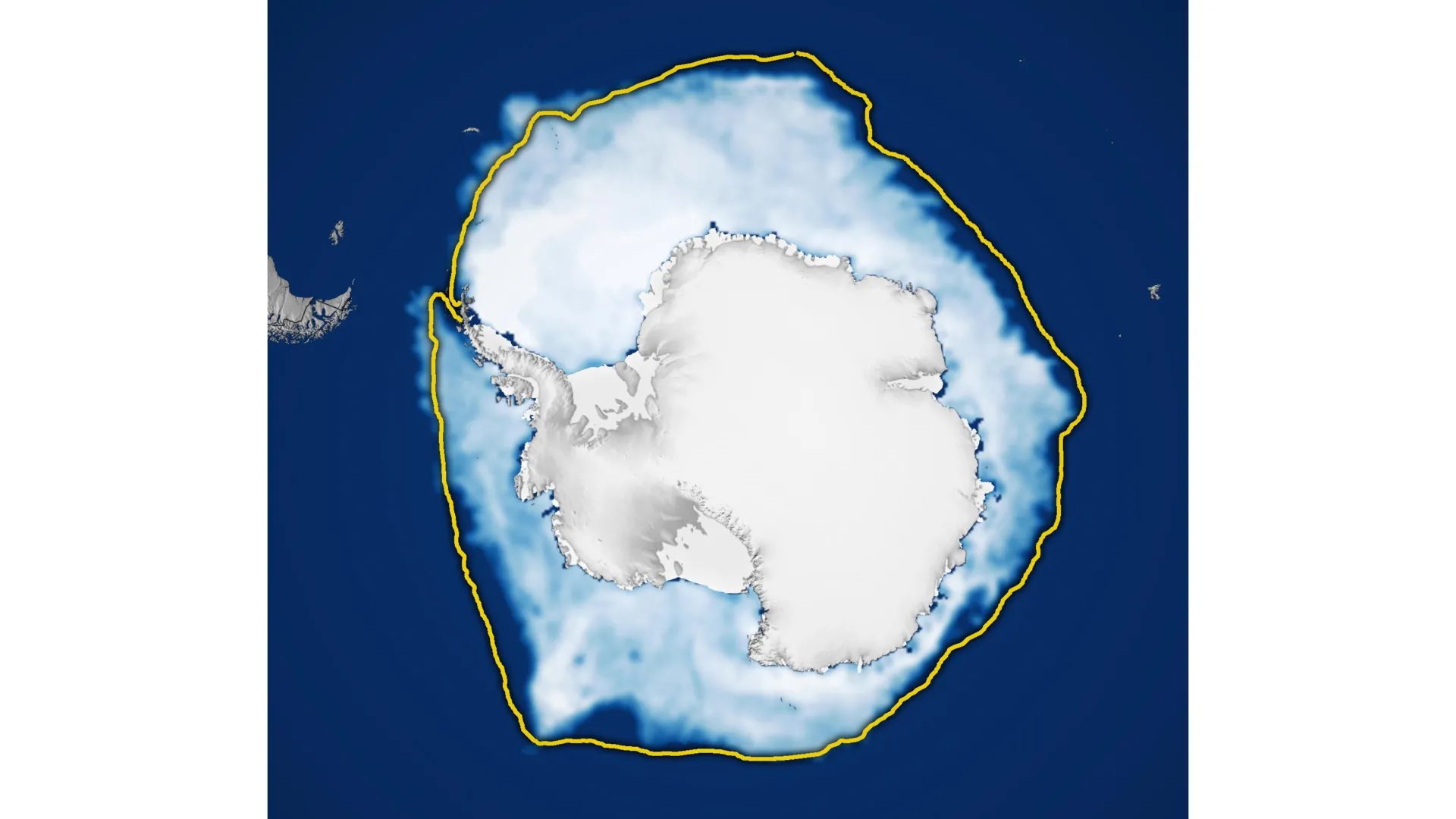
    Antarctic Sea Ice Hits Third-Lowest Winter Maximum on Record in 2026

    Antarctic sea ice reached its annual winter peak on September 14, 2026, with less ice covering the Southern Ocean than in almost any year since satellite measurements began. The maximum extent was the third lowest in the satellite record, adding to growing evidence of major changes in Antarctica’s ice cover.

    Why Antarctic sea ice peaks in September

    Antarctica is surrounded by a vast ocean, giving sea ice plenty of room to spread outward during the Southern Hemisphere winter. This differs from the Arctic, where ocean basins are largely surrounded by land.

    Antarctica’s open-ocean geography allows winter sea ice to expand over long distances. However, that expansion also pushes the ice into warmer latitudes, making it more vulnerable to melting during summer. Antarctic sea ice typically reaches its maximum extent in September before shrinking to its annual minimum in February.

    According to NASA and the National Snow and Ice Data Center (NSIDC), Antarctic sea ice may have reached its 2026 maximum extent on September 14. At its peak, the ice covered approximately 17.59 million square kilometers (6.79 million square miles). That made 2026 the year with the third-lowest winter maximum sea ice extent in the satellite record.

    The map below compares seasonal changes in Antarctic sea ice. It shows average ice concentration for September on the left and February of the following year on the right, using data from 1990 through 2026. The solid white areas show the highest ice concentrations, while dark blue represents open ocean.

    Only locations where ice covers at least 15 percent of the water are included. Scientists use this threshold to determine which areas count as ice-covered when calculating total sea ice extent.

    Antarctic sea ice went from record highs to historic lows

    For decades, Antarctic sea ice appeared to be moving in the opposite direction of the Arctic’s rapidly shrinking ice cover. Between 1979 and 2014, Antarctic sea ice extent increased by about 1 percent per decade.

    However, Antarctic sea ice naturally fluctuates widely from year to year. Researchers therefore remain uncertain whether the gradual increase during that period represented a meaningful long-term trend.

    The expansion was especially pronounced from 2012 to 2014, when Antarctic winter sea ice reached a record high for three consecutive years. Those records contrasted sharply with conditions in the Arctic, where sea ice was declining rapidly.

    That upward trend ended in 2015. As 2016 began, Antarctica experienced a significant drop in sea ice extent, marking a notable reversal from the previous decades. Although some years have brought modest recovery, Antarctic sea ice has generally remained below historical averages.

    The most extreme conditions occurred in 2023, when Antarctica recorded both its lowest summer minimum and lowest winter maximum since satellite observations began. The unusually low 2026 maximum adds another important data point to the region’s changing ice conditions.

    Scientists continue to monitor Antarctic sea ice each year to determine whether these declines signal a permanent shift in conditions or remain within the range of natural statistical fluctuations.

    How satellites measure Antarctic sea ice through clouds

    Scientists measure Antarctic sea ice with satellites equipped with instruments called passive microwave sensors. Instead of relying on visible light, these instruments detect microwave energy naturally emitted from Earth’s surface.

    Sea ice produces stronger microwave signals than open ocean water, allowing researchers to distinguish between frozen and ice-free areas. Microwaves can also pass through clouds, enabling scientists to observe Antarctic sea ice even when thick cloud cover blocks traditional satellite cameras.

    The long-term satellite record began in late 1978 with observations from NASA’s Nimbus 7 spacecraft. Beginning in 1987, satellites operated by the Defense Meteorological Satellite Program (DMSP) supplied additional measurements. NASA’s Aqua satellite also contributed data from 2002 to 2011.

    Monitoring efforts continue to evolve as satellite technology changes. In 2025, researchers began incorporating observations from the Japan Aerospace Exploration Agency’s GCOM-W satellite, helping maintain the decades-long record used to study changes in Antarctic sea ice.

    Image by Michala Garrison using data from NASA Earth Observatory and the National Snow and Ice Data Center.

    Source: www.sciencedaily.com

    Share. Facebook Twitter Pinterest LinkedIn WhatsApp
    Previous ArticleArchaeologists Discover Oldest Known Dwelling in the Western Hemisphere at 13,800-Year-Old Alaska Site
    Next Article Polymarket Recorded $600 Million in Election-Related Transactions After Election Day

    Related Posts

    Science

    Coherent Fermion-Parity Oscillations in Coupled Minimal Kitaev Chains

    Science

    Iowa Explosion Lead Contamination Concerns Persist Despite Official Assurances

    Science

    Einstein’s 120-Year-Old Theory May Be Missing a Major Clue About the Big Bang

    Science

    Physicists Use Gravity to Send Unblockable Messages Through Brick Walls

    Technology

    Iowa Lead Explosion Investigation: Scientists Begin Studying Its Environmental Impact

    Science

    Engineering Signaling Centers for Human Trunk Morphogenesis In Vitro

    Science

    NASA Expands Supplier Program With New Mentor-Protégé Agreements

    Science

    Single-Cell Variant-to-Enhancer-to-Gene Map of Coronary Artery Disease Genetics

    Add A Comment
    Leave A Reply Cancel Reply

    Stay In Touch
    • Facebook
    • Twitter
    • Instagram
    • Pinterest
    Top Picks
    Science

    Rare Comet Becomes Third Interstellar Object in Our Solar System: New Research Unveils Its Mysterious Formation

    Recent research explores the chemical structure of 3I/ATLAS through telescope observations, suggesting its formation in…

    BOOX Picco Unveiled as the World’s Smallest E-Reader in 2026

    Google DeepMind’s New AI Tool Advances Genetics Research, but Experts Urge Caution

    Ötzi’s Frozen Remains: Potential Home to Active Microorganisms

    Beyond the Transcontinental Burrito Tunnel: An Unforgettable Journey

    Most Popular
    Science

    Biologists Create Synthetic Cells Capable of Nourishing, Growing, Dividing, and Evolving

    Science

    Hip Bone Reveals Homo floresiensis ‘Hobbit’ Species Walked More Like Modern Humans Than Lucy

    Categories
    • AI (9)
    • Gadgets (6)
    • Science (3,594)
    • Space (3)
    • Technology (3,237)
    • Wheels (3)
    Our Picks
    Technology

    RFK Jr. Suggested FDA Overlook Unproven Peptides, Report Says

    Technology

    Huawei Found Guilty of Stealing Trade Secrets but Acquitted of Extortion

    © 2026 Hitechub.
    • Home
    • About Us
    • Privacy Policy
    • Terms & Conditions

    Type above and press Enter to search. Press Esc to cancel.

    GDPR Cookie Banner

    We are using cookies to give you the best experience on our website.

    You can find out more about which cookies we are using or switch them off in .

    Ad Blocker Enabled!
    Ad Blocker Enabled!
    Our website is made possible by displaying online advertisements to our visitors. Please support us by disabling your Ad Blocker.