


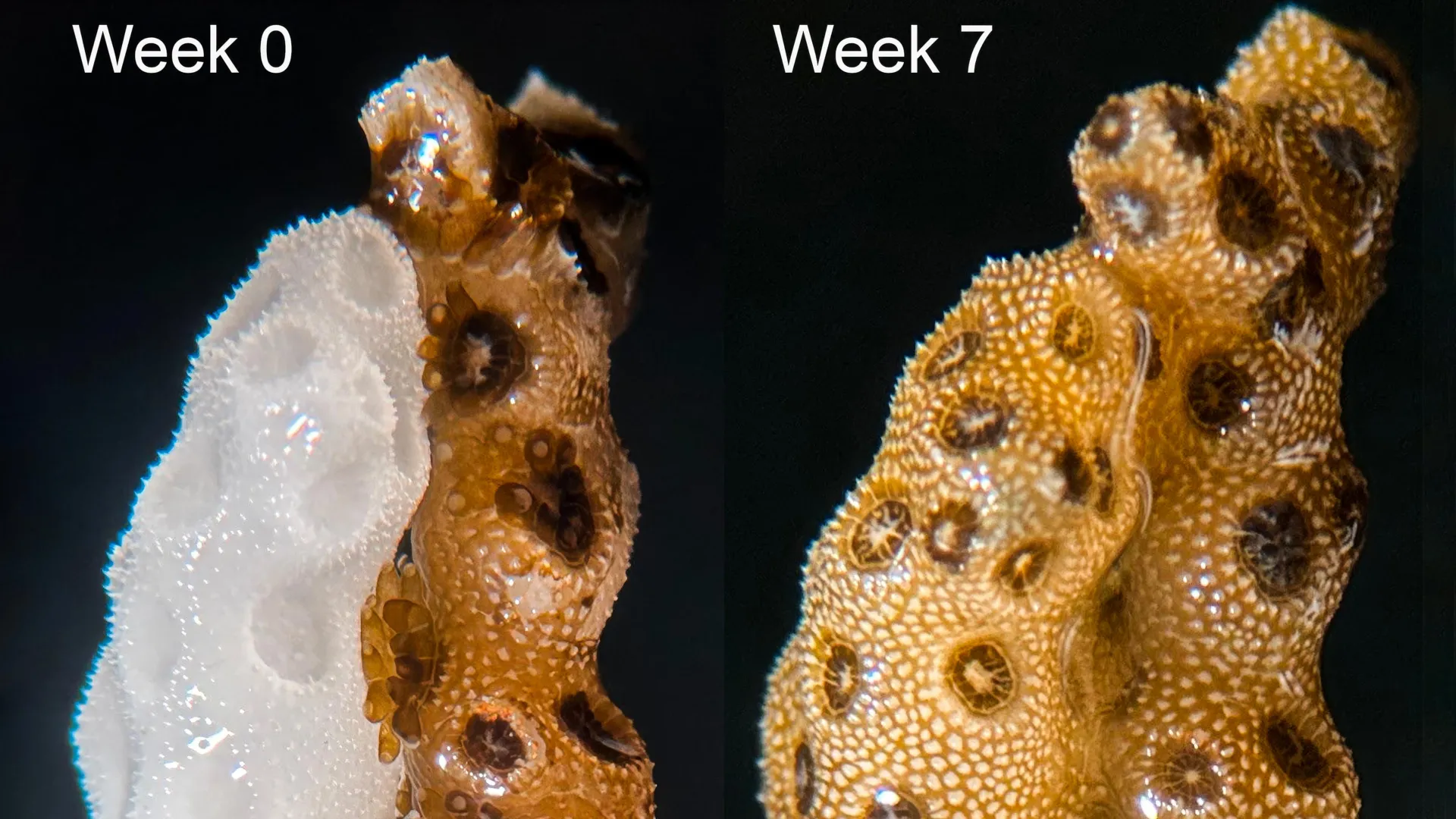
Bleached Corals Can Recover in Just Seven Weeks After Contact With Genetically Identical Healthy Corals
Researchers have demonstrated for the first time that severely bleached corals can fully recover after only a few days of contact with healthy, genetically identical corals.
In laboratory experiments, corals that had turned white and were close to death returned to health within seven weeks. The study, published on October 14 in Science Advances, documents the fastest coral-bleaching recovery reported to date. The discovery could help inspire new techniques for restoring damaged coral reefs.
Some estimates suggest that climate change will make ocean heatwaves more intense and frequent, putting coral reefs at risk of disappearing within a few decades.
Coral bleaching occurs when rising ocean temperatures cause corals to lose the beneficial algae living in their tissues. These algae provide much of the energy corals need to grow and survive. Without them, corals lose their vibrant colors, struggle to obtain enough nutrients, and become more vulnerable to harmful algae and disease. Even when bleached corals survive, they can need months or years to regain their health.
“Bleached corals may be dying, but they’re not dead yet,” said lead author Danny Collins, a marine doctoral student at the Stanford Doerr School of Sustainability. “The question we wanted to answer is: What can be done when corals bleach?”
An unexpected discovery points to a way to save bleached corals
Although corals may resemble plants or rocks, they are animals. In many coral species, individual animals reproduce by creating genetically identical copies of themselves. These clones grow together into large colonies that form the foundation of coral reefs.
The idea for the study came from an unexpected observation in 2025. Study co-author Steve Palumbi, the Jane and Marshall Steele Jr. Professor of Marine Science, noticed that two fragments from the same coral colony had fallen against each other in his laboratory tank. One fragment was healthy, while the other was bleached.
Where the two fragments touched, the bleached coral began to regain its color, suggesting that beneficial algae were returning to its tissues.
Around the same time, Collins was studying how coral diseases begin and spread. He was particularly interested in bacteria carried by plastic debris that attaches to corals and introduces harmful microorganisms through direct contact.
“Harmful bacteria enter corals through physical contact,” said Collins, who is also a Knight-Hennessy Scholar. “We were interested in what would happen if we used contact to reintroduce something good: beneficial algae from healthy corals.”
To test the idea, Collins and his colleagues created 10 pairs of coral fragments. Each pair consisted of one healthy and one bleached fragment from the same coral animal.
Five pairs were placed in direct physical contact. The other five pairs were separated by a gap of just a few millimeters.
The results showed a dramatic difference. Every bleached fragment that touched a healthy fragment fully recovered within seven weeks. By contrast, the bleached fragments kept apart died.
How contact with healthy corals triggers rapid recovery
The researchers discovered that the recovery depends on the ability of genetically identical corals to connect their tissues.
“Genetically identical corals recognize each other when they come into contact,” said Palumbi, a professor of oceanography in the Doerr School of Sustainability and a professor of biology in the School of Humanities and Sciences. “If they are from the same clone, the tissues will fuse. A similar phenomenon is seen in humans. Organ transplants are often successful when the donors are identical twins.”
Using powerful microscopes, Collins and his colleagues observed what happened as the coral fragments touched. Small channels inside the tissues quickly aligned and formed connections that allowed material to move between the two pieces.
These connections enabled beneficial algae and the nutrients they produce to move from healthy corals into bleached corals. Within just three days, the researchers observed algae colonizing the damaged fragments.
The team then investigated how long the corals needed to remain connected. By separating the pairs after different periods of contact, the researchers found that one week was enough to transfer the algae required for full recovery. In some cases, the same result was achieved after only five days.
After being separated, the bleached corals returned to full health within seven weeks—the same recovery period observed when the fragments remained connected throughout the experiment.
This finding showed that rapid recovery was not primarily caused by a continuous supply of algae from the healthy coral. Instead, once enough algae entered the bleached fragment, the algae multiplied rapidly inside the new host and restored its energy supply.
“Once the beneficial algae enter the bleached coral, they don’t just spread,” Palumbi said. “They crowd in at the fastest rate seen in corals and begin to fragment.”
During the second week of contact, the number of beneficial algae inside the bleached fragments doubled approximately every four days. That growth rate was about 10 times faster than the rate observed in wild corals.
Could the discovery help restore coral reefs?
Scientists have spent decades searching for ways to protect coral reefs from rising ocean temperatures, disease, ocean acidification, and other environmental pressures.
Current approaches include selectively breeding corals that tolerate high temperatures, raising young corals in nurseries to rebuild damaged reefs, and transferring microbial communities between corals to improve their resilience.
The new findings suggest another possible strategy: helping bleached corals recover quickly enough to survive the dangerous period following a marine heatwave.
“Bleached corals are often thought of as a lost cause because they recover very slowly, even in heatwaves,” said Fiorenza Micheli, the David and Lucille Packard Professor of Marine Science and an advisor at Collins College. “We hope this new research will yield solutions that keep corals healthy long enough to allow for full recovery through slow processes such as growth, reproduction, and recruitment of new colonies after a heatwave.”
However, the researchers stress that this experimental approach cannot yet be used for large-scale coral reef restoration. For the method to work as demonstrated, every bleached coral would need access to a healthy, genetically identical coral. Finding and supplying those matches across an entire reef would be impractical.
Important questions also remain about how the recovery mechanism could be adapted for broader use.
The researchers plan to investigate other ways to introduce beneficial algae into bleached corals without keeping them physically connected to healthy coral fragments.
One possibility is to collect beneficial algae from healthy corals before a marine heatwave occurs. Researchers could then introduce large numbers of the algae into damaged corals after a bleaching event, potentially allowing them to recover more quickly.
“These new insights into how corals naturally recover give us hope for the future,” said Micheli, who is also co-director of the Stanford Center for Ocean Solutions. “They open the door to possibilities and could lead to the breakthroughs needed to accelerate coral reef recovery.”
Research authors and support
Micheli is also a professor of oceans and biology. Micheli and Palumbi are senior fellows at the Woods Institute for the Environment, part of the Stanford Doerr School of Sustainability.
Other Stanford researchers who contributed to the study include Yana Shipkova, Nathaniel Mollica, Tom Rowland, Courtney Klepak, Gabriel Calistro, and Vanessa Barone.
Mollica is a research scientist at Stanford University’s School of Oceanography, and Calistro is a research assistant. Rowland is a research engineer in the Manufacturing Laboratory in the Harold A. Miller Library at Hopkins Marine Station, part of the Doerr School of Sustainability.
Shipkova is a postdoctoral researcher, while Klepak is a research scientist. Barone is an assistant professor in the Department of Biology in the College of Humanities and Sciences at Stanford University and is affiliated with Bio-X and the Institute for Maternal and Child Health.
Coral image analysis was conducted by the Center for Molecular and Cellular Biodiversity Imaging at Hopkins Marine Station, operated by Stanford University’s Department of Biology.
Funding came from the National Science Foundation and Stanford University, including seed funding through the Big Idea for Oceans grant program. The program is organized by the Department of Oceanography within the Stanford Doerr School of Sustainability and the Woods Institute for the Environment.
Source: www.sciencedaily.com