



How Many Cosmic Particles Pass Through Your Body Every Second?
Earth is constantly bombarded by particles from space. Some are blocked or absorbed by the atmosphere, while others pass through the air, the ground and even our bodies without us noticing.
So, how many cosmic particles pass through a person at any given moment? The answer is surprisingly large: roughly 100 trillion neutrinos pass through each of us every second, along with dozens to hundreds of other particles produced by cosmic rays.
Neutrinos: The “Ghost Particles” Passing Through You
The most common particles from space passing through our bodies are neutrinos. These tiny, electrically neutral particles have almost no mass and rarely interact with ordinary matter.
“An estimated 100 trillion neutrinos pass through each of us every second,” Michael Pravica, a physics professor at the University of Nevada, Las Vegas, told Live Science.
Because neutrinos interact so weakly, almost all of them pass through the human body—and even through the entire Earth—without leaving a trace. Their ability to travel through dense matter makes them extremely difficult to detect.
From the latest videos Live Science
Neutrinos are created by nuclear reactions. Most of the neutrinos reaching Earth come from nuclear fusion inside the sun, where hydrogen atoms combine to form helium. Others originate much farther away, including from exploding stars, active galaxies and other powerful cosmic events.
Sign up for our newsletter
Image credit: Marilyn Perkins / Future
Sign up for our weekly Life’s Little Mysteries newsletter to discover the latest scientific mysteries and explanations.
Cosmic Rays Create Showers of Particles
Neutrinos are not the only extraterrestrial particles reaching Earth. The planet is also struck by cosmic rays—high-energy, charged particles that travel through space at close to the speed of light.
Most cosmic rays are protons, which are the nuclei of hydrogen atoms. Others are atomic nuclei from heavier elements, including helium and iron. A smaller portion consists of electrons and positrons, the antimatter counterparts of electrons.
Cosmic rays come from a variety of sources. Some are produced by the sun, while many others originate beyond the solar system. Supernova explosions, colliding galaxies and regions surrounding black holes can all accelerate particles to enormous energies.
When a cosmic ray strikes a molecule high in Earth’s atmosphere, the collision produces a cascade, or shower, of secondary particles. Some of these particles reach the ground, including muons.
Muons are negatively charged subatomic particles similar to electrons, but they are more than 200 times heavier. Because they carry an electric charge, muons can interact with matter as they pass through it.
At sea level, approximately one muon passes through each square centimeter every minute. For the human body, that translates to tens to hundreds of muons passing through the body every second. Approximately one or two muons may pass through an area the size of a person’s hand each second.
Scientists can observe the paths of muons in a cloud chamber, where charged particles leave visible trails in supersaturated vapor.
Unlike muons, neutrinos have no electric charge and almost no mass. These properties allow them to pass through matter with an extraordinarily small chance of interacting, earning them the nickname “ghost particles.”

The IceCube Neutrino Observatory in Antarctica.
How Scientists Detect Cosmic Particles
Scientists estimate the number of neutrinos passing through our bodies by measuring the tiny fraction that interact with matter inside or near a detector. Researchers then use those observations to calculate how many neutrinos must have passed through undetected.
One of the world’s most sophisticated neutrino detectors is the IceCube Neutrino Observatory at the South Pole. The detector uses about 1 cubic kilometer of Antarctic ice, surrounded by thousands of optical sensors.
When a neutrino collides with an atomic nucleus in the ice, it can produce a fast-moving charged particle. That particle emits a faint blue glow known as Cherenkov light. By analyzing the light’s pattern and brightness, scientists can determine the neutrino’s energy and direction.
Estimating the total number of neutrinos is similar to estimating the number of fish in a river after catching only a few. Researchers account for the detector’s size, the length of time it operates, its detection efficiency and the probability that neutrinos of different energies will interact.
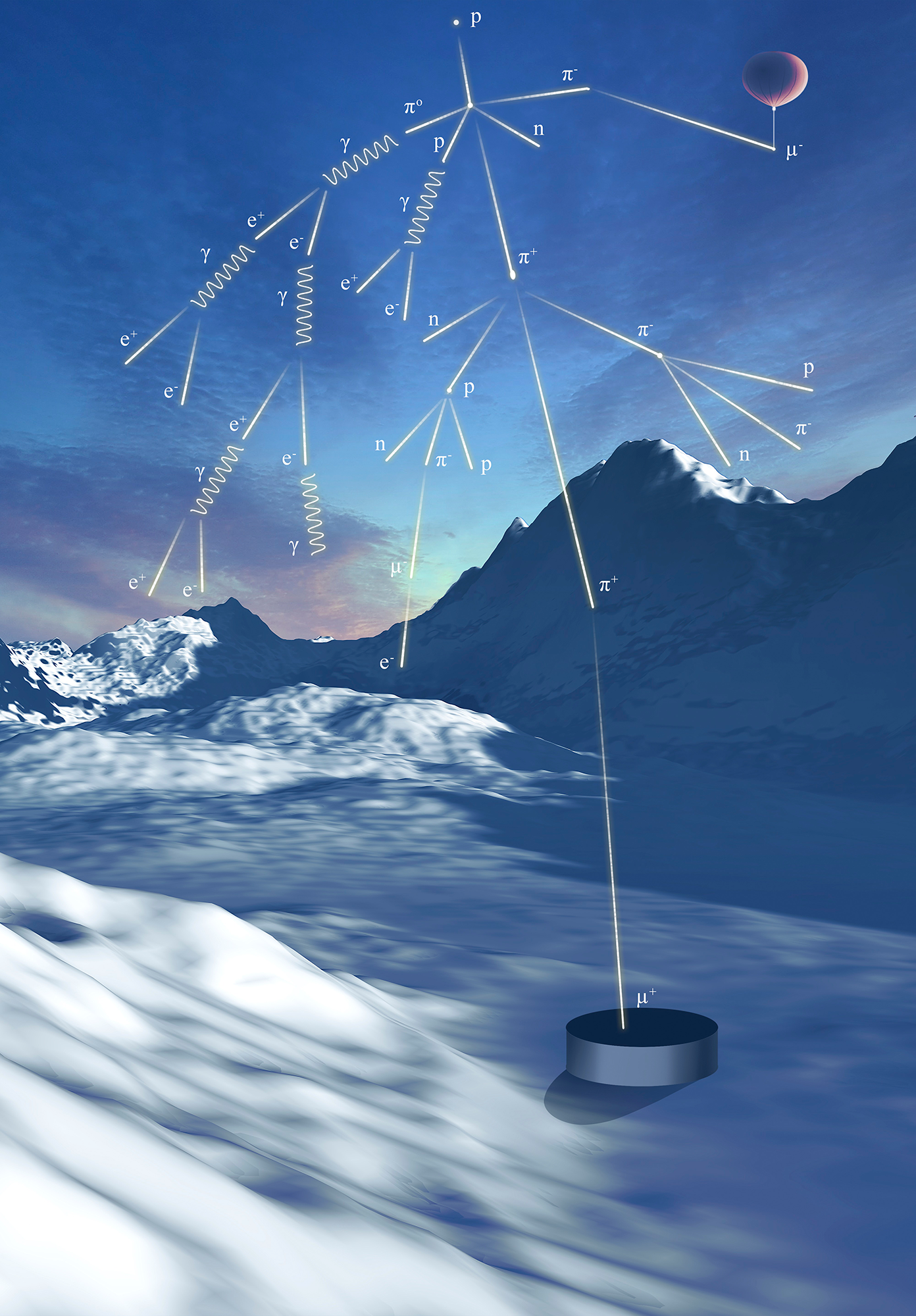
Cosmic rays collide with molecules in Earth’s atmosphere and create showers of secondary particles, including muons.
Image credit: MARK GARLICK/SCIENCE PHOTO LIBRARY via Getty Images
Are Cosmic Particles Dangerous?
Although trillions of neutrinos pass through the human body every second, they almost never interact with atoms. Over an entire lifetime, a person may experience only one or a few neutrino interactions inside their body.
These rare interactions are harmless. Neutrinos carry so little energy that they do not pose a meaningful health risk.
Cosmic-ray particles can have a greater biological effect, particularly at high altitudes. On the ground, the penetrating charged particles produced by cosmic-ray showers are mainly muons. During air travel, secondary particles such as neutrons contribute more significantly to radiation exposure.
Even so, the health effects are generally small. Cosmic radiation contributes about 0.4 millisieverts of radiation exposure per year for the average person—roughly comparable to the exposure from a few chest X-rays. The amount varies with altitude, latitude and the level of shielding.
At typical ground level, muons and other cosmic-ray particles are not considered a significant health hazard. Life on Earth has existed with this natural background radiation for billions of years.
What Can Cosmic Particles Reveal?
Cosmic particles are more than invisible visitors. They also provide scientists with valuable information about the universe and can be used to study objects that are difficult to observe with light.
For example, muon detectors have helped researchers identify a previously hidden chamber inside the Great Pyramid of Giza. Muons can pass through large structures, making them useful for imaging areas that cannot be reached directly.
High-energy neutrinos allow astronomers to investigate some of the most violent environments in the universe, including regions near black holes, exploding stars and powerful cosmic accelerators. Because neutrinos interact so weakly, they can escape from dense regions that block light and other forms of radiation.
As a result, neutrinos can carry information directly from the locations where some of nature’s most energetic particles are produced.
Every second, around 100 trillion neutrinos and tens to hundreds of muons pass through our bodies. Smaller numbers of neutrons and other secondary particles also reach Earth’s surface.
These invisible particles are a constant reminder that humans are connected to the wider universe—and to a cosmic history stretching back approximately 13.8 billion years.
How much do you know about black holes? Take our black hole quiz.
Topics
Source: www.livescience.com