


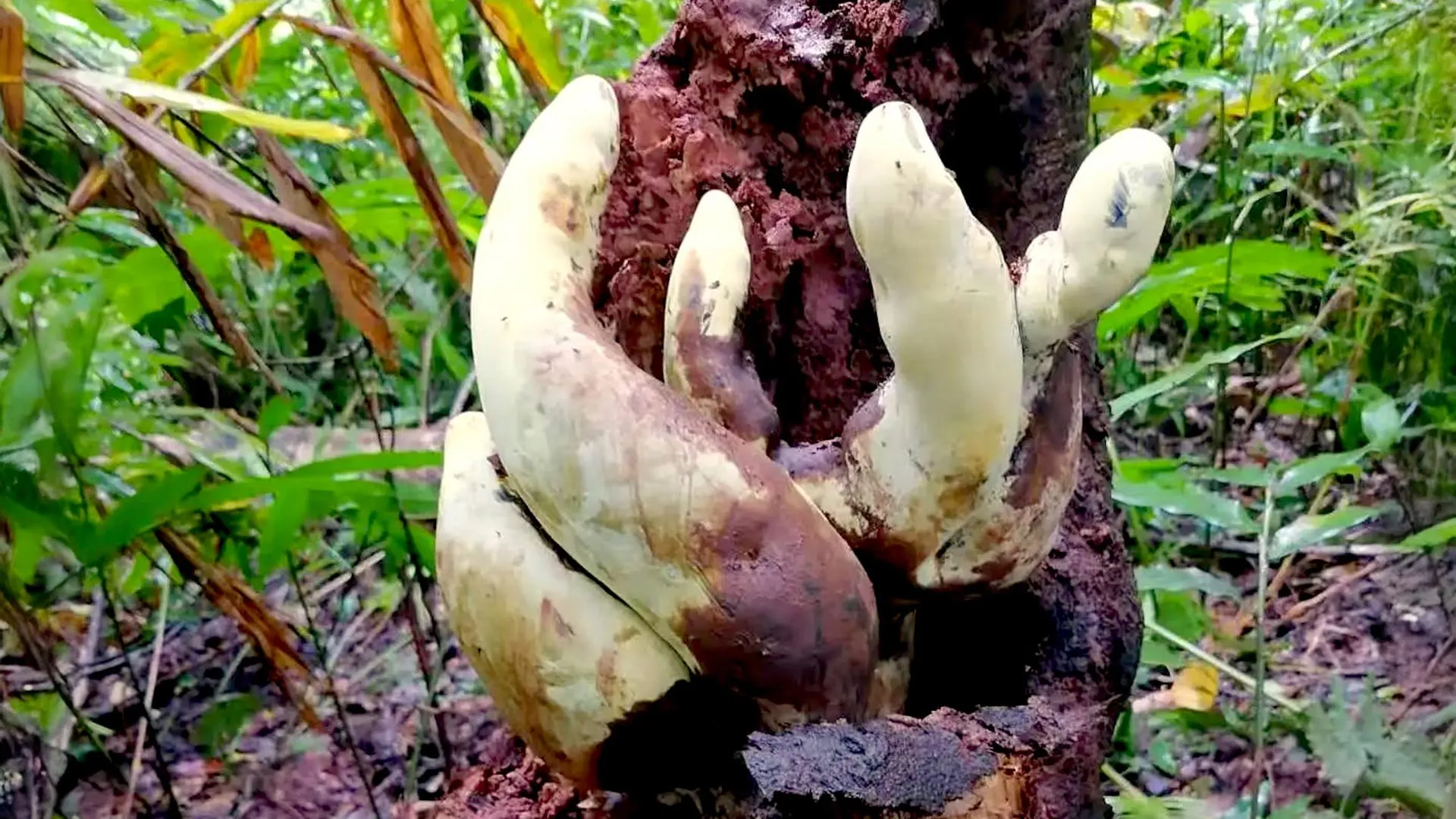
Scientists surveying forests in China’s Yunnan province have identified a giant fungus whose reproductive structures can grow to 50 centimeters (20 inches) tall and weigh up to 2.2 kilograms (4.9 pounds). Named Dianjunus rex, the species produces the largest known fruiting bodies among fungi in the phylum Ascomycota. Genetic and morphological analyses indicate that it is distinct enough to warrant a new genus and family, highlighting how much fungal diversity may remain undiscovered in East Asian forests.
A giant fungus in Yunnan’s forests
Researchers from the Kunming Institute of Botany encountered the unusual fungus while surveying several forest environments in Yunnan. Their fieldwork included temperate coniferous forests near Damaidi and Yipinglan, as well as tropical rainforest near Nanbang.
They found an unusually large, whitish reproductive structure called a stroma growing from the base of a Chinese cork oak tree. The structures emerged from the rhizosphere, the soil surrounding plant roots, and appeared to belong to an unidentified member of the Ascomycota.
Ascomycota is the largest major fungal group, with more than 64,000 recognized species. Unlike familiar mushrooms, ascomycetes do not produce typical mushroom structures. Instead, they release spores from small sac-like structures located inside or on the surface of their fruiting bodies.
To study the discovery, the scientists collected samples and preserved reference specimens in the Kunming Botanical Research Institute’s collection. They also cultivated spores in laboratory conditions, examined the fungus’s physical characteristics and sequenced its genome, including its protein-coding genes.
A new genus and fungal family
Genetic analysis and detailed examination of the fungus’s morphology showed that it was more than a previously unknown species. It differed sufficiently from known fungi that the researchers established both a new genus and a new family, Dianjunaceae, within the order Xylariales.
The researchers named the species Dianjunus rex, drawing on its impressive size and the ancient kingdom of Dyan. Its nickname, “D-rex,” refers to its exceptional stature among closely related fungi.
Its closest known relative is Graphostroma platystoma, a fungus that grows on dead hardwood trees in the Northern Hemisphere. That species is the only known representative of the family Graphostromataceae.
Members of Xylariales produce a range of specialized compounds and enzymes capable of breaking down complex plant molecules. The researchers believe that similar enzymes may enable D. rex to decompose dead wood and obtain nutrients from it.
An evolutionary link to the aftermath of dinosaur extinction
The newly identified family also appears to have an ancient evolutionary origin. Using a technique known as a molecular clock, the scientists compared the fungus’s DNA with genomic information from hundreds of other fungi whose evolutionary histories have been established.
The analysis suggested that the lineage arose about 65 million years ago, roughly 1 million years after the Cretaceous–Paleogene mass extinction. That catastrophe eliminated non-avian dinosaurs and many other plant and animal species.
The timing raises the possibility that the large-scale environmental changes following the extinction created favorable conditions for the fungus’s ancestor. “This timing poses an interesting possibility: After the mass extinction, forests experienced dramatic changes, with large amounts of dead plant material suddenly becoming available,” said Dr. Indunil C. Senanayake, associate professor at the Wild Species Germplasm Bank at the Kunming Botanical Research Institute in China and corresponding author of the study. “Such environmental disruption may have created new ecological opportunities for wood-associated decomposers.”
Why did the fungus evolve such a large structure?
Before Dianjunus rex was identified, the tallest known ascomycete fruiting bodies were approximately 20 to 30 centimeters high. The newly discovered fungus can reach 50 centimeters, making it considerably taller than the previous record holder.
One possible explanation involves spore dispersal. By extending above the forest floor, the fungus’s reproductive structures may be better positioned to catch moving air and distribute spores through dense vegetation.
Producing such a large structure also requires substantial energy. The researchers suggest that this strategy would be advantageous only where the benefits of improved spore dispersal outweigh the resources required for growth.
“Fruiting bodies towering above surrounding vegetation and debris may be better able to disseminate spores by wind in dense forests. However, such large structures require significant energy investment, suggesting that this strategy is likely to have evolved only when the ecological benefits outweighed the costs,” Senanayake said.
More undiscovered fungi may inhabit China’s forests
The discovery underscores how little is known about fungal diversity in China’s subtropical forests. The region may be particularly favorable to the evolution of rare fungi because it contains a wide range of habitats, has relatively stable climatic conditions and supports complex interactions among organisms.
Despite these conditions, many fungi in the region have received little scientific attention. Remote locations and difficult terrain make fieldwork challenging, while the seasonal and hidden nature of fungal reproductive structures can make some species difficult to find. Historically, research has also focused on fungi with commercial or practical value.
Scientists hope that continued exploration will reveal additional species, along with more unexpected fungal forms and evolutionary histories.
“This region combines exceptional habitat heterogeneity, climatic stability, and complex biotic interactions that drive fungal diversification. Historically, however, fungal diversity in these ecosystems has been underestimated due to logistical difficulties in field sampling, the seasonal and cryptic nature of fungal fruiting, and the historical emphasis on economically important fungi,” Senanayake said.
Source: www.sciencedaily.com