


NASA and DOE Launch “Nuclear NASA Era” to Power the Future of Moon and Mars Exploration
As a new era of deep-space exploration begins, NASA and the U.S. Department of Energy (DOE) are developing the next generation of safe, reliable nuclear technology for space.
The partnership will strengthen civilian space exploration, support major scientific discoveries, and reinforce U.S. leadership in space nuclear power and propulsion.
“We are entering the ‘Nuclear NASA Era,’ which represents a major transformation for space exploration,” said NASA Administrator Jared Isaacman. “Nuclear power will enable us to go further, operate longer, and operate more powerful spacecraft and equipment than ever before. The work we are doing today will lay the foundation for tomorrow’s fission-powered spacecraft and open up entirely new frontiers for exploration and discovery.”
NASA and DOE Sign Space Nuclear Power Agreement
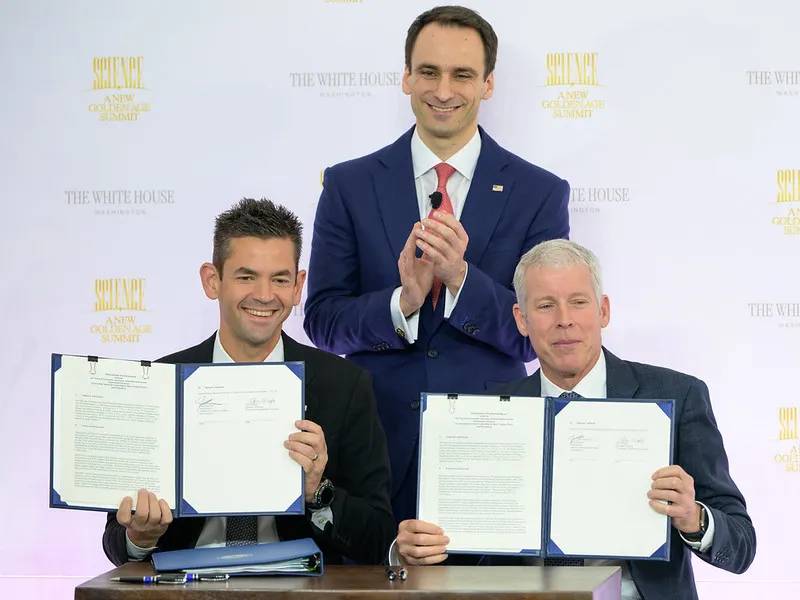
NASA and the DOE signed a new memorandum of understanding, “Accelerating U.S. Leadership in Space Nuclear Power and Propulsion,” on Thursday. The agreement establishes a framework for end-to-end cooperation, bringing the two agencies together across the full spectrum of nuclear space development.
The collaboration will cover advanced research, fuel production, rigorous testing, launch integration, and mission operations. Safety will remain a central priority throughout every initiative.
The agreement was signed by Isaacman and U.S. Energy Secretary Chris Wright during the Golden Age Summit, hosted by the Donald J. Trump Institute for Peace’s Office of Science and Technology Policy in Washington. It will go into effect on Sunday, November 1.
“Thanks to President Trump, America’s nuclear renaissance is reaching new heights,” Wright said. “The Department of Energy is proud to partner with NASA to help America’s space missions reach uncharted territory.”
U.S. Space Nuclear Plans Target the Moon and Mars
President Trump’s December 2025 Executive Order on Securing U.S. Space Superiority directs NASA to develop a launch-ready lunar reactor by 2030. NASA, working with the DOE, is making steady progress toward that goal.
The agreement strengthens existing cooperation on nuclear fission and radioisotope power systems. It also advances NASA’s vision for a sustained human presence on the Moon and accelerates technologies needed for future lunar and Mars missions.
Space Reactor-1 Freedom and Lunar Reactor 1
When NASA’s Space Reactor-1 Freedom launches in 2028, nuclear propulsion will move from laboratory research toward practical deep-space applications. The milestone will help pave the way for Lunar Reactor 1, a nuclear fission surface power system designed to support a future lunar base through periods of darkness and shadow.
Nuclear power could provide energy for lunar habitats, communications systems, equipment, spacecraft, resource utilization, and other critical infrastructure. It will also be essential for meeting the demanding energy requirements of future Mars missions.
Together, SR-1 and LR-1 are expected to form the foundation of a strong domestic nuclear space industry. The programs could help power permanent lunar outposts, enable exploration of distant worlds, and strengthen U.S. leadership in deep-space exploration for generations.
Radioisotope Power Systems Support Missions to Titan and Mars
Alongside nuclear fission power generation, NASA continues to expand its use of radioisotope power systems.
NASA’s Dragonfly mission to Saturn’s moon Titan, scheduled to launch in 2028, will rely on a multi-mission radioisotope thermoelectric generator and 24 lightweight radioisotope heating units. These systems will power and heat the car-sized rotorcraft as it travels to different locations on Titan to investigate the moon’s habitability.
NASA and the DOE will also support the European Space Agency’s Rosalind Franklin Mars rover by providing 24 similar heating units. The units will help maintain instrument temperatures in Mars’ frigid environment while the rover studies the possibility of past and present life on the planet.
More Information About Nuclear NASA
For more information about Nuclear NASA, please visit:
-end-
Camille Gallo / Elizabeth Shaw
Headquarters, Washington
202-358-1600
[email protected] / [email protected]
Source: www.nasa.gov