


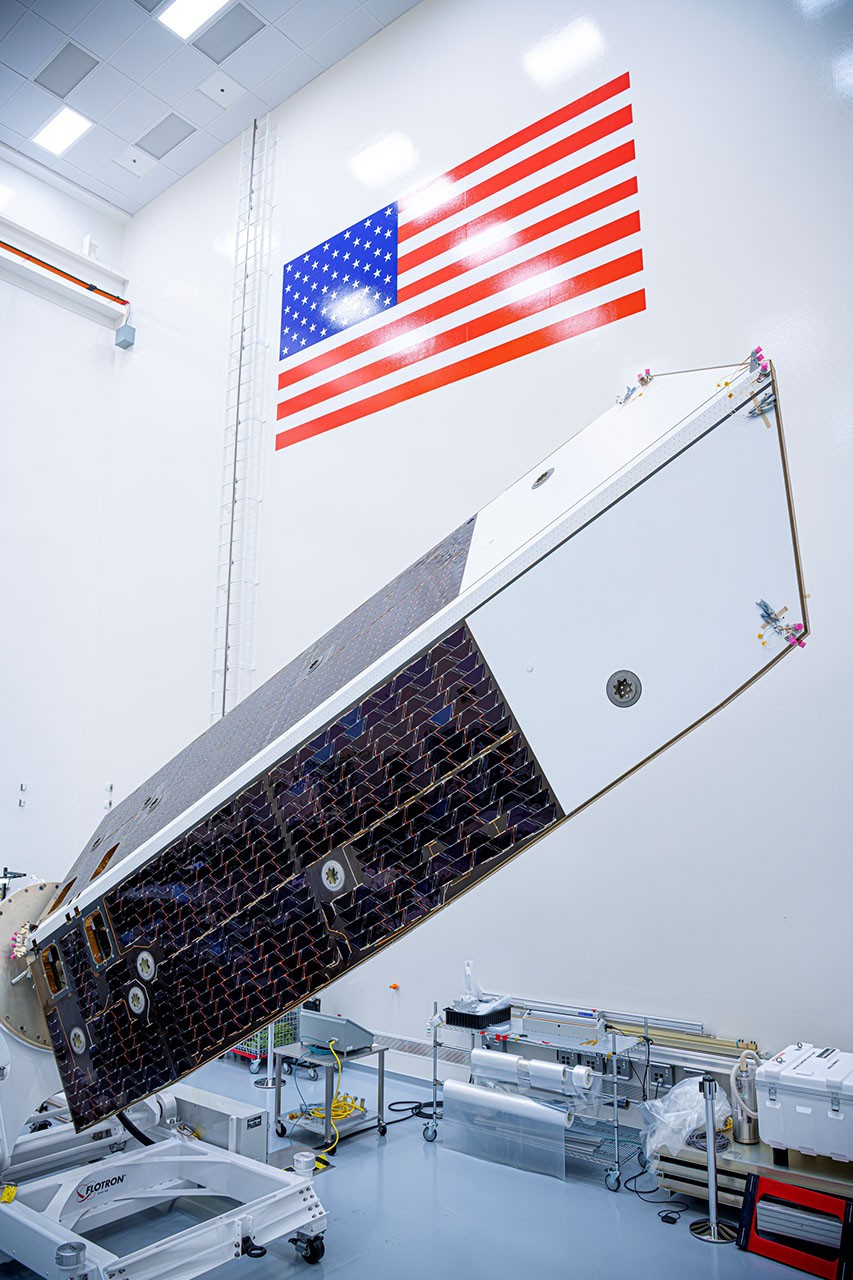
NASA’s NEO Surveyor spacecraft is moving toward assembly after its large sunshade and specialized solar array were delivered to BAE Systems Space & Mission Systems in Colorado. The structure will provide power for the spacecraft while helping it search for elusive asteroids and comets, including objects located in regions of the sky that are difficult for ground-based telescopes to observe.
Sunshade and solar array
In July 2026, the sunshade was attached to an assembly ring during an inspection in a clean room at BAE Systems Space & Mission Systems in Boulder, Colorado. The structure is 6 meters high and 8 feet (2.4 meters) wide at its base. Its two flat panels are joined at a 23.5-degree angle and covered with 864 interconnected solar cells.
The solar array was tested before arriving in Colorado. It can generate up to 2 kilowatts of power, enough to provide the power needed to charge the onboard batteries that operate the spacecraft’s systems. NASA has released an image of the sunshade structure.
Applied Aerospace of Stockton, California, manufactured the sunshade structure. SolAero Technologies of Albuquerque, New Mexico, installed the solar cells in January. Environmental testing of the sunshade and solar array was completed in March at a commercial thermal vacuum test facility in El Segundo, California. The hardware was delivered ahead of schedule to BAE Systems Space & Mission Systems in May.
Searching near the Sun
Once in space, NEO Surveyor will search for some of the most elusive asteroids and comets. Some of these objects may be located in the direction of the Sun, a region of the sky that is difficult to survey with ground-based optical telescopes.
Source: science.nasa.gov