


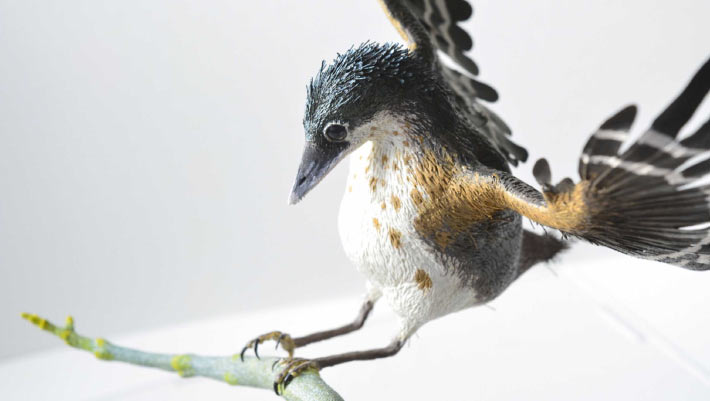
Concornis lacustris, a small enantiornithine bird that lived alongside dinosaurs in what is now Europe about 125 million years ago, has been reconstructed at life size using fossil evidence, digital modeling, 3D printing and traditional sculpting. The resulting model combines anatomical data from the bird’s fossils with comparisons to related early birds and modern species.
A Cretaceous bird from Las Hoyas
Concornis lacustris lived during the Early Cretaceous, about 125 million years ago. It belonged to the enantiornithines, an extinct group of birds that flourished during the Cretaceous period before disappearing in the mass extinction 66 million years ago that eliminated the non-avian dinosaurs.
Fossils of the species were discovered at the Las Hoyas site in Cuenca, Spain. First described in 1992, the fossils have continued to provide paleontologists with important information about the anatomy and evolution of early birds.
“This provided fundamental anatomical data for understanding the evolution of small Mesozoic birds,” said Dr. Victor Peco of the Complutense University of Madrid and Dr. Sergio Nebreda of Johns Hopkins University, the Natural History Museum of Los Angeles County, and the Autonomous University of Madrid.
“Furthermore, this species helped reveal details of the active flight capabilities of these birds, revealing important aspects of bird behavior and paleontology.”
From fossil to sculpture
In their new paper, the researchers describe the creation of the first life-size, three-dimensional reconstruction of Concornis lacustris. They began with the fossilized skeleton and added layers representing muscle and skin, following an approach commonly used by anatomists and paleoartists.
The team created a digital model in Blender using publicly available drawings and photographs of the fossil. Because the skull and other parts of the specimen were missing, they used comparisons with other early birds, including a well-preserved skull from Brazil and another skull from Las Hoyas.
The digital model was 3D-printed in plastic, covered with sculpted epoxy putty and finished with oil paint. Thin plastic filament represented the bird’s downy covering, while the wing feathers were printed separately.
The researchers estimated the number and shape of the feathers using fossil evidence from China and Spain, together with comparisons to modern birds. The wallcreeper (Tichodroma muraria) was among the modern species considered because it flies in a similar manner.
“The methodology developed in this study integrates digital tools, 3D printing, and traditional sculpting techniques to optimize the restoration process, facilitate scientific review, and yield anatomically consistent results with a high degree of realism,” the researchers explained.
Reconstructing color and behavior
Because pigments were not preserved in the holotype specimen of Concornis lacustris, the researchers used related fossils to inform their color choices. The sculpture has a dark brown back and wings, striped flight feathers, a pale underside and an iridescent blue-green sheen on the head.
The reconstruction has a wingspan of approximately 30 centimeters (12 inches) and a body length of approximately 13 centimeters (5 inches). It depicts the bird perched on a branch of Frenelopsis, a coniferous tree that was abundant in the Las Hoyas ecosystem.
The pose shows the bird spreading its wings and moving its feathers forward as it slows to land.
“Our study aims to improve our understanding of Enantiornis by integrating osteological, myological, and integumentary data from highly preserved fossils,” the researchers said.
Their paper was published in Earth’s History and Biodiversity in an issue dated September 26, 2026.
Publication details
Victor G. Peco and Sergio M. Nebreda. 2026. “Mesozoic bird scientific sculpture Concornis lacustris: Paleoart as an outreach resource.” Earth’s History and Biodiversity 10: 100047. doi: 10.1016/j.hisbio.2026.100047.
Source: www.sci.news