


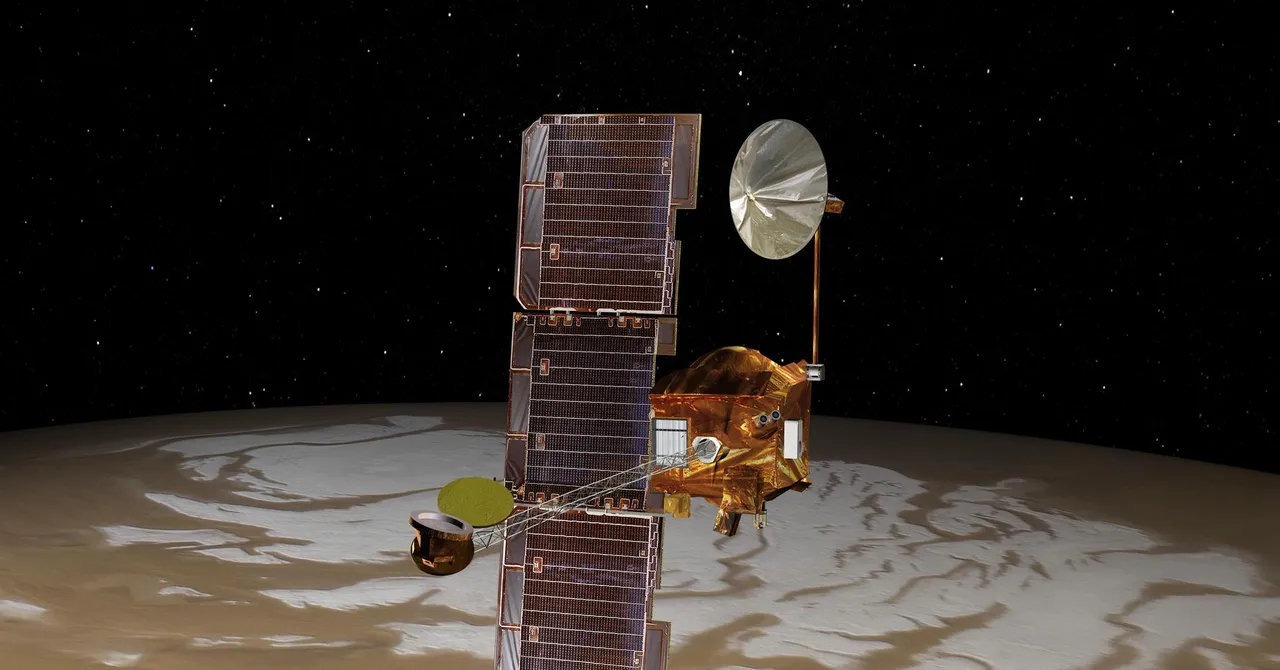
NASA’s Mars Odyssey and Mars Reconnaissance Orbiter (MRO) have operated at Mars for far longer than their original missions were expected to last. Odyssey arrived on October 24, 2001, while MRO has now spent about 20 years studying the planet. Together, the orbiters have transformed scientists’ understanding of water on Mars, monitored a changing world, and relayed communications between Earth and NASA’s rovers.
Their longevity has depended on careful engineering, constant problem-solving and some luck. Despite their remarkable record, scientists are questioning whether Odyssey and MRO could be among the last long-lived orbiters supporting NASA’s Mars research program.
Orbiters that reshaped Mars science
“Both Odyssey and MRO are among the most productive spacecraft that have ever existed,” said Bryony Hogan, a planetary scientist at Purdue University who was not affiliated with either mission. She described the spacecraft as “critically important” to NASA’s overall Mars research program.
Odyssey’s observations of Martian ice and MRO’s ability to track surface features that change over time have provided unprecedented insight into Mars. Their observations show that the planet is an active, dynamic world rather than merely a block of rock.
The two orbiters also serve as essential communication links for NASA’s rovers, which cannot communicate directly with Earth. Their contributions are especially notable because both spacecraft were designed to operate for only a few years.
The challenge of surviving decades in space
Spacecraft face an unforgiving environment, and operating for decades requires both resilience and good fortune. One of the greatest threats is the constant bombardment by high-energy particles. A sufficiently powerful particle strike can permanently damage sensitive equipment.
Engineers can monitor satellites orbiting Earth continuously, but communication with Mars is more limited. Scientific spacecraft at Mars may be able to check in only once or twice a week, said Rob Lillis, a planetary scientist and astrophysicist at the University of California, Berkeley, who has worked on several recent Mars-orbiting missions.
“The Mars rover has to be able to manage itself,” he says.
Source: www.wired.com