


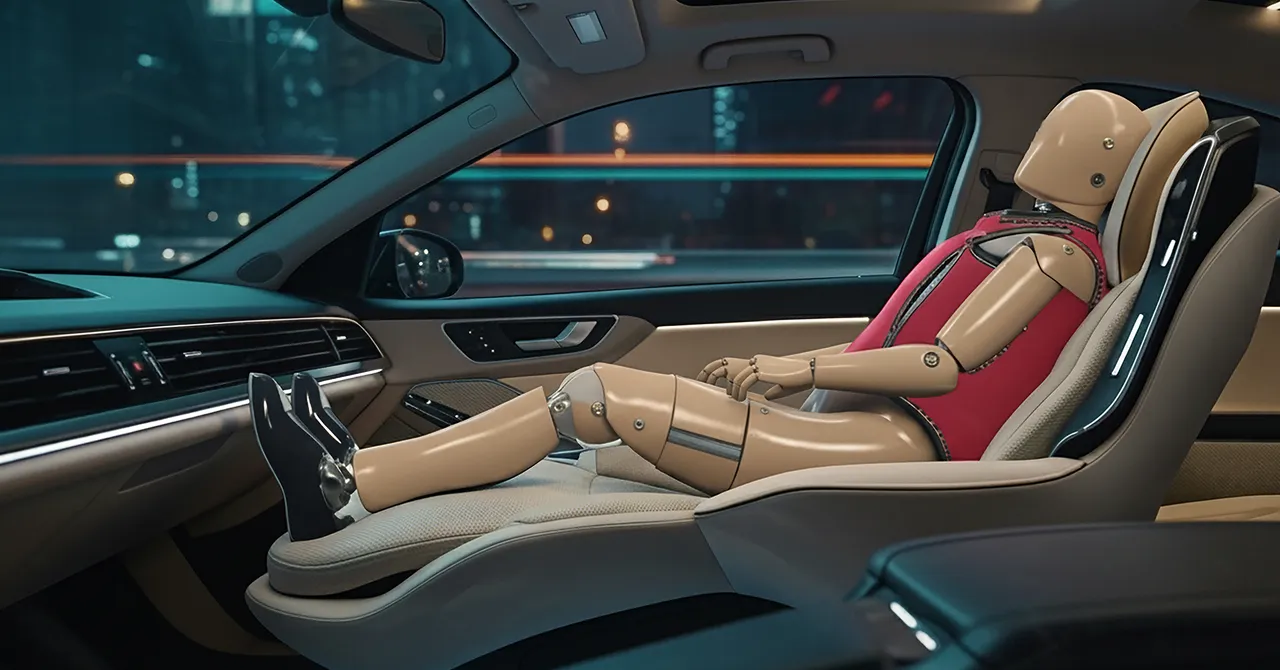
Tesla CyberCab’s Reclining Seats Raise New Safety Questions for Self-Driving Cars
On video Posted on X, Tesla enthusiasts climb into what was once the driver’s seat of a new matte-gold CyberCab. We say “once” because the vehicle, which officially debuted earlier this month as part of Tesla’s Robotaxi ride-hailing service, has no steering wheel or brake pedal.
For passengers in the front seats, the absence of driving controls creates new possibilities: eating, playing games, watching videos, working, or even dozing off. Enthusiasts also demonstrated that the CyberCab’s seats can recline. “You can really go back,” one says. “You can really sleep here.”
But Tesla’s official CyberCab rider guide offers a warning. Passengers in self-driving cars must keep their seatbacks reclined within 35 degrees of vertical, wear their seatbelts snugly against their hips, and keep their feet flat on the floor. These measures, Tesla says, “reduce the risk of injury in the event of a collision or sudden stop.” Tesla did not respond to WIRED’s questions for this article.
Why Reclining in a Self-Driving Car Could Be Dangerous
Safety researchers say reclining creates a serious risk. Passengers who sit lower than normal in any vehicle are more likely to be injured in a crash, even when their seatbelts are fastened. According to US federal safety data, 42 people who died in traffic accidents over the past 10 years were recorded as having their backs reclined rather than sitting in the normal upright position.
That figure is probably an underestimate. “It’s very difficult to identify people who are sitting out of position” after a crash, says Becky Mueller, a senior research engineer at the Insurance Institute for Highway Safety. A collision can displace occupants, while emergency responders work quickly to remove injured people from damaged vehicles. Few records accurately show how victims were positioned before or during a crash, and few vehicles provide a way to document it.
A spokesperson for the National Highway Traffic Safety Administration, the federal vehicle safety regulator, said field data on reclining occupants is sparse. However, the rise of self-driving cars such as the Tesla CyberCab is prompting governments to revisit the long-standing safety problem.
“NHTSA has decided to consider reclining occupants as a starting point for autonomous vehicle occupant safety based on the fact that occupants may choose to ride in a reclined position when they are no longer required to drive,” the spokesperson said in a statement to WIRED.
Crash-Test Rules Were Designed for Upright Passengers
Updating the rules could take years. Current vehicle safety standards generally assume that occupants sit upright and wear seatbelts secured around their hips. Airbags are designed for people sitting in this position, and the dummies used in crash tests have inflexible pelvises that physically prevent them from leaning forward.
Creating new safety standards requires research to be proposed, funded, completed, and analyzed. The government must then solicit public comments from all participants.
“That’s a big excuse: ‘Oh, we can’t revisit this regulation because it would be too cumbersome to reopen it and go through the whole process,’” says Moller. Self-driving cars may finally persuade regulators to “open up some of these outdated rules and make modifications. Maybe there will be modifications that will help modernize regulations for other vehicles as well. It’s a good time to make fundamental changes.”
Why Seatbelts May Not Work as Intended When Passengers Recline
Photo: Smith Collection/Getty Images
Seatbelts are designed to be worn on an upright, forward-facing body. If a person is lying down or sitting on their side during a crash, the seatbelt may not perform as intended. Instead of tightening around the hard, bony pelvis, it can move upward and tighten around the soft abdomen.
Source: www.wired.com