


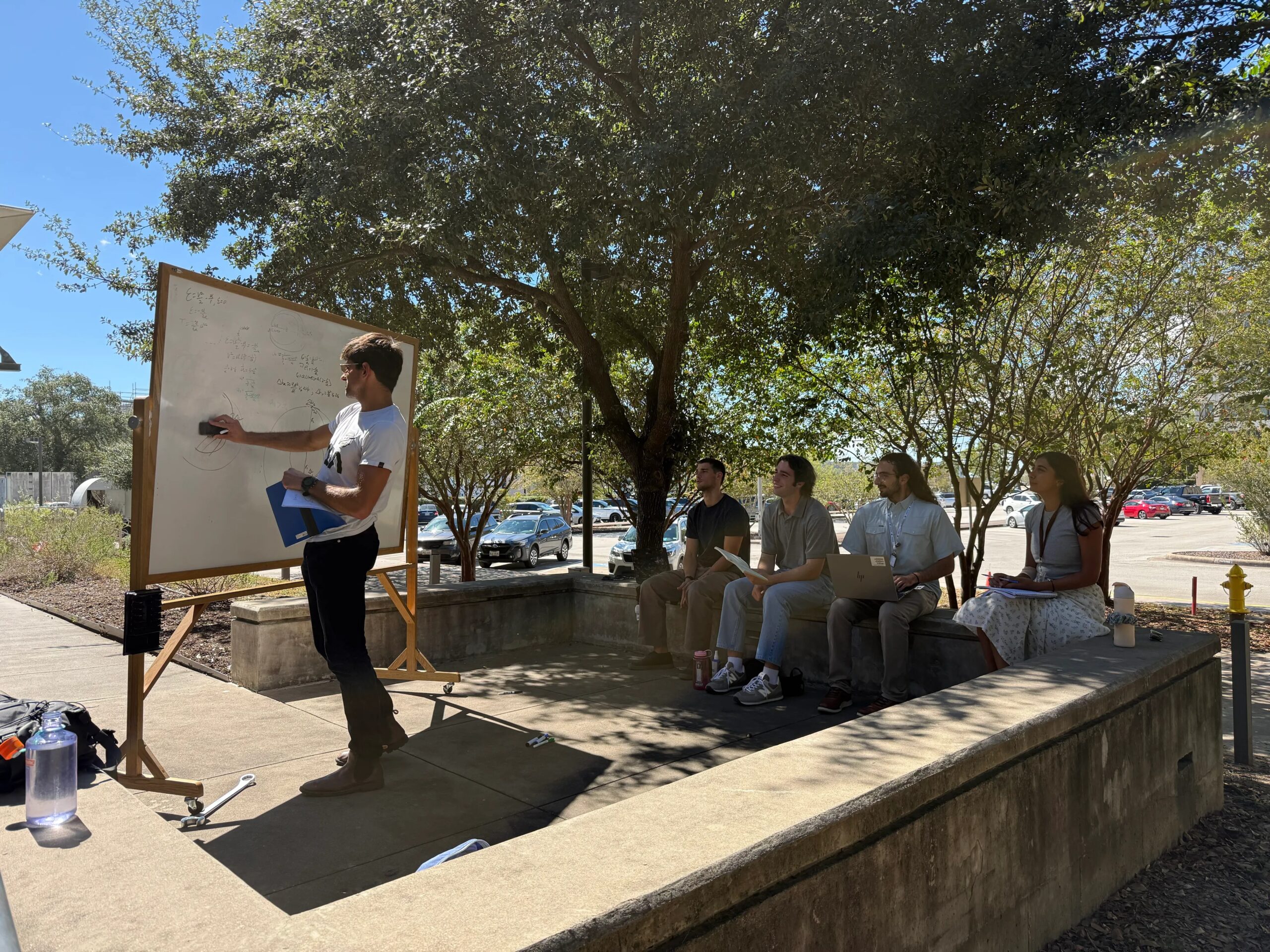
For Rice University student Malvika Bhardwaj, an internship with NASA’s Guidance, Navigation, and Control (GN&C) team at Johnson Space Center became a lesson in both spacecraft engineering and the value of mentorship. Her mentor, NASA engineer Daniel Cohen, encouraged her to prioritize what mattered, supported her technical work and helped her see how collaboration shapes projects across the agency.
Bhardwaj is being highlighted in connection with National Mentoring Day on October 27. Through NASA’s Office of STEM Engagement, interns contribute to agency projects while developing technical skills and gaining hands-on experience alongside NASA mentors.
Studying spacecraft navigation
Bhardwaj studied computational and applied mathematics at Rice University and interned with Johnson’s GN&C team. Her work focused on how spacecraft determine their position and maneuver in orbit.
She developed tools to analyze thruster firings on U.S. deorbit vehicles, work intended to help NASA safely deorbit the International Space Station at the end of its operational life. She also used computer simulations to test the vehicle’s control system and identify conditions that could cause it to fail.
“I learned about the culture of community and support at Johnson and NASA as a whole. Daniel introduced me to the team and made an effort to include me in conversations and meetings. I saw how team members supported each other and stepped up to move the entire unit forward,” Bhardwaj said.
A mentor’s example
Cohen, who earned a master’s degree in mechanical engineering from Rice University, began his NASA career in 2020 as a flight operations intern. After internships in docking dynamics, propulsion systems and GN&C analysis, he joined Johnson as a full-time engineer in August 2024.
His current work includes developing simulations and models for the U.S. Deorbit Vehicle study, analyzing its control algorithms and GN&C performance, and evaluating SpaceX’s design during multiple lifecycle reviews.
Cohen will also analyze the Orion spacecraft’s docking camera setup. The camera provides position measurements that will help inform navigation during future Artemis rendezvous operations.
Beyond the internship, Cohen continues to support Bhardwaj and closely observes how colleagues collaborate and exchange ideas on projects. He sets aside several hours each week to teach interns subjects including orbital mechanics and control systems.
Learning through collaboration
Bhardwaj took Cohen’s advice about deciding what is important to heart. She said the internship showed her that problem-solving is rarely an individual effort: teams need different perspectives, and members must understand how their work connects to a larger project.
Working with interns in outreach, social media and digital design also broadened her view of careers in STEM. “No matter what you’re interested in, there’s definitely a role for you here,” she said.
She was especially proud of completing her first project, a set of analytical tools she built from scratch. Working through the debugging process and seeing the finished product function was particularly rewarding, she said.
Bhardwaj advises students interested in NASA internships to apply even if they do not feel fully prepared.
“You’ll probably never feel 100 percent prepared, but a lot of the learning happens on the job,” she said. “Trust in your ability to navigate your new environment.”
Source: www.nasa.gov