


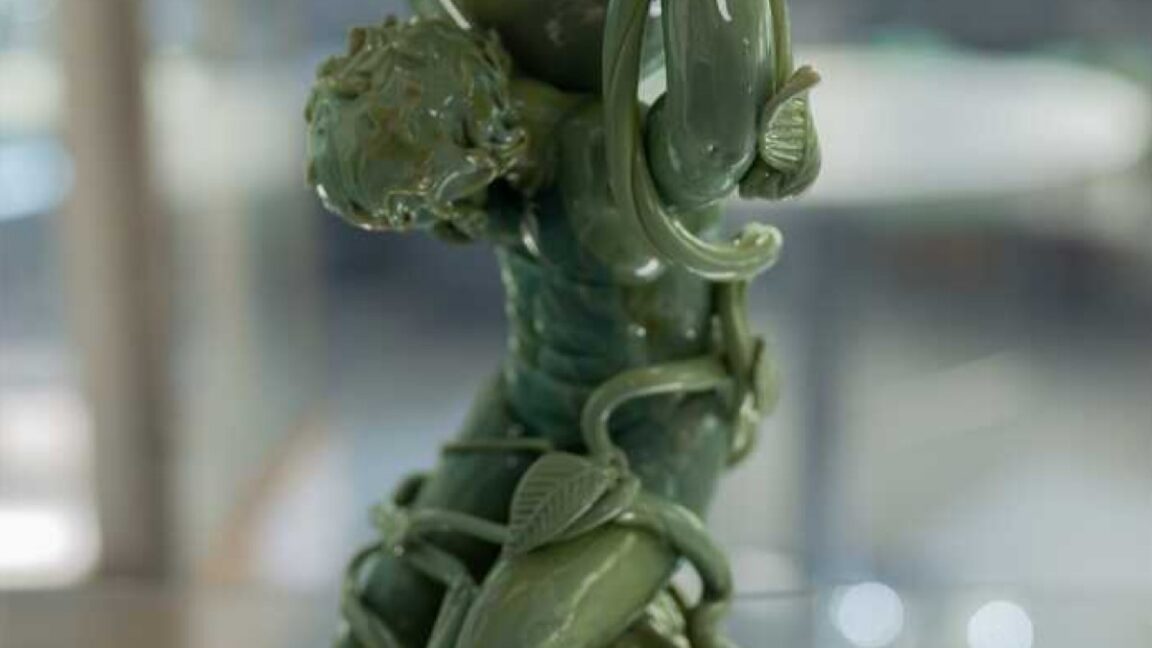
Researchers at the University of Sheffield have developed a consistent recipe for making dichroic glass that recreates the Lycurgus Cup’s distinctive color-changing effect. The glass appears green in reflected light and red when viewed with light shining through it, allowing British glass artist Elliot Walker to create a modern sculpture inspired by the 1,600-year-old Roman masterpiece.
Recreating the Lycurgus Cup’s elusive glass
In 2020, Dutch researchers reproduced the Lycurgus Cup’s green-and-red dichroism by embedding appropriately sized and shaped silver and gold nanoparticles in 3D-printable nanocomposites. However, scientists had not yet established a consistent and reproducible recipe for making the effect in glass.
Lisa Holland and Caroline Jackson of the University of Sheffield worked together to solve the problem. Jackson is an expert in Roman glass. The researchers experimented with different furnace types, materials and oxygen levels, and at one point even added sugar to the mixture.
“We knew that manufacturing this type of glass was likely to be a complex task, as it involved not simply adding nanoparticles to the glass,” the researchers said. “I’ve been studying and working with glass for over 25 years, so I used the knowledge and experience I’ve gained, combined with modern scientific understanding of what I was trying to achieve. But if a Roman saw me experimenting, he would probably laugh and ask, ‘Why doesn’t she know how to make this?’”
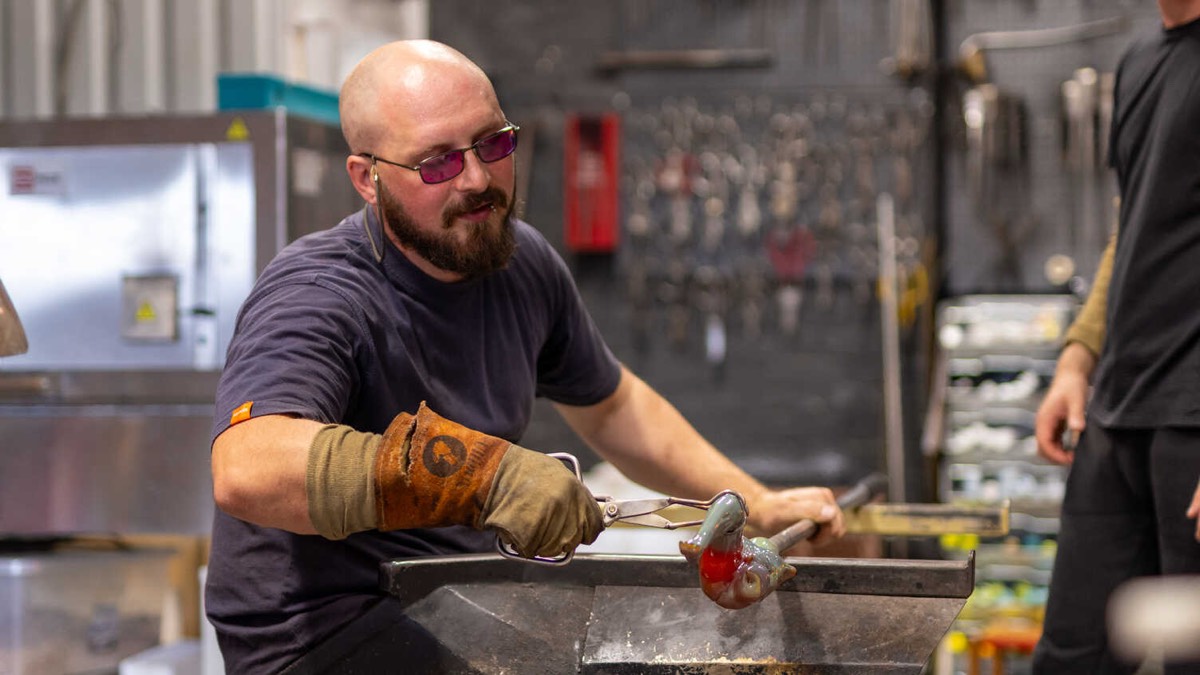
A modern sculpture inspired by an ancient masterpiece
The experiments eventually produced glass with the desired optical properties: green in reflected light and red when illuminated from behind. Holland’s early glasswork formed part of Light Fest and the Molecular Photonic Breadboards project, a UK initiative focused on designing new materials that use light for sustainable technology.
Project leaders then approached British glass artist Elliot Walker, the season 2 winner of Netflix’s Blown Away competition, to create a contemporary sculpture honoring the Lycurgus Cup.
“It is very rare to have the opportunity to work with glass that has been developed from ancient mixtures and recipes, but it is always very exciting,” Walker said. “You can really see how glassmakers of the past have adapted to this kind of glass. It’s like shaking hands.”
Walker said he wanted to retain a classical form and tell the story of Lycurgus depicted on the original cup, while also incorporating a blown element to highlight the dichroic glass. The sculpture combines the Lycurgus story with the Farnese Atlas sculpture, replacing the earth with the cup.
Where to see the sculpture
The public will be able to see Walker’s sculpture in person when it goes on display at the Millennium Gallery next month during the University of Sheffield’s Festival of the Mind. The work will then be permanently displayed at the university’s Turner Museum of Glass.
Source: arstechnica.com