


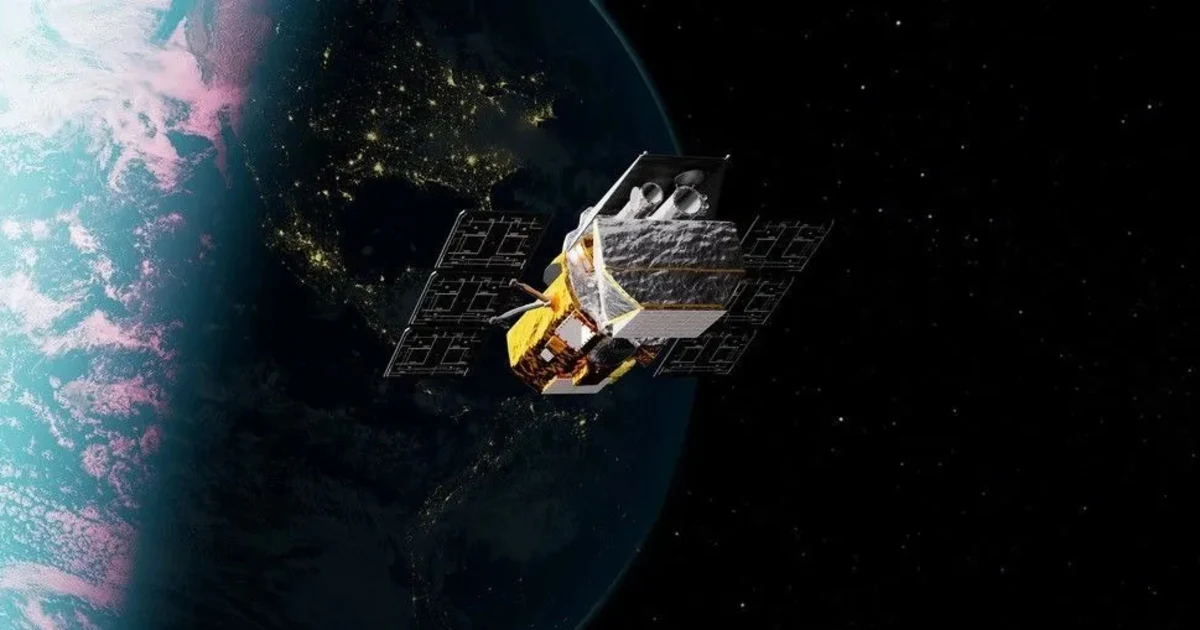
NASA’s effort to save the Neil Gehrels Swift Observatory from an uncontrolled reentry into Earth’s atmosphere has failed, the agency announced Wednesday.
Launched into low-Earth orbit in 2004, the Swift Observatory continues to lose altitude rapidly. The space telescope is expected to reenter the atmosphere later this year, where it will break apart.
NASA launched a first-of-its-kind rescue mission in July to raise the Swift Observatory into a higher orbit, extend its operational life and preserve its scientific research. Arizona-based Katalyst Space Technologies spent months developing a spacecraft called Link, designed to rendezvous with, capture and boost the observatory.
Link launched July 3 aboard a Northrop Grumman Pegasus XL rocket. Problems emerged soon afterward.
Mission managers established communication with Link after launch, but less than two weeks into the flight, engineers began reporting problems with the spacecraft’s orientation and attitude control.
In a July 15 blog post, NASA officials said Katalyst engineers had “addressed initial communications and attitude control issues.”
However, the software fix did not resolve the problem. In a July 28 update, NASA said Link’s attitude control system had failed, causing the spacecraft to spin and resulting in sporadic communications.
According to NASA, Link was rotating at approximately 9 degrees per second. Mission managers had planned to fire the spacecraft’s thrusters to slow the rotation, and a previous update said recovery efforts were progressing. However, the continuing attitude control problems ultimately forced NASA to abandon the Swift orbit-boost attempt.
“While this is not the result we were aiming for, it remains a worthwhile mission,” NASA Administrator Jared Isaacman said in a statement.
NASA said Link will not be able to boost the Swift Observatory. However, Katalyst will continue operating near the observatory to conduct technology demonstrations that could support future in-space servicing missions.
“We will learn everything we can from the Link rendezvous attempt and apply those lessons to future missions,” Isaacman said.
The Swift Observatory studies gamma-ray bursts, the most powerful explosions in the universe. These events can occur during the birth of a black hole or the collisions of superdense stars at the end of their lives.
The observatory began experiencing problems in 2024 during a period of heightened solar activity. Satellites in low-Earth orbit gradually lose altitude because of atmospheric drag. Increased solar activity can heat and expand Earth’s atmosphere, creating additional drag and accelerating orbital decay.
In 2025, NASA awarded Katalyst a $30 million contract to build Link and attempt the ambitious Swift Observatory rescue mission.
“We took on this high-risk, high-reward challenge and are proud of the milestones we achieved along the way,” Katalyst Space CEO Ghonhee Lee said in a statement Wednesday. “We have already learned a tremendous amount, and our job now is to turn those lessons into something lasting — building a repeatable playbook to inform future rendezvous, close operations and satellite services.”
Sean Domagal-Goldman, director of astrophysics at NASA Headquarters, said the mission was “the first of its kind, developed on an unprecedented timeline driven by solar activity.”
Isaacman said that although the orbit-boost attempt was abandoned, the mission will provide valuable lessons for future satellite servicing and maintenance operations. Such capabilities are becoming increasingly important as NASA and commercial space companies expand activities in low-Earth orbit and beyond.
“NASA should be prepared to act quickly and take smart risks when the potential benefits are worth it, and that’s exactly what we did,” Isaacman said.
Source: www.nbcnews.com