


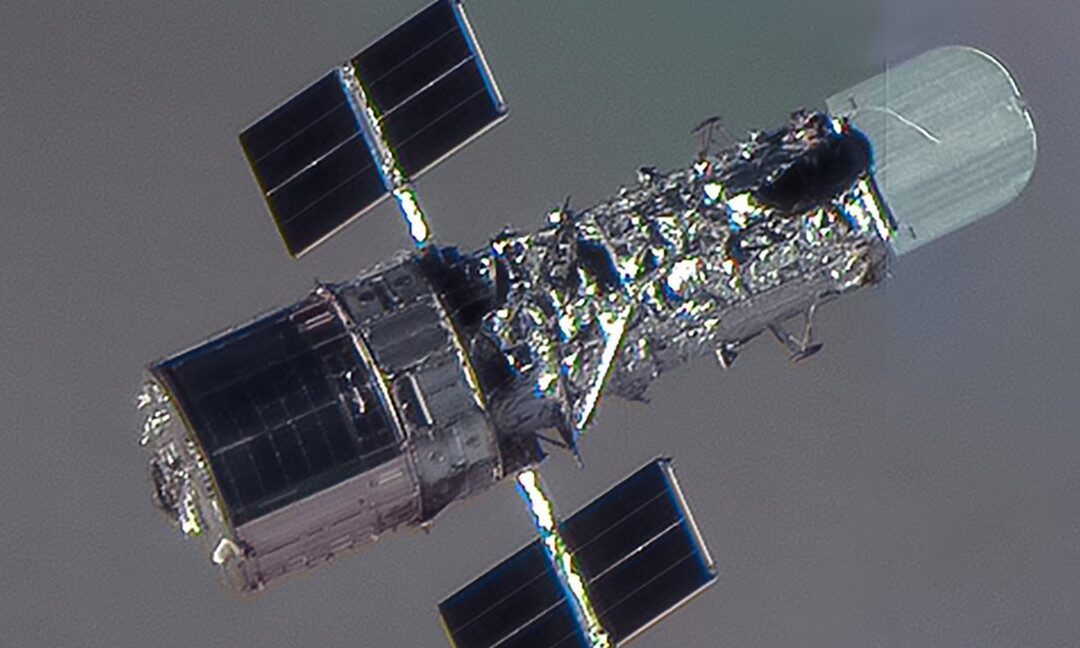
After 36 years in orbit, NASA’s Hubble Space Telescope remains one of the world’s most important astronomical observatories, but its orbit is steadily decaying. Without intervention, Hubble is expected to reenter Earth’s atmosphere in the early to mid-2030s. NASA is now asking commercial space companies for proposals to boost, service, or safely deorbit the aging telescope before that happens.
Hubble’s last trip to orbit came in 2002, when the space shuttle Columbia visited the observatory for maintenance work. The final shuttle servicing mission, in 2009, did not raise Hubble’s orbit. After NASA retired the shuttle fleet two years later, the telescope continued losing altitude with no practical way to prevent its eventual reentry.
On Thursday, NASA issued a request for information (RFI) seeking details about commercial companies’ current and near-term capabilities. Responses are due by November 30. The agency wants to learn whether companies could capture Hubble and raise it to an altitude of at least 373 miles (600 kilometers), improve its performance, or guide it through a controlled reentry.
“Requirements include that boost and/or maintenance missions must not damage the HST and that this mission is scheduled to be conducted by 2032,” NASA wrote in the RFI. The selected contractor would be responsible for the launch vehicle, spacecraft maintenance, mission operations, and “crew, if applicable.”
NASA has not committed to a rescue mission
NASA has not decided to purchase a Hubble rescue mission. Instead, the agency wants to determine which companies would be interested in such an effort, how much it might cost, and whether any provider could realistically reach Hubble before the telescope falls from orbit and burns up during reentry.
Orbital mechanics experts currently expect Hubble to reenter the atmosphere in 2033 or 2034 if no action is taken. However, the forecast can change because solar activity affects the density of Earth’s upper atmosphere and, consequently, the rate at which spacecraft lose altitude.
Hubble has no onboard propulsion system. Since 2002, it has gradually descended from an altitude of 362 miles (583 kilometers) to its current orbit of about 292 miles (470 kilometers) above Earth—a decline that took 24 years.
Raising Hubble to NASA’s requested altitude of 373 miles (600 kilometers) would likely allow the telescope to remain in orbit for at least another 25 years. The RFI is intended to clarify whether commercial space companies can provide that boost, along with any servicing or controlled-reentry capabilities, by 2032.
Source: arstechnica.com