


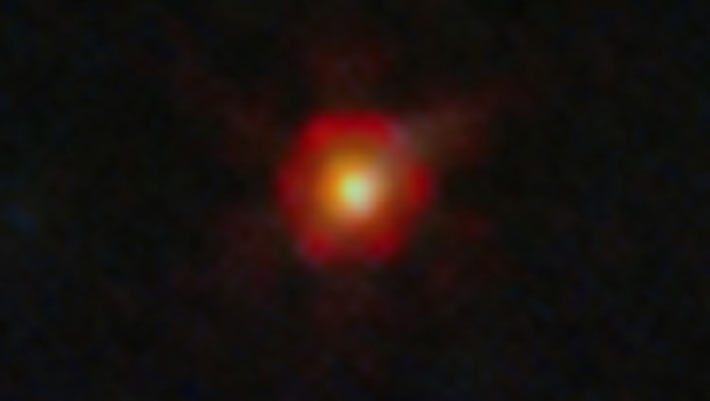
For years, scientists have been intrigued by a mysterious cluster of objects identified by the NASA/ESA/CSA James Webb Space Telescope, referred to as “little red dots.” These faint red objects date back to the early universe. Astronomer Vasily Kokolev from the University of Texas at Austin, along with his research team, employed Webb’s NIRCam and NIRSpec instruments to capture the deepest spectrum ever recorded of a tiny red dot. Their findings suggest that this object, designated GLIMPSE-17775, may be a supermassive black hole surrounded by a dense cocoon of partially ionized gas, a scenario known as the BH* (black hole star) model.
This image illustrates the small red dot GLIMPSE-17775, positioned behind the galaxy cluster Abel S1063. Image credit: NASA / ESA / CSA / Vasily Kokorev, UT Austin / Alyssa Pagan, STScI.
“I believe parts of the scientific community are starting to align on the notion that the little red dot can be elucidated using the black hole star model,” Kokolev stated.
“However, none of the little red dots studied so far have presented all the necessary evidence in one place.”
“GLIMPSE-17775 enables us to validate these theories due to the remarkable quality of its spectrum.”
This extraordinary cosmic object has a cosmological redshift of 3.5, indicating its existence approximately 1.8 billion years after the Big Bang.
Interestingly, GLIMPSE-17775 was serendipitously discovered amidst Webb’s observations of the galaxy cluster Abel S1063, which was being scrutinized for Population III stars and elusive early galaxies.
This small red dot is situated behind the star cluster, with its brightness significantly magnified through gravitational lensing.
“When I first viewed the spectrum, it felt akin to a puzzle where all the pieces were scattered,” Dr. Kokolev remarked.
“We meticulously examined each piece, measured the lines, and began assembling the components to create a coherent mosaic.”
“Some pieces that initially appeared insignificant eventually came together, revealing a more significant picture.”
The spectroscopic data acquired by Webb contains a multitude of lines that bolster the interpretation of GLIMPSE-17775 as a black hole star. This black hole is rapidly accreting matter, enveloped in a dense gas cocoon that reprocesses light emitted in its vicinity, generating the spectral features observed.
“Everything aligns perfectly; there are no discrepancies, which enhances the puzzle of our universe,” Kokolev noted.
“As we look ahead, I aim to delve deeper and uncover the mechanisms that power this little red dot’s central engine.”
“While we suspect it is a black hole, there are other compelling theories that warrant exploration.”
“In all likelihood, we will have a conclusive answer about the energy sources powering it within a year or two.”
The findings from the team will be published in the Astrophysical Journal.
_____
Vasily Kokolev and colleagues. 2026. An examination of the deepest part of the dense gas cocoon enveloping a small red dot. APJ 1004, 153; doi: 10.3847/1538-4357/ae4ed7
Source: www.sci.news