


Voynich Manuscript Mystery: Researchers Say Its Pages Were Bound in the Wrong Order
The mysterious Voynich Manuscript has puzzled codebreakers, linguists and medieval historians for more than a century. Now, researchers believe they may have identified one reason the document is so difficult to decipher: its pages were incorrectly bound in the 15th century and are probably out of order.
A new linguistic analysis suggests that the manuscript may not be a conventional book at all. Instead, it may have originally consisted of separate parchment sheets that were later assembled incorrectly, making its illustrations and text difficult to interpret.
What is the Voynich Manuscript?
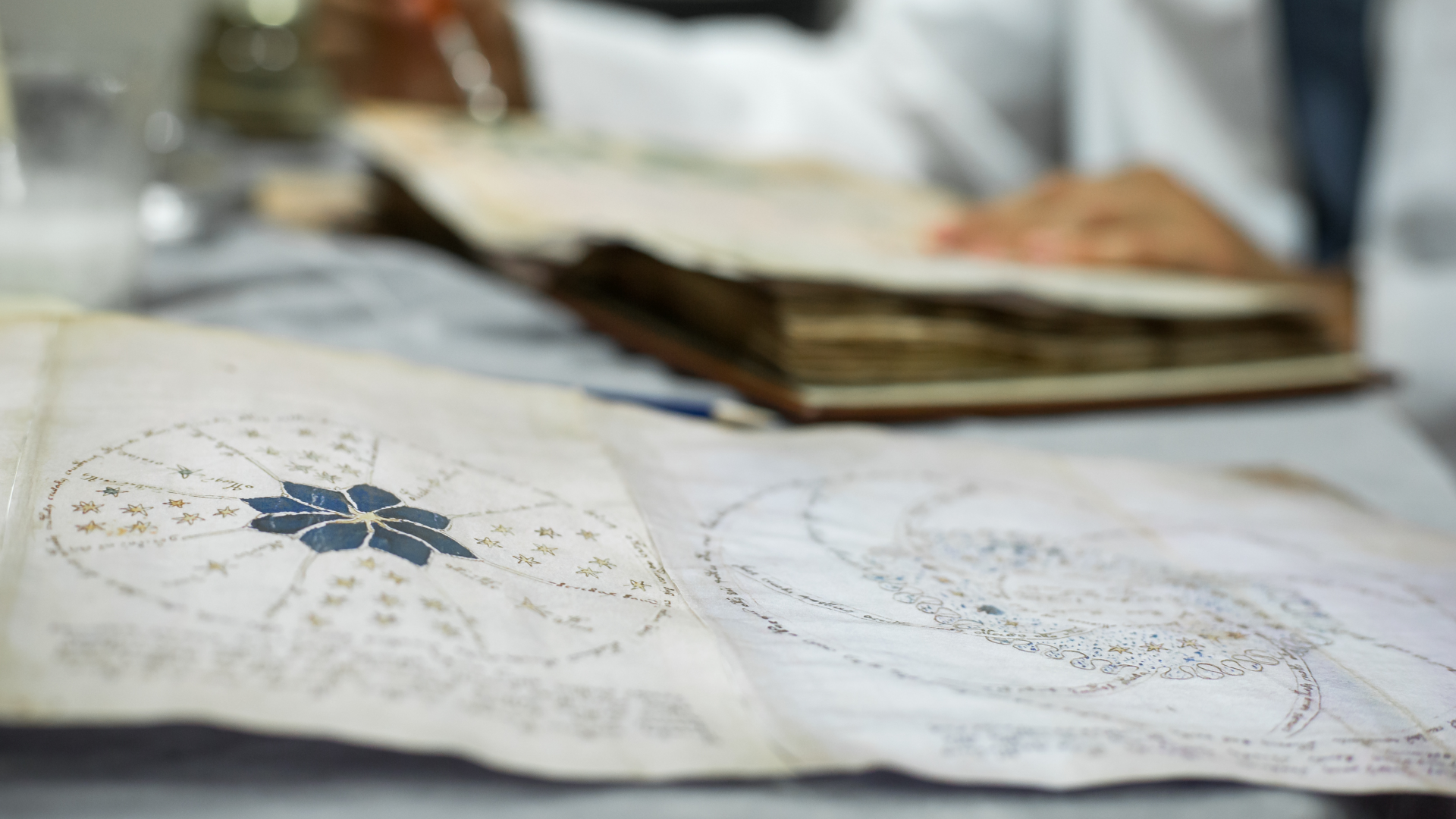
The Voynich Manuscript is a medieval document made from parchment, or animal skin. Carbon dating places the parchment in the early 15th century. Its approximately 240 pages contain about 38,000 words written in a unique, undeciphered script, along with illustrations of plants, people and astrological symbols.
Also known as the Beinecke Codex, the manuscript was purchased by bookseller Wilhelm Voynich in 1912. It is now held in the collections of the Yale University Beinecke Rare Book and Manuscript Library. Experts have tried unsuccessfully to decipher its writing for more than 100 years.
“I don’t know if that’s a code. However, the Voynich Manuscript has some strange features in terms of its physical structure,” Lisa Fagin Davis, co-author of the study and executive director of the Medieval Academy of America, told Live Science.
Why researchers think the pages are out of order
While studying the number of scribes who copied the manuscript, Davis noticed that the handwriting appeared on pages arranged in an unusual way. In some cases, illustrations seem to continue across pages that are now separated by several leaves.
“There are several instances where the image comes off the page halfway through and comes out on the other side, even though there are many pages in between,” Davis said.
Medieval manuscripts were typically made from rectangular pieces of parchment folded in half to create bifolia. Several bifolia were nested together to form a gathering, which was then sewn along the spine to create a book.
However, Davis and information-systems researcher Colin Layfield of the University of Malta suggest that the Voynich Manuscript may have begun as a collection of individual bifolia rather than as a single, properly organized book.
Researchers have previously proposed that some Voynich Manuscript pages are out of order. In their study, published in Digital Medievalist, Davis and Layfield used graphical and linguistic analysis to test whether the theory was plausible.
How language analysis revealed hidden patterns
“We see it as text and assume it contains a message,” Layfield told Live Science. That assumption makes it possible to compare different blocks of writing and determine whether they may have originally appeared together.
Layfield used a method called latent semantic analysis, or LSA. Developed in the 1980s, LSA is a natural-language-processing technique that identifies hidden patterns and relationships in text.
LSA can be useful for relatively small datasets. Unlike modern artificial intelligence systems, which require enormous amounts of training data, the Voynich Manuscript contains only about 35,000 words that can be analyzed.
The researchers’ analysis found that some pages were less similar to one another and may not have been intended to be read together. Other pages showed stronger similarities, supporting the idea that they originally belonged together.
Could the manuscript be a bundle of separate pages?
Viewing the Voynich Manuscript as a collection of individual sheets helped explain several of its unusual features, the researchers said. It could explain why individual scribes appear to have written on separate sheets and why some illustrations seem to cross a fold or continue across pages that are no longer adjacent.
“Once you start thinking about it in the context of other strange features of the manuscript, all of those problems disappear,” Davis said. “This solves the problem of each scribe writing one sheet. It also solves the problem of the image crossing the groove.”
If the manuscript’s pages are not in their original order, previous research based on the assumption that they were correctly arranged may need to be reconsidered. At the same time, identifying the likely structure could make future attempts to understand the text more productive.
“This study helps us think about whether there’s an actual meaning underlying it all,” Davis said. “That won’t get us there” — referring to a final translation — “but it gets the ball rolling because you can’t make sense of a book where all the pages are jumbled together.”
Why artificial intelligence has not solved the Voynich mystery
Davis remains optimistic that someone may eventually solve the Voynich Manuscript mystery. She pointed to Kane’s Jawbone, a modern language puzzle from the 1930s that consists of 100 pages of a murder mystery arranged in the wrong order.
Because of the text’s unusual structure and stylized language, artificial intelligence was unable to solve Kane’s Jawbone. The comparison suggests that even a relatively short text can be extremely difficult to reconstruct when its pages are mixed up.
Watermarks may help reconstruct the manuscript
Davis also noted large watermarks near the tops of some Voynich Manuscript pages. If two pages originally faced each other, their stains should be symmetrical. The fact that they are not may provide additional evidence that the manuscript was assembled out of order.
Davis and Layfield are now considering whether the shapes of these smudges can be compared across pages. Such analysis could help researchers identify which leaves were originally positioned together.
The Voynich Manuscript remains undeciphered, but understanding how it was assembled may be an important first step toward determining whether its mysterious writing contains a meaningful message.
Source: www.livescience.com